
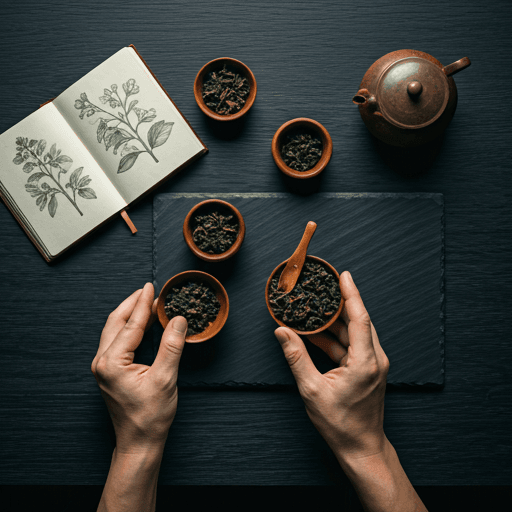
Gyokuro vs tencha is a comparison of two of Japan's most prized shade-grown green teas — and the twist is that they begin from almost the same leaf. Both are grown under cover for weeks before harvest, then processed for opposite ends: gyokuro is rolled into glossy needles and sold as a loose-leaf tea you steep and sip, while tencha is left unrolled, cleared of its stems and veins, and made specifically to be stone-ground into matcha powder. Same shaded field, two very different destinies.
If you have ever wondered whether the tencha vs gyokuro distinction is really worth making, the short answer is yes: one lands in your teapot, the other in your matcha bowl. Below is the quick version, then the detail behind each.
Gyokuro vs tencha at a glance
Here is the whole comparison in one view before we unpack it.
| Attribute | Gyokuro | Tencha |
|---|---|---|
| Origin | Japan | Japan |
| Shaded before harvest | Yes, roughly three weeks | Yes, roughly three weeks |
| Rolled or shaped? | Rolled into fine needles | Left flat and unrolled |
| Stems and veins | Kept | Removed |
| Final form | Loose-leaf tea | Ground into matcha powder |
| How you consume it | Steeped and strained | Whisked as matcha (rarely steeped) |
| Typical character | Silky, sweet, deeply umami | Mellow and delicate on its own |
| Caffeine | High for green tea | High; more per serving once whisked as matcha |
| Where you meet it | Luxury loose tea | The matcha in your bowl |
What gyokuro is
Gyokuro (roughly "jade dew") is one of the highest grades of Japanese leaf tea. The plants are shaded for around three weeks before the spring picking, the young leaves are steamed soon after harvest to lock in their color, and — crucially — they are then rolled and shaped into the thin, dark-green needles you recognize as loose-leaf tea. You brew it gently, often at a notably low temperature, to coax out a sweet, thick, intensely savory liquor. For the full story on how it is grown, steamed and steeped, see our guide to gyokuro green tea; here we are focused only on how it differs from tencha.
What tencha is
Tencha starts the same way — shaded leaves, steamed quickly after picking — but then the paths split. Instead of being rolled, tencha is dried flat and left loose and crumbly, and the stems and leaf veins are carefully separated out so that only the tender leaf flesh remains. Those clean flakes are what get stone-ground into matcha. On its own, tencha looks more like coarse green confetti than tidy needles. Because it is essentially an intermediate product, it is rarely sold to drink as-is; for the deeper picture, read what tencha is.
The key difference: rolled leaf vs matcha-in-waiting
The difference between gyokuro and tencha comes down to a single decision at the factory: to roll or not to roll. Gyokuro is rolled, so it stays a whole-leaf tea you infuse in water and then discard the spent leaves. Tencha is deliberately left unrolled and cleaned of stems and veins, because a smooth, even matcha powder needs pure leaf flesh and no fibrous bits. In other words, gyokuro is a finished tea, while tencha is a raw material waiting to become something else.
Is tencha the same as gyokuro?
No — though the confusion is understandable, since both come from shaded plants and can even be picked from the same gardens. Is tencha the same as gyokuro? Only up to the steaming stage. After that, gyokuro is rolled and sold to steep, while tencha is dried flat and destined for the grinding stone. Think of them as siblings raised for different careers.
The shared secret: weeks under shade
What gyokuro and tencha have in common is the shading. For roughly the last few weeks before harvest, growers cover the plants with reed screens or black netting to block most of the sunlight. Starved of direct sun, the leaves are thought to hold on to more of the amino acid L-theanine and to build up less of the compounds behind sharp astringency. Tea drinkers generally associate that with a sweeter, more umami-rich, less bitter cup — which is a big reason both teas taste so different from an ordinary open-field sencha. Responses vary from palate to palate, and none of this is medical advice.
Processing: rolled and shaped vs unrolled and cleaned
It is worth spelling out the processing, because it is really the whole story. After the shaded leaves are picked and steamed, gyokuro goes through repeated rolling and drying stages that twist the leaf into those slender needles and concentrate its flavor. Tencha skips the rolling entirely: the steamed leaf is dried in a special oven so it stays flat and papery, then machines and airflow separate the stems and veins, leaving only clean leaf flesh. That flesh — the tencha itself — can be stored and later stone-ground, slowly, into fine matcha powder. Rolling versus not rolling is the fork that sends one leaf to your teapot and the other to your matcha bowl.
How you actually drink them
Gyokuro is brewed like other loose-leaf teas, just gentler: a generous spoon of leaf, water cooled well below boiling, a short steep, then you strain and pour. Many people re-steep the same leaves several times, and the flavor shifts with each infusion. Tencha is a different ritual entirely — because it is milled into matcha, you usually meet it as a bright-green powder whisked into hot water rather than a liquor poured off leaves. If the powder-and-whisk method is new to you, our explainer on what matcha is walks through the bowl and whisk.
Can you steep tencha like gyokuro?
Technically yes — you can pour hot water over tencha and drink the infusion, and a few Japanese tea rooms do serve it that way as a quiet, delicate cup. In practice it is uncommon, because tencha's whole reason for existing is to be ground into matcha, where you drink the suspended leaf itself and get its full color, body and caffeine. Steeping it away throws out most of what makes it special. Gyokuro, by contrast, is engineered to give its best as an infusion: the rolling helps the leaf unfurl and release that signature sweetness into the water.
How they taste
Brewed properly, gyokuro is famous for a silky body, genuine sweetness and a deep, almost broth-like umami — one of the most distinctive flavors in all of tea. Tencha, tasted on its own (which few people ever do), is milder and more delicate, closer to a gentle, grassy-sweet green. Its concentrated character only fully shows up once it is ground and whisked into matcha, where you drink the whole leaf rather than a strained infusion. So if you are weighing gyokuro or tencha purely on flavor, remember you are really comparing a steeped cup against a whisked bowl.
Caffeine
Both sit at the higher end for green tea, thanks to the shading and the young, tender leaves. As a rough rule, whisked matcha made from tencha tends to deliver more caffeine per serving than a cup of steeped gyokuro, simply because you consume the ground leaf itself instead of a water infusion. Actual amounts vary a lot with grade, dose and how you brew, so treat any figure as a ballpark rather than a promise. If caffeine sensitivity, sleep, pregnancy or medications are a concern, check with your own healthcare provider — responses vary, and this is not medical advice.
Which one you will actually meet
In everyday life the answer is simple. You will meet gyokuro as a luxury loose-leaf tea — the kind a specialist shop pours at a low temperature and lets you re-steep. You will meet tencha almost entirely in disguise, as the matcha in your latte, your whisked bowl or your green-tea dessert; hardly anyone buys tencha to brew as leaf tea. If you want to go deeper on how the ground version stacks up against the steeped one, see our comparison of matcha vs gyokuro.
So gyokuro and tencha are less rivals than two answers to the same question: what do you do with a shade-grown leaf? Roll it, and you get a sweet, umami loose tea to steep. Leave it flat and clean it up, and you get the raw material for matcha. Once you spot that single fork in the road, the rest of the tencha vs gyokuro puzzle falls neatly into place.