
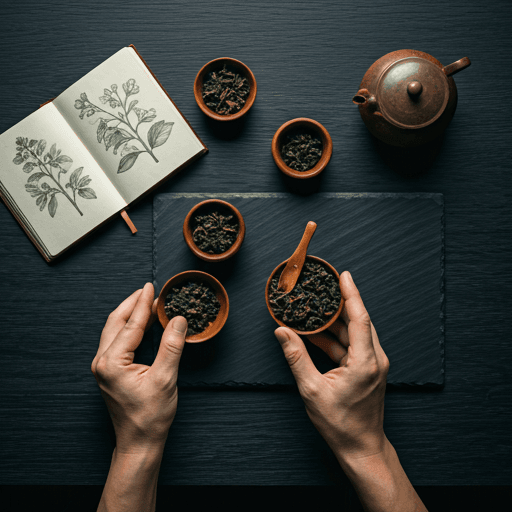
So what is tencha? Tencha is the Japanese green tea leaf that is stone-ground into the vivid green powder we know as matcha. It is shade-grown like gyokuro, then steamed and dried but deliberately never rolled, and its stems and veins are stripped away to leave flat, papery flakes of pure leaf. Those flakes are exactly what get milled into matcha powder. On its own, tencha is rare, mellow, sweet and full of savory umami — a quiet tea that most people only ever taste after it has already been turned into powder.
What is tencha, exactly?
Tencha (碾茶) is best understood as the un-ground precursor to matcha: the finished leaf, just before the last step. Growers shade the tea bushes for roughly the last few weeks before harvest, covering the rows with netting or straw so the leaves develop the way premium Japanese greens do. After picking, the leaves are quickly steamed to lock in their green color and stop oxidation, then gently dried with warm air.
Here is the part that makes tencha distinctive. Unlike almost every other Japanese green, tencha is not rolled. Most green teas are rolled and shaped during drying, which is what gives sencha its needle-like leaves. Tencha is left flat and loose so that it can later be milled into a fine powder — rolling would compress the leaf and work against grinding. On top of that, the stems, veins and any coarse bits are separated out, leaving mostly the soft leaf flesh. What remains looks like small, crumbly green flakes rather than tidy tea leaves. All of this happens in Japan, where tencha production is closely tied to the same regions famous for matcha.
How tencha relates to matcha
The simplest way to say it: matcha is ground tencha. There is no separate "matcha plant" and no special second leaf — the powder is made by slowly milling those flat tencha flakes into an ultra-fine dust. If you have ever wondered where matcha comes from before it lands in the tin, the answer is a pile of tencha.
Because tencha is the raw material, its quality more or less sets a ceiling on the finished powder. The best matcha starts from carefully shaded, well-sorted tencha; more everyday grades often start from tencha that was picked later or sorted less strictly. We will keep the deep dive on the powder itself brief here — for what matcha is, how it is whisked and enjoyed, see the matcha explainer, and for how those grades stack up, see powder versus loose leaf. This page stays focused on the leaf.
What tencha tastes like as a loose leaf
Tencha is rarely sold as a loose-leaf tea, but when it is, it makes a gentle, refined cup. Expect something mellow and sweet, low in astringency, with a soft, brothy umami and a clean, grassy-green aroma. It tends to be less bracing and less bitter than a full-sun green, which is a direct result of the shading before harvest.
Brewed as a leaf, tencha behaves like a delicate green tea rather than an intense one. Cooler water and a short steep keep it sweet and rounded; water that is too hot can pull out sharper, drying notes and mask the smoothness that is the whole point of the leaf. Because it is unrolled and light, it also infuses quickly. Most tea drinkers will never see tencha on a shelf, which is part of what makes a loose cup feel like a small discovery.
Tencha vs gyokuro vs sencha
Tencha sits in a family of steamed Japanese greens, so it helps to line it up against its two closest relatives. Gyokuro is a shade-grown leaf tea you steep and sip; sencha is the everyday full-sun green; tencha is the shade-grown leaf destined to be ground. The table below keeps the contrast tight — for the full story on each, this article defers gyokuro to its own guide and sencha to the wider Japanese-green family.
| Attribute | Tencha | Gyokuro | Sencha |
|---|---|---|---|
| Grown in shade? | Yes, shaded before harvest | Yes, shaded before harvest | No, full sun |
| Rolled during drying? | No, left flat for milling | Yes, rolled | Yes, rolled into needles |
| Stems and veins removed? | Yes, sorted out | Largely kept | Largely kept |
| Usual form | Flat flakes, then powder | Whole loose leaf | Whole loose leaf |
| Typical flavor | Mellow, sweet, umami-rich | Sweet, silky, deeply umami | Grassy, brisk, refreshing |
| Main use | Ground into matcha | Steeped and sipped | Steeped and sipped |
The headline difference is that gyokuro and tencha share the same shading step, while sencha grows in full sun — but only tencha is de-stemmed and left unrolled so it can be milled. For a proper look at the shaded leaf tea, see the gyokuro guide, and for how these teas fit together, browse the Japanese green tea family.
Why shading matters for tencha
Shading is the quiet trick behind tencha's character. When the bushes are covered for the final stretch before harvest, the leaves get less direct light and respond by changing their chemistry. Research generally associates this reduced light with higher levels of amino acids such as L-theanine, which many tasters connect to a sweeter, more savory, less bitter cup, and with a deeper green color. In other words, the shading is largely why tencha — and the matcha made from it — reads as mellow and umami-forward rather than sharp.
Keep this light: exact numbers vary a lot by farm, cultivar, weather and how long the plants are shaded, so treat any figures you see as rough rather than fixed. Responses vary from person to person, and this is not medical advice. The takeaway is simply that shade before harvest tends to nudge the leaf toward sweetness and smoothness, which is exactly what you want in a leaf you plan to drink whole as powder.
How tencha becomes matcha
Turning tencha into matcha is the last, slow step. The sorted flakes are milled — traditionally between granite stones that grind only a small amount of powder per hour — into a talc-fine, bright green dust. The stone-milling is gentle and slow on purpose: grinding too fast generates heat that can dull the flavor and color, so quality producers keep it cool and unhurried.
That is really the whole transformation. There is no roasting, no extra oxidation and no blending required to make plain matcha — just a good leaf, carefully sorted, patiently ground. If you want the full picture of how the finished powder is graded and used, that story lives in the dedicated matcha guides rather than here.
Who actually encounters tencha
In practice, tencha lives mostly behind the scenes. The people who handle it are matcha makers — the farms, refiners and mills that buy or produce tencha specifically to grind it. For them, sourcing good tencha is the real craft; the milling is almost the easy part.
The other group is tea enthusiasts who go looking for something unusual. A handful of specialty tea shops sell small amounts of loose tencha for people who want to taste the leaf in its pre-powder form, and it can be a rewarding, gentle cup for anyone curious about where their matcha comes from. But it remains a niche within a niche: if you drink matcha regularly, you are already drinking tencha every single time — just in ground form.
The short version
Tencha is the shade-grown, steamed, unrolled and de-stemmed Japanese green leaf that becomes matcha the moment it is milled. It is mellow, sweet and umami-rich thanks to the shading, closely related to gyokuro, and only rarely enjoyed as a loose-leaf tea in its own right. Understanding tencha is really understanding matcha from the leaf up — and the next time you whisk a bowl of bright green powder, you will know exactly which leaf you have in the cup.