
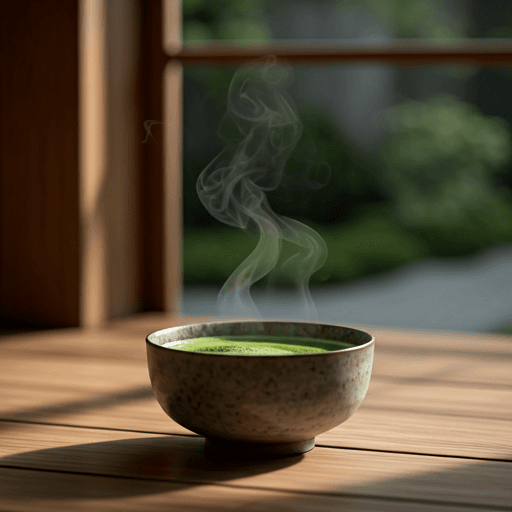
Almost all Japanese tea is green tea, pressed from the leaves of the same Camellia sinensis plant that gives us black and oolong tea. What sets it apart is one early step: the fresh leaves are steamed within hours of picking, rather than pan-fired the way most Chinese green teas are. That steaming locks in a bright, grassy, almost marine character and the savoury depth the Japanese call umami, and it runs through the whole family, from everyday sencha to shaded gyokuro, powdered matcha and roasted hojicha.
Why Japanese green tea tastes different
The signature flavour of Japanese green tea comes down to how the leaf is stabilised after harvest. To keep any tea green, the enzymes that would otherwise brown and oxidise the leaf have to be switched off quickly. Chinese producers usually do this by pan-firing, which adds a toasty, nutty edge. Japanese producers steam instead, a step known as mushi, which preserves the leaf's fresh vegetal notes and its vivid green colour.
Steaming time is itself a variable. Lightly steamed teas (asamushi) stay clear and delicate, while deep-steamed teas (fukamushi) break down more, brewing a cloudier, deeper-green cup with a fuller body and softer edge. It is why two sencha from the same garden can taste noticeably different.
The other big lever is shade. In the weeks before harvest, some fields are covered to block most of the sunlight. Starved of light, the plant slows its production of bitter catechins and holds on to more amino acids, chiefly L-theanine, which reads on the tongue as sweetness and umami. Shading is the difference between a brisk everyday sencha and the rich, brothy sweetness of gyokuro or matcha.
The main types of Japanese tea
There are dozens of named teas, but most of the ones you will meet are variations on a handful of processing choices: how mature the leaf is, whether it was shaded, and whether it was later roasted, blended or ground. Here are the core types of Japanese tea, each with its character and a rough brewing note.
Sencha
Sencha is the everyday staple and by far the most-drunk tea in Japan. It is made from unshaded leaves that are steamed, rolled into thin needles and dried. Expect a fresh, grassy cup with a clean, gently astringent finish. Brew it with water that has cooled to around 70 to 80 C (160 to 175 F); boiling water scorches the leaf and turns it bitter.
Gyokuro
Gyokuro (“jade dew”) is sencha's luxurious cousin. The bushes are shaded for roughly three weeks before harvest, which builds up L-theanine and mutes bitterness, giving an intensely sweet, umami-rich, low-astringency cup. It is brewed almost lukewarm, around 50 to 60 C (120 to 140 F), and sipped in small amounts. Our guide to gyokuro green tea goes deeper on the shading and steeping.
Matcha
Matcha is the one you drink whole. Shaded leaves (called tencha) are steamed but not rolled, then stone-ground into a fine powder that is whisked into hot water rather than steeped and strained. The result is a creamy, vegetal, umami-forward cup and the vivid green of countless lattes and desserts. For the full picture, see what matcha is and how it is made.
Bancha
Bancha comes from the same plants as sencha but from later, more mature pickings, after the prized young shoots have been taken. The coarser leaf makes a mellow, everyday brew that is lighter on caffeine and easy to drink through the day. It tolerates hotter water, around 90 C (195 F).
Hojicha
Hojicha is roasted green tea, usually made from bancha or stems roasted over high heat until they turn reddish-brown. Roasting drives off much of the caffeine and replaces grassy notes with warm, toasty, caramel-like ones, which makes it a popular evening cup and a favourite with children. Brew it hot, around 90 to 100 C (195 to 212 F), to draw out the aroma. Read more in our hojicha explainer.
Genmaicha
Genmaicha blends green tea (bancha or sencha) with toasted brown rice, some of which pops like tiny popcorn. The rice adds a nutty, savoury, comforting note and softens the tea, so the cup feels gentle and warming. Around 80 to 90 C (175 to 195 F) suits it well.
Kukicha
Kukicha, or twig tea, is made from the stems and stalks sifted out during sencha and gyokuro production. Little goes to waste: the stems brew a light, slightly sweet, low-caffeine cup with a smooth texture. Cooler water around 80 C (175 F) keeps it delicate.
Shincha, tencha and kabusecha
A few more names are worth knowing. Shincha is simply the first sencha of the season, harvested in spring and prized for its vivid, sweet freshness. Tencha is the shaded, steamed, unrolled leaf that is ground into matcha. Kabusecha sits between sencha and gyokuro: shaded for about one to two weeks, it lands rounder and more umami than sencha but brighter than gyokuro.
Japanese tea types at a glance
| Tea | What it is | Flavour | Typical brew temp |
|---|---|---|---|
| Sencha | Everyday steamed, rolled green leaf | Fresh, grassy, gently astringent | 70–80 C (160–175 F) |
| Gyokuro | Shaded ~3 weeks before harvest | Sweet, intense umami, low bitterness | 50–60 C (120–140 F) |
| Matcha | Shaded leaf ground to powder, whisked | Creamy, vegetal, umami | 70–80 C (160–175 F), whisked |
| Bancha | Later-harvest, coarser leaf | Mild, mellow, lower caffeine | ~90 C (195 F) |
| Hojicha | Roasted green tea (often bancha) | Toasty, nutty, low caffeine | 90–100 C (195–212 F) |
| Genmaicha | Green tea plus toasted brown rice | Nutty, popcorn-like, savoury | 80–90 C (175–195 F) |
| Kukicha | Stems and twigs sifted from green tea | Light, sweet, low caffeine | ~80 C (175 F) |
| Shincha | First-flush sencha of the season | Vivid, sweet, fresh | ~70 C (160 F) |
Where Japanese tea comes from
Origin shapes flavour as much as processing does. Shizuoka, wrapped around Mount Fuji, has long been the country's largest tea-growing region and supplies a big share of everyday sencha. Kagoshima, in the warm south, harvests early and has grown into the second major producer, known for deep-steamed styles. Uji, just outside Kyoto, is the historic heartland for the finest gyokuro, tencha and matcha, with a tea culture stretching back centuries. You will often see these place names on a good bag of leaf, and they are a reliable clue to what is in the cup.
It is worth saying that “green” does not mean the whole story. Japan makes small amounts of black tea (wakocha) and lightly oxidised styles too, but green tea is overwhelmingly what the industry grows and what most people drink, which is why a guide to Japanese tea is, in practice, mostly a guide to Japanese green tea.
How to brew Japanese green tea
The single most useful habit is to stop pouring boiling water over green leaves. Most Japanese greens are happiest somewhere between 60 and 80 C (140 to 175 F); the more delicate and shaded the tea, the cooler the water. A quick trick with no thermometer: pour boiling water into an empty cup and let it cool a minute or two before it touches the leaf, which sheds roughly 5 to 10 C each time you decant.
Steep times are short, often 30 seconds to two minutes, and good Japanese leaf gives several infusions from the same measure. Roasted and rice-blended teas such as hojicha and genmaicha are the forgiving exceptions, happy with hotter water and quick steeps. Caffeine varies a lot across the family: gyokuro and matcha sit at the high end, while bancha, hojicha and kukicha are gentler, which is handy if you are drinking late in the day.
Where to go next
Japanese tea rewards curiosity. Start with a friendly everyday sencha, then branch out to the sweet depth of gyokuro, the toasty comfort of hojicha or the whisked ritual of matcha, and you will quickly find the styles that suit your kettle and your mood. If you want to place these teas in the wider world of leaf, our overview of the main types of tea explained shows how Japan's steamed greens sit alongside black, oolong, white and herbal infusions.