
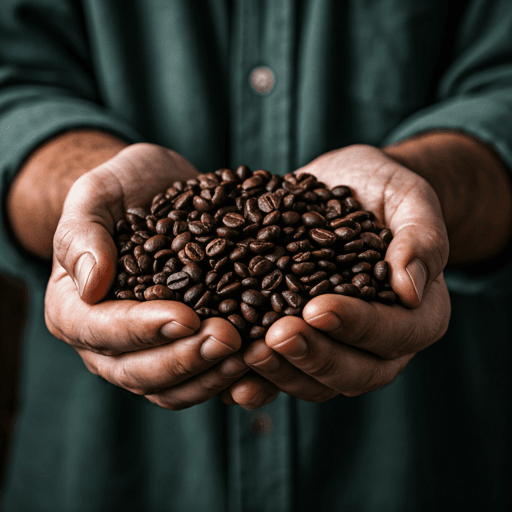
There is no Greenland coffee in the agricultural sense: no plantations, no smallholdings, no commercial trees, and no documented record of a coffee crop ever being established here. The inland ice, the narrow ice-free fringe of coast, the thin young soils and a short cool summer settle that before the question is properly asked. And yet coffee sits close to the centre of social life on this island, through a hosting custom widely known as kaffemik - which makes Greenland one of the most interesting coffee cultures anywhere, precisely because the bean is not the point.
Almost every question about a coffee origin is a question about land. In Greenland it becomes a question about a room. Once the growing question is closed, and it closes fast, what is left is the thing coffee actually does inside a house, and here that job is unusually easy to see.
Why no Greenland coffee grows on the world's largest island
The inland ice covers roughly four-fifths of the island's surface. Everything human happens on the remaining rim: a broken, fjord-cut fringe of rock, tundra and glacial outwash, unconnected by any road network, facing water that carries ice for part of the year. Only a sliver of that ice-free ground is farmed at all, and almost all of it lies in the far south.
A coffee tree is a badly matched crop for that rim, and not by a narrow margin. Coffee is an evergreen perennial: it does not go dormant and wait out a winter the way a hardy root crop or a pasture grass does. It needs years in the ground before a first harvest, which means it has to survive every winter in between, and frost kills it outright. The southern Greenlandic summer is short and cool, generous enough for forage and for vegetables that mature inside a single season, and nowhere near enough for a tree that needs several uninterrupted years of warmth. Soil is the second refusal. The ice-free ground is geologically young and thin in most places, better suited to pasture and shallow-rooted crops than to a deep-rooting tree.
What does grow marks the ceiling precisely. Farming here is concentrated in the sheltered fjords of the far south, where winters are milder, and it is overwhelmingly sheep and forage, with potatoes and a widening list of vegetables as a younger branch. Sheep farming on modern lines was introduced in the early twentieth century, and as seasons have lengthened growers have been reported experimenting further: cabbage, cauliflower, broccoli, carrots, strawberries, even apples in the most favoured spots, with the tenderest crops needing shelter. That southern landscape of pasture and small farms is the setting of the Kujataa World Heritage area, recognised by UNESCO for Norse and later Inuit farming at the edge of the ice cap. Agriculture in the south is genuinely old, and it has always been grass, animals and roots. The frontier there is a hardier turnip, not a tree crop.
Kaffemik: a coffee culture whose subject is the house, not the bean
The word joins coffee to the Greenlandic ending -mik, which carries the sense of by means of, and it is commonly translated as via coffee. That grammar is the whole idea. Coffee is not the object of the gathering. It is the means.
A kaffemik is an open house held to mark something: a birth or a birthday, a first day of school, a confirmation, a graduation, a new home, a child's first catch. The door is open, word travels by mouth and by phone as much as by card, and guests arrive in waves through the day rather than at a set hour. Accounts commonly describe an all-day flow, with dozens of people passing through one home before evening - old friends, family from other towns, colleagues, neighbours, people the host has only just met. Shoes come off at the door. A table is laid with coffee and cake, and crowberry muffins, apple tarts and marzipan biscuits turn up in many descriptions, with Greenlandic dishes beside them depending on the household and the occasion: fish soup, lumpfish roe, reindeer or muskox. Soft drinks and infused water are usually there too. Nobody is expected to dress up, and nobody stays long, because somebody else is waiting for the chair.
What that makes coffee
Notice what coffee is being asked to do. It is not being evaluated. There is no origin to trace, no roast to argue about, no extraction to score. What matters is that a pot is hot, that it can be refilled without ceremony, that it serves an unpredictable number of people arriving at unpredictable times, and that accepting a cup is a complete act of participation. A guest with fifteen minutes can drink one, say what they came to say, and go, and the visit is whole rather than cut short. That is coffee as the infrastructure of hospitality: the mechanism that lets a private house stay open to much of a settlement at once.
Geography makes that structural rather than sentimental. Greenlandic towns and settlements are not joined to one another by a road network, so movement between them happens by boat, plane or helicopter, and weather decides whether it happens at all. Within a town, visiting is close-range and the social obligation to turn up is real; between towns, a visit can be a rare and weather-dependent event. In that setting, a hosting form with no fixed start time, no seating plan and no required duration is not casual. It is close to the only shape a gathering can reliably take when the host cannot know who will get there, or when. A coffee culture organised around small, widely separated settlements and unreliable travel arrives at a different answer than one organised around a high street.
It also explains why the drink has to be coffee-shaped. A hot beverage that keeps in a pot, scales to any number of guests, asks nothing of the guest and can be received standing up is doing work that a plated meal cannot. The cake matters. The coffee is what makes the cake serveable to a crowd that keeps changing.
The house does what a cafe does elsewhere
In most of the world, the public social work of coffee happens in a room nobody at the table owns: the cafe is the institution that hosts strangers, holds conversation and lets people arrive uninvited, and that history is covered in our explainer on what a coffee house is. Greenland moves the address. The open-door function belongs to a private home, on a chosen day, for a stated reason, and the host absorbs it. It is the same social job, brought indoors and made personal. For how differently other places have solved that problem, our survey of coffee culture around the world is the place to go rather than a list here.
At a glance: what a coffee tree needs versus what Greenland has
| What coffee requires | What Greenland offers |
|---|---|
| A frost-free year, every year | Arctic winters across the whole island, with sea ice along much of the coast for part of the year |
| Several uninterrupted years in the ground before a first harvest | A short cool summer that suits plants finishing inside one season |
| Deep, well-drained soil for a tree root system | Thin, young soils on a narrow ice-free coastal fringe |
| Sustained warmth with no dormant period | Warmth measured in weeks rather than in years |
| Continuous plantable land at scale | Roughly four-fifths of the surface under inland ice; farmed ground confined to sheltered southern fjords |
| Tropical or subtropical latitude, usually with altitude for cup quality | High Arctic latitude, where extra altitude only makes conditions colder |
| A local harvest for the supply chain to organise around | Coffee arriving as cargo, on schedules shaped by ice and weather |
Coffee arrives here as cargo
Every coffee in Greenland is imported, and the way it arrives shapes the habit. Goods travel by sea from the North Atlantic, with container sailings out of Denmark and Iceland forming the backbone, and are then redistributed along the coast to towns and to smaller settlements. Deliveries concentrate in the open-water part of the year; when ice closes in, air freight covers what cannot wait, which in practice means fresh produce rather than pantry goods. Coffee belongs firmly in the pantry category. It travels well, it stores well, and it can be bought in quantity when the ship comes. That favours ground coffee and instant in sealed packaging, bought at the store and brewed by the potful. Grocery stores stock coffee, tea and biscuits as standard, and the range is wider and steadier in Nuuk than in smaller, more isolated places further north. Fresh-roasted whole bean and specialty cafe service exist in the larger towns, but they are the newer layer, not the foundation.
Behind all of this sits a long trade connection with Denmark, and it is audible in the habit itself: strong pot coffee with something sweet beside it is a recognisably Nordic pattern. How household habits like that translate into national drinking volumes is a separate question, and one better answered with data than with anecdote; our overview of coffee consumption trends is where that belongs.
Greenlandic coffee: the flamed serve, and an honest word about it
Search for Greenlandic coffee and much of what comes back is a dessert drink rather than a farm. It is an after-dinner serve: hot coffee in a stemmed glass, layered with spirits and liqueur under a cap of whipped cream, and set alight at the table before it is drunk. Restaurants and hotels in the larger towns make a small performance of it for guests, and that performance, not the recipe, is the reason it exists.
Take it for what it is. It is a modern restaurant and bar preparation, part of the wider family of flamed and layered coffee drinks described in our piece on Spanish coffee rather than re-explained here. The documented record of where it came from is thin: it circulates widely in visitor-facing material and much less in anything documentary, so treat any claim that it is ancient or Indigenous with care, because the honest position is that its origin is not well established. It is a real and enjoyable part of hospitality on the island. It is also not what a Greenlandic household means when it puts on coffee.
Will a warming Arctic change the answer?
Partly, and not in the direction the question implies. Warmer, longer seasons in the south have already widened what farms and gardens can attempt: the growing season there has been reported to be lengthening, potatoes have moved from marginal towards ordinary, and growers are trialling vegetables that would not have finished a season a generation ago. Those changes are real, and they are the ones worth following.
None of them reaches coffee. Lengthening a summer helps plants that complete a cycle inside one summer. Coffee's constraint is the winter in between, several winters over, and a warming Arctic still delivers hard winter frost across the whole island. The one route that would technically work is heated, lit, controlled greenhouse space of the sort cold countries everywhere use for salad crops, and that is the same route that could raise a coffee tree in any cold country on earth. It produces a horticultural curiosity rather than an origin. Expect the agricultural story here to stay sheep, forage, roots and protected salad crops. Expect the coffee story to stay about the house.
The bottom line
Greenland grows no coffee and will not, and the reasons are structural rather than incidental: ice over most of the land, a thin young coastal fringe, a summer built for one-season crops, and a winter no perennial tree can sit through. What makes the island worth a coffee reader's attention is the other half of the answer. In kaffemik, coffee is not a product under review. It is the reason a door can stand open to a whole settlement on the day something is worth marking, and the reason a fifteen-minute visit still counts as a real one. That is a definition of coffee culture worth carrying back to places that grow the crop and still manage to make the drink lonelier.