
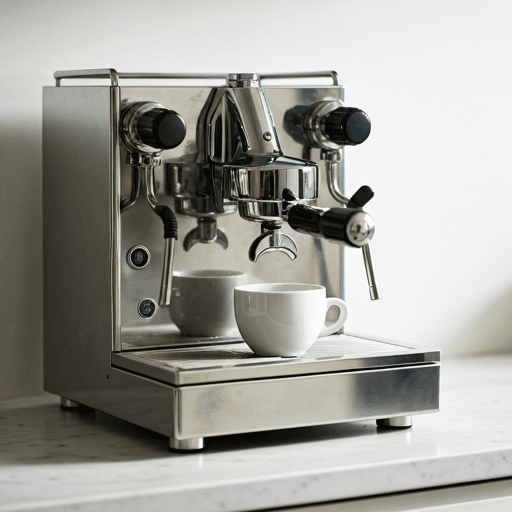
A Gaggia espresso machine comes from one of the most storied names in coffee. Gaggia is a historic Italian brand whose lineup spans hands-on semi-automatic espresso makers and push-button bean-to-cup super-automatics. Whether you want to learn to pull a shot by hand or press one button for a milky drink, there is a Gaggia built for it.
This guide maps the range categorically rather than ranking models, because Gaggia's exact model names change over time. We name machines only as factual examples, not as endorsements, and there are no prices here. Think of it as a tour of the brand's two halves and a checklist for choosing between them. For the single most famous model, see our deeper Gaggia Classic espresso machine guide.
What is a Gaggia espresso machine?
A Gaggia espresso machine is a home (and, in some lines, commercial) coffee machine made by Gaggia, an Italian brand closely tied to the birth of modern espresso. Across its catalogue, Gaggia machines fall into two broad families:
- Semi-automatic espresso makers — you grind, dose, tamp and steam yourself, using a portafilter. The Gaggia Classic family leads this side. These reward technique and are endlessly tinkerable.
- Bean-to-cup super-automatics — the machine grinds, doses, tamps, brews and often froths milk at the touch of a button. Lines such as Anima, Magenta, Cadorna, Brera, Babila and the top-end Accademia have appeared here over the years.
So the brand covers both ends of the convenience spectrum: a manual machine for people who want to learn the craft, and an automatic one for people who want a good cup with minimal fuss. Owning a Gaggia Italian espresso machine, in either form, connects you to a lineage that helped define what espresso even is.
A short history: Achille Gaggia and the birth of crema
The Gaggia story is one of the best-attested origin tales in coffee. Achille Gaggia was an Italian espresso pioneer working in Milan in the late 1930s and 1940s. In 1938 he filed a patent for a steam-free brewing method that used hot-water pressure rather than steam, which produced a softer, less burnt-tasting shot. In 1947 he patented the lever-piston mechanism that defined the brand: a spring, loaded by a lever, drove a piston that forced hot water through the coffee at high pressure.
That high-pressure extraction is widely credited with creating crema — the golden-brown layer of emulsified oils and gases that sits on top of a good espresso. Gaggia established his company in the late 1940s, and the first machine carried the name Tipo Classica. Exact dates and patent details vary slightly between sources, so treat them as the well-documented broad strokes rather than gospel, but the headline is consistent: Gaggia is one of the founding fathers of the pressurized espresso shot we know today.
The lever made the pressure; the pressure made the crema; the crema made modern espresso. That is the short version of why the Gaggia brand matters.
The Gaggia range, mapped
Because current model names shift, it is most useful to think in categories. Here is how the Gaggia range generally breaks down, what each type is, and who it tends to suit.
| Category | What it is | Who it suits |
|---|---|---|
| Semi-automatic (e.g. Gaggia Classic, Classic Pro, Classic Evo Pro) | A manual machine with a 58mm portafilter, single boiler and steam wand. You control grind, dose, tamp and milk steaming. | Hands-on learners who want to develop barista skill and tinker; need a separate grinder. |
| Entry / compact espresso (small home models) | Simple, smaller espresso makers aimed at easy daily use, sometimes accepting ground coffee or pods alongside the portafilter. | Beginners who want espresso without a steep setup or much counter space. |
| Bean-to-cup super-automatic (e.g. Brera, Magenta, Anima) | One-touch machines with a built-in grinder that brew espresso automatically; many add automatic or one-touch milk frothing. | People who prioritise speed and convenience over manual control. |
| Premium super-automatic (e.g. Cadorna, Babila, Accademia) | Higher-end bean-to-cup machines with user profiles, milk carafes, flow or pressure tweaks and bigger menus of drinks. | Households wanting a wide one-touch menu and customisation without manual work. |
| Gaggia Milano / professional | The brand's commercial-oriented line, revived in recent years for cafe and light professional use. | Small venues and enthusiasts who want a more commercial build. |
Within those Gaggia machines, the dividing question is always the same: do you want to make the coffee, or do you want the machine to make it for you?
The semi-automatic side: the Classic family
The Gaggia Classic and Classic Pro are the brand's icons. The current Classic Pro carries a 58mm commercial-style chrome-plated brass portafilter (the same diameter many professional machines use), a single boiler, a three-way solenoid valve that releases pressure for a dry puck, and a steam wand for milk. The single boiler means you wait roughly a minute when switching between brewing and steaming, because one heating element handles both.
The Classic's other claim to fame is how moddable it is. Owners commonly add a PID controller for tighter temperature control, adjust the over-pressure valve (OPV) toward the classic 9-bar target, or fit a bottomless portafilter to diagnose their extraction. None of that is required, but it turns the machine into a long-term hobby rather than a one-off purchase.
The Gaggia super-automatic side: bean-to-cup
The other half of the catalogue is the Gaggia super-automatic bean-to-cup range. These hide the whole process inside the machine: a hopper of beans, an integrated grinder, an automatic brew unit and, on most models, a milk system. Press a button for an espresso; on milk-capable models, press another for a cappuccino or latte. Entry lines such as Brera keep it simple, the Magenta and Anima families add more drinks and display options, and the Cadorna, Babila and Accademia lines layer on user profiles, milk carafes and finer control. For the wider category beyond Gaggia, see our bean-to-cup coffee machine guide and our overview of fully automatic coffee machines.
Semi-automatic vs bean-to-cup: which side of the range?
The single most important choice with the Gaggia brand is not a specific model — it is which half of the lineup you belong to. The trade-off is control versus convenience.
- Choose semi-automatic (Classic family) if you enjoy process, want to learn latte art and dialling in shots, like the idea of upgrading over time, and do not mind a learning curve or the extra minute of fuss per cup.
- Choose bean-to-cup (super-automatic) if you want a consistent cup at the touch of a button, value speed on busy mornings, would rather not steam milk by hand, and are happy to trade some flavour control for ease.
One practical point is easy to forget: a semi-automatic needs a separate grinder. A good burr grinder matters more than almost any other variable for espresso, so budget for it alongside a Classic. A bean-to-cup machine has its grinder built in, which is part of what you pay for. If you are weighing this up broadly, our general guide on how to choose an espresso machine walks through the same decision across all brands.
Where Gaggia sits among espresso brands
Gaggia's position is best described as approachable, heritage Italian espresso with strong value. On the manual side, the Classic is often a first "real" espresso machine — more serious than a cheap steam-toy, but far less costly than prosumer dual-boiler machines from premium specialists. It sits in entry-level to mid-range territory and earns loyalty because it is repairable, well-supported by a parts ecosystem, and capable of genuinely good espresso once dialled in.
On the automatic side, Gaggia competes with other mainstream bean-to-cup makers, including fellow Italian brand De'Longhi and various pod and super-auto specialists. Gaggia tends to offer solid build and a recognisable name rather than the absolute cutting edge of automation. As a point of fact, the Gaggia brand has changed corporate hands several times: it was bought by the Italian company Saeco in the late 1990s, passed to Philips when Philips acquired Saeco, and its professional arm later moved to the Evoca Group, which relaunched the commercial "Gaggia Milano" range. Ownership specifics are worth verifying if they matter to you, but the machines are still sold under the Gaggia name.
How to choose within the Gaggia brand
Use this short checklist to land on the right Gaggia for you. It is about fit, not a ranked pick.
- Decide your appetite for effort. Do you want to learn espresso (semi-automatic) or press a button (bean-to-cup)? This single answer narrows the field by half.
- Count the grinder. If you lean toward a Classic, factor in a quality burr grinder. If that pushes the total too high, a bean-to-cup with a built-in grinder may be better value overall.
- Match the milk. Steam milk by hand (Classic wand) for the best texture and latte art, or choose an automatic milk system on a super-automatic for speed.
- Think about menu breadth. If several people want different drinks at a touch, a premium super-automatic with user profiles (Cadorna, Babila, Accademia families) earns its keep.
- Plan for upkeep. Every espresso machine needs cleaning; bean-to-cup machines also need regular descaling and brew-unit care. Be honest about the maintenance you will actually do.
- Mind your space and power. Compact and entry models fit small kitchens; larger super-automatics need counter depth and a tall clearance for the bean hopper.
Whichever way you go, remember that beans, grind and routine matter as much as the machine. A modest Gaggia run well beats a fancy one run carelessly.
The bottom line
The Gaggia range is really two stories under one historic Italian name: a hands-on, hugely moddable semi-automatic tradition headlined by the Classic, and a convenient bean-to-cup line that does the work for you. Knowing which story you want makes the choice straightforward. If you are drawn to the craft, the Classic family is the natural starting point; if you want push-button ease, a bean-to-cup machine will suit your mornings better. Either way, you are buying into a brand that helped invent the crema in your cup.