
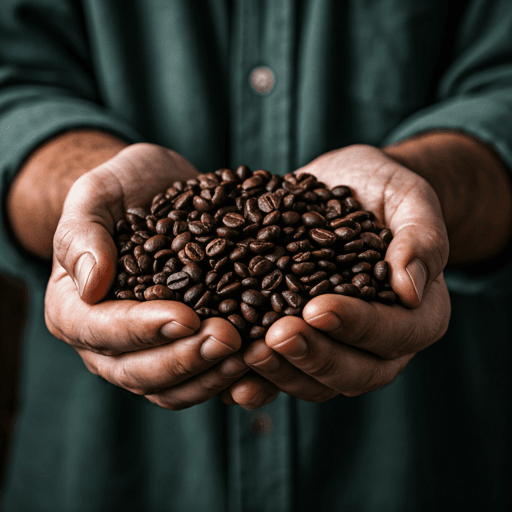
Cuba still grows coffee. Cuban coffee growing survives mainly in the eastern mountains — the Sierra Maestra and the ranges of the island's far east — but the harvest is a small fraction of mid-century output, and the island now brings in coffee from outside to help meet its own demand. The strong, sweet cup most people mean by "Cuban coffee" is a brewing tradition, and it lives on other pages: how to make Cuban coffee covers the method, and the cafecito family covers the drinks. This page is about the crop, the mountains and the industry behind them.
What makes Cuba unusual as an origin is not agronomic. The mountains are good mountains. The species is right, the shade is right, the harvest is hand-picked, and the record shows the island exporting real volume for the better part of two centuries. What sets it apart from almost every other origin is the shape of the market a grower faces — and the end point of that shape is a striking piece of arithmetic: a country with a deep daily coffee habit, and coffee mountains older than most of the famous ones in the Americas, meeting part of that habit with coffee grown somewhere else.
Cuban coffee growing at a glance
| Question | What the record supports |
|---|---|
| Does Cuba grow coffee? | Yes — genuinely, continuously, and almost entirely in mountain zones. The volume is small enough that the world market barely registers it. |
| Main growing area | The Sierra Maestra in the southeast, plus the highlands of the far east behind Baracoa. Published accounts put the great majority of the crop in the eastern ranges. |
| Secondary areas | The Escambray range in the centre, reported to feed mostly domestic supply; a small remnant in the west, where the old plantation landscape is now largely historical. |
| Species and processing | Mostly arabica, washed, with some robusta. Typica, Bourbon and Caturra are the varieties trade descriptions usually name, though independent documentation of what is planted where is limited. |
| Harvest | Reported as running from around late summer into midwinter, with the peak in autumn. Sources give slightly different windows. |
| Who buys the crop | A single state channel: collection points, municipal processing, a state export enterprise, and state roasting for the domestic ration. |
| Where it goes | Both ways — a modest export line, and the home market, which is also supplied by imports. |
| Reliability of published figures | Poor. Tonnage, area and percentage claims for Cuba are inconsistent between sources and often framed by whoever publishes them, so this page gives direction rather than numbers. |
The geography: coffee is an eastern crop here
Cuba is a long, mostly low island, and the coffee is where the land goes up. The Sierra Maestra rises steeply off the southeastern coast, and its slopes — above Santiago de Cuba and running west along the shore — are the heart of the industry. Sierra Maestra is what most export lots mean when they name a place at all. Farther east, in the highlands behind Baracoa, the ridges of the Nipe-Sagua-Baracoa massif form the island's other coffee country, a wet, broken landscape that also grows cacao and coconut. These are shade systems: coffee under forest canopy, on slopes too steep and too remote for anything mechanised, on the reddish, humus-rich mountain soils that Cuban and trade sources alike describe as unusually forgiving of low fertiliser use.
The Escambray range in central Cuba carries a smaller share, and accounts from visiting buyers describe its coffee as going largely to domestic consumption rather than to the export line. The west is a different story. Coffee reached Cuba in the middle of the eighteenth century, and it became a serious crop in the hills inland from Havana in the decades that followed, when planters arriving from Saint-Domingue brought better methods with them. Those earliest estates were worked by enslaved people. The crop then moved east into the mountains, and much of what remains in the west is archaeological rather than agricultural: terraces, drying floors, aqueducts and estate ruins. The best-known group of early plantation remains, in the ranges of the southeast, was inscribed on the UNESCO World Heritage list in 2000 as a cultural landscape.
None of this geography explains why the industry is small. The slopes, shade and soil are the same slopes, shade and soil that produced two centuries of export coffee. The constraint sits somewhere else.
One buyer: the structure that shapes Cuban coffee growing
In most origins, a grower faces a market. Several buyers exist — a cooperative, a private trader, an exporter, a mill that pays for cherry, sometimes a roaster after one specific lot. What the crop is worth moves, and the grower can hold, switch, sell part of the harvest, or refuse. That movement is information. It says pick riper, sort harder, renovate this block, plant that variety, put fertiliser here rather than there.
Cuban coffee growing runs on a single channel instead. Farms are mostly small — family holdings and cooperative members working mountain plots — and they deliver their cherry into a state collection and processing system. Wet processing happens at municipal stations; the dry-milled result is split between a state export enterprise, which handles sales abroad, and state roasting plants, which supply the rationed domestic coffee. Small direct sales at the margin are reported, and renovation projects have recently added nursery capacity and closer record-keeping at the mill, but the main road out of the mountains still leads to one buyer, and what that buyer pays is set administratively rather than discovered between bidders.
The agricultural consequences follow logically, and they are worth stating plainly, because they explain the scale better than any argument about climate or soil.
A set return stops carrying information
When the payment a grower receives is fixed by administration rather than discovered between buyers, it still arrives, but it stops being a signal. It cannot say "this block of old trees is finished, replant it" or "sort more carefully, someone will pay for the difference." Selective picking is the clearest case. Everywhere in coffee, the gap between stripping a branch once and returning to it several times is covered by someone downstream who tastes the result. Remove that link and the extra passes through the field are simply extra work.
Inputs arrive as allocations, not purchases
A grower who cannot buy is a grower who waits. Seedlings, hand tools, fuel for the truck that gets cherry off the mountain before it ferments, spare parts for a pulper, capacity at the wet station in the two weeks when it matters — in a single-channel system these arrive as allocations. When any one of them arrives late, the loss is immediate and physical: cherry that sits, cherry that dries badly on an exposed patio, cherry that never leaves the farm at all. Visiting buyers have described exactly this pattern — good raw material, inconsistent outturn, and post-harvest losses caused by roads and timing rather than by farming.
The mountain workforce ages and thins
Picking on Cuban slopes is hard seasonal work, and the return to it is fixed. Over decades the mountains have lost working-age people to the cities, and the growers who remain are older. Cuban reporting from recent harvests describes cherry left unpicked for want of hands, and picker camps that no longer function as they once did; harvest labour has long been supplemented by seasonal help organised from outside the mountains, including workers and students brought in for the season. A crop that must be gathered by hand within a few weeks of ripening is exceptionally exposed to that arithmetic.
A tree crop declines invisibly
This is the part that makes the decline hard to see and hard to reverse. An unrenovated coffee field does not fail; it fades. Trees that should have been stumped or replaced keep bearing something for years, then less, then less again. Yield per tree slips below the level at which the field repays the walk up the hill, and by the time the tonnage admits what has happened, the problem is not one season's weather but two or three decades of deferred replanting. Cuban agricultural bodies and their outside partners now describe a large share of the planted area as deteriorated and low-yielding — which is the same sentence, arrived at from the other end.
The arithmetic: an origin that imports its own coffee
Put the pieces together and the outcome is the striking part. Cuban demand for coffee is not modest; the small strong cup is woven into the day. The harvest no longer covers it. Sources differ on how far short it falls — published production figures for Cuba are inconsistent, and several widely repeated numbers disagree with one another by a wide margin — but the direction is not in dispute, because the island's own coffee institutions have said openly that imports are needed to supply the domestic system. Reporting on those purchases names Brazil and Vietnam among the origins bought.
The ration is also stretched. The blend distributed through the supply booklet is described officially as containing a substitute, and in practice that has meant roasted peas or chickpeas ground in with the coffee, a practice that has come and gone as supply has tightened and eased. In 2023 the shortage reached the roasteries themselves: Cuban and independent outlets reported roasting plants standing idle for want of raw material, and distribution of the rationed blend interrupted for months in parts of the island.
The mechanism is not mysterious. When a tree crop goes unrenovated for decades, harvest labour thins, and the payment reaching a grower cannot signal either problem, the gap between a habit and a harvest gets filled from outside. That is the whole sequence.
What the coffee actually is, and how much of that is documented
Cuban arabica is washed, and export lots are usually labelled lavado. The names attached to them read like places but function as a quality hierarchy: sources list them from high to low as Crystal Mountain, Extraturquino, Turquino, Altura, Montaña, Cumbre, Serrano Superior and Serrano Corriente, with Caracolillo for peaberry. Sellers describe Crystal Mountain as the largest, cleanest screens and a small share of the crop. Sources disagree even about where the name comes from, some tying it to crystalline mineral content in the central hills and others using it purely as a top-grade label for eastern coffee. The hierarchy is real; its geography is unsettled.
On flavour, the useful distinction is between what is repeated and what is documented. The descriptions repeated consistently across sellers and roasters are dark chocolate, nuts, brown sugar, a tobacco or leather note, moderate acidity and a heavy, low-toned body — a Caribbean profile in the same broad family as its neighbours. There is very little independent, published cupping of Cuban coffee to set against that, the island has had limited exposure to the competition and third-party review circuit that builds a public tasting record, and a great deal of the available description is written by people selling the bag. The reported profile is consistent; the evidence behind it is thin.
Two neighbours are useful for contrast. Haiti shares the same island chain and also collapsed as an exporter, but through an entirely different mechanism — see Haitian coffee. The Dominican Republic is the nearby origin whose coffee also mostly stays home, but by force of domestic demand rather than by channel.
Could the scale change?
There is real activity. A long-running renovation partnership between Cuban agricultural institutions and an Italian roasting group has, by its own account, built high-quality nursery capacity in the eastern mountains, backed by agronomic support and by record-keeping at the wet stations of a kind Cuban coffee has not had for years; the participants describe it as a multi-decade undertaking rather than a season's project. State plans call for higher output. Cuban lots do reach European shelves, and Japan and France are among the established export markets.
Three things temper the outlook.
- Trees take years. A coffee seedling planted this year will not give a meaningful crop for several years, and will not reach full bearing for longer. No change of approach — better nursery stock, better contracts, better terms — shows up in a harvest quickly. Renovation is a decade-scale instrument, so the current tonnage reflects decisions already taken.
- Labour, not land, is the binding constraint. More trees do not help if the cherry cannot be picked in the fortnight it is ripe. Bringing people back to mountain settlements is a slower and harder problem than distributing seedlings.
- The channel is still the channel. Nursery work and improved contracts operate inside the single-buyer structure; they do not replace it. Whether they can put enough information back into what a grower receives to change field decisions across a whole mountain range is genuinely unknown.
Weather sits on top of all three. Tropical storms reach the eastern ranges during and just before the picking season, and a storm that strips cherry off unpicked trees takes a whole year at once, then takes part of the next one while the trees recover.
The bottom line
Cuban coffee growing is real, small, mountainous and eastern, and the reason it is small has almost nothing to do with whether Cuba can grow good coffee. It can, and the grade hierarchy its export coffee still carries is evidence that someone once organised it carefully. What changed is the market a grower faces: one channel, a return set by administration, inputs by allocation, and a tree crop quietly ageing out underneath. That combination produced an outcome worth sitting with — an origin with two centuries of coffee history importing coffee to help fill its own cups, and stretching the rest with roasted peas. Anything that reverses it will be visible in the mountains long before it is visible in a harvest figure.