
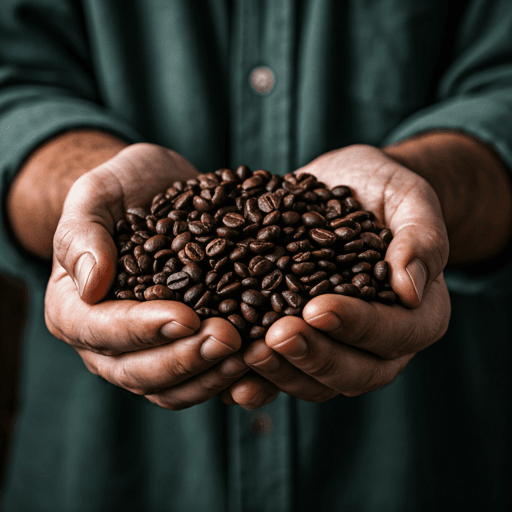
Coffee sample roasting is the practice of roasting a very small quantity of green coffee to a deliberately neutral, standardized profile so that the coffee can be judged rather than the roast. It is not an attempt to make something delicious. It is the diagnostic step by which buyers, importers, exporters, producers and quality labs decide which lots to buy, reject or grade differently, and almost every green coffee that reaches a shop passed through one first.
That single idea carries the whole subject. A sample roast is a measuring instrument. A production roast is a piece of authorship. Confusing the two is the most common mistake people make when they start evaluating green coffee.
A sample roast is not a production roast, and is not meant to taste good
A production roast exists to flatter a coffee. The roaster chooses a development window, a drop point and a colour that show the bean at its most appealing for a particular brewing method and a particular audience. Two roasters can take the same lot in wildly different directions, and both can be right.
A sample roast exists to do the opposite: to get out of the way. The goal is a colour and a time window that add as little roast character as possible. No caramel sweetness borrowed from a longer development, no smoke, no roasty top note, and equally no grassy, peanut-like under-roast. What is left in the cup is, as far as possible, the green coffee itself: its acidity, its body, its defects, its uniformity, its processing signature.
This is why an experienced cupper will happily tell you a sample roast is not a nice cup of coffee. It is often a little sharp, a little thin, a little unresolved. That is by design. If a sample tastes gorgeous, the honest question is whether the roast flattered it. The corollary matters just as much: a sample roast is a poor guide to how a coffee will taste once someone actually builds a profile for it. A lot that cups merely clean and correct on the sample table can become excellent in production, and a showy sample can flatten out at scale.
What a sample roaster is
A sample roaster is a small-batch machine built for repetition rather than volume. The classic form is a multi-barrel drum unit: several small drums sharing one heat source and one control panel, so an operator can stagger lots and keep a table of samples moving. Two-, four- and six-barrel configurations are all common, and importer and exporter labs that process hundreds of samples a week tend toward the larger counts. Fluid-bed and hot-air sample machines are widespread too, particularly the electric benchtop units with digital profiling and automatic cooling, and many quality labs run both because the two heat-transfer styles read a coffee slightly differently. The broader taxonomy of drum, air and hybrid machines is covered in our guide to coffee roaster machines.
Batch sizes are small. Depending on the machine, a barrel typically takes somewhere between a few dozen grams and a couple of hundred grams. Working ranges of roughly 50 to 150 g are the ones most often quoted, with something in the region of 80 to 120 g per barrel very typical in trade labs, and some benchtop units happily running larger. A standard cupping set of five bowls needs only a modest fraction of a mid-sized batch, so the remainder becomes a retained reference, a second roast, or a brewed check.
Two features matter more on a sample roaster than on a production machine. The first is rapid, air-only cooling. Quenching with water is not used for evaluation samples, and a sample that keeps roasting in the tray is no longer a controlled measurement. The second is a small, accessible drum that lets the operator read colour, smell and crack directly, because a sample roast leans much harder on sensory cues than on a data curve.
The standardized conventions of coffee sample roasting
The widely used trade convention descends from the Specialty Coffee Association's cupping protocols and is best understood as a protocol, not a law of physics. In broad terms, with the numbers hedged because they are conventions that have been revised over the years and are quoted differently across sources and assessment systems:
- Time: the roast is completed in roughly 8 to 12 minutes. Shorter tends to bring in a sharp, underbaked edge; longer tends to bake the sample flat.
- Drop point: shortly after first crack. The protocol itself is written around colour and elapsed time rather than a fixed offset from the crack, and shop convention commonly puts the drop somewhere around a minute to two minutes past it, adjusted by ear and eye rather than by stopwatch alone.
- Colour: a light to light-medium brown. Protocol figures are usually quoted on the Agtron Gourmet scale as approximately 58 on whole bean and 63 on ground, within about a point. Be careful with cross-scale comparisons, because the same roast reads very differently on the commercial scale or on another manufacturer's meter, which is a frequent source of confusion. The scale itself is explained in our guide to the Agtron scale.
- Evenness: little or no attached chaff, no scorching, no tipping, and as small a gap as possible between the whole-bean and ground readings, since a wide gap signals an uneven roast.
Notice what is absent from that list: any target for chasing sweetness, any brewing-method tuning, any instruction to make the coffee show well. Development is a production concern, and how it is measured and steered belongs to roast development. On the sample table it is simply held constant so that it stops being a variable.
Sample roast vs production roast at a glance
| Dimension | Sample roast | Production roast |
|---|---|---|
| Goal | Reveal the green coffee; remove roast as a variable | Express the coffee at its best for a brew method and audience |
| Batch size | Commonly tens of grams to a couple of hundred grams per barrel | Kilograms upward, often far more |
| Time | Around 8 to 12 minutes by convention | Commonly longer; set by the roaster, machine and style |
| Colour | Standardized light to light-medium, held constant across every sample | Chosen deliberately; varies by coffee and by brand |
| Cooling | Air only, as fast as the machine allows | Air or water quench, depending on scale and machine |
| Rest before tasting | A fixed window, commonly about 8 to 24 hours | Days; chosen to suit the coffee and the brew method |
| Who tastes it | Buyers, importers, exporters, producers, QC labs, competition panels | Customers |
| Success looks like | Comparable, fault-free, unflattering, repeatable | Distinctive, enjoyable, repeatable |
| Judged by | Cupping score and defect notes | Feedback, repeat drinkers, the roaster's own palate |
Why standardization is the whole point
A cupping table may carry ten, twenty or forty coffees in a session, roasted on different days from different origins for different decisions. The only way a score on one bowl means anything relative to another is if the roast contributed the same amount to every bowl. Standardization is not bureaucracy here; it is the thing that makes the comparison legitimate.
It also makes the assessment portable. When an exporter and a buyer on another continent both roast to the same convention, they can argue about a coffee rather than about each other's machines. That shared baseline is what allows a lot to be approved, contracted and shipped on the strength of a sample. The tasting procedure that sits on top of it, meaning grind, water, ratio, breaking the crust and scoring, is a separate discipline described in our guide to coffee cupping.
It is worth being clear about who does this. Sample roasting is not a buyer-side activity that happens only at the importing end. Mills, exporters, producer cooperatives and larger farms run their own sample roasters and cup their own lots before anything is offered, which is how separations get decided: which day lots stay apart, which get combined, which are set aside for a different grade. By the time an offer sample reaches a buyer, the same coffee has usually been roasted and tasted several times already at origin.
Resting the sample before it reaches the table
Freshly roasted coffee is not stable. Sample protocol typically calls for the roast to be air-cooled to room temperature quickly, sealed in an airtight container or non-permeable bag, kept cool and dark, and cupped within a defined window after roasting, commonly stated as roughly 8 to 24 hours. Not refrigerated, not frozen.
The window exists for the same reason as everything else here: comparability. A sample cupped two hours off the roaster and one cupped three days later are not the same experiment, because carbon dioxide degassing changes both aroma release and how the crust behaves in the bowl. Holding the rest constant removes one more way for the roast to contaminate the verdict. Grinding is held to the same logic. Samples are ground immediately before the water goes on, and the grinder is purged between coffees so the previous sample does not carry into the next one.
The chain of samples behind one purchase
Green coffee evaluation is rarely a single roast. The trade uses a sequence of named samples, and each one gets the same standardized treatment so they can be cupped meaningfully against each other:
- Type sample is indicative of the general quality a supplier can offer, often from a previous harvest. It is used for orientation, not for contracting a specific lot.
- Offer sample is drawn from a specific lot being offered for sale. This is usually the roast that drives the buying decision.
- Pre-shipment sample is drawn from the prepared, milled lot before it leaves origin, frequently as a composite made up from across the bags, to confirm that what will actually ship still matches what was bought. Lots get combined, subdivided or simply age between offer and export, so this check is not a formality.
- Arrival sample is drawn after the coffee lands, to confirm the voyage did no harm. Standard trade contract terms frequently make approval of a pre-shipment or arrival sample an explicit condition of the sale, with the required approval point spelled out in the contract itself.
Some buyers keep the retained portion of the offer roast as a physical reference and cup it side by side with the arrival sample. A coffee that has faded in transit will show it against its own earlier self far more clearly than against a score written down months earlier. Warehouses and labs will also pull fresh samples periodically from coffee in storage for the same reason, since the reference point that matters is how the coffee tastes now.
From a promising sample to a real production profile
Approval is where sample roasting stops and roasting proper begins. A lot that scored well tells you the raw material is sound; it tells you almost nothing about the profile it wants. The usual next step is a small series of profile roasts on the production machine, several drop points and development windows across the same coffee, cupped or brewed against each other to find where it opens up.
Scaling is not a matter of copying the sample curve. A small barrel and a large drum have completely different thermal mass, airflow behaviour and heat-transfer balance, so absolute times and temperatures do not transfer. What roasters commonly carry across instead is shape and proportion: holding charge temperature, drum speed and airflow pattern as fixed reference points, then using drop temperature and the proportion of the roast spent after first crack as the working controls, so that a sample and a production batch share a structure even though the sample runs in a fraction of the time. Even that is a working method rather than a rule. Probe placement alone means one machine's numbers are not another's, and roasters differ on how much of the arithmetic is worth trusting.
What goes wrong, and the honest limits
The classic sample-roasting faults are mechanical rather than artistic. Scorching and tipping come from too much heat into too little mass, a chronic risk when a batch is far too small for the drum it has been put in. Baking comes from a roast that stalls and drags past the protocol window, and it flattens acidity so thoroughly that a good coffee can be scored down for the operator's error. Under-roasting leaves grassy, cereal and peanut notes that are easy to mistake for a green-coffee defect. Uneven roasting, visible as a wide whole-bean-to-ground colour gap, mixes several of the above into one bowl. Carry-over is the quiet one: a drum that has not been allowed to return to the same starting condition will roast the next sample differently, which is why labs are fussy about between-batch recovery and about roasting a throwaway batch to bring a cold machine up to a steady state.
Then the limits, stated plainly. Sample roasting is machine-dependent: the same lot, roasted to the same colour on a drum and on a fluid-bed unit, will not cup identically, and labs know it. The numbers quoted as protocol are conventions that have been revised over time and are read differently across colour-meter models and scales, so a bare figure with no scale attached is close to meaningless. Small batches are volatile, and a few grams of variation in charge weight shifts the whole roast. Green coffee is not uniform either, so a sample only means as much as the sampling behind it, which is why composites drawn across a lot are preferred to a scoop from one bag. And the standardized profile deliberately suppresses the very thing a production roaster exists to find, which is why nobody should decide a coffee's ceiling from a sample roast alone.
The bottom line
Coffee sample roasting is a controlled, deliberately unexciting, repeatable roast whose only job is to let the green coffee speak for itself. Small batch, roughly 8 to 12 minutes, dropped not long after first crack, held to a light to light-medium colour, rested for a defined number of hours, then cupped against everything else on the table under identical conditions. It should not taste like a finished product, and if it does, be suspicious. Its value is that it produces a fair comparison, and a fair comparison is what a buying decision, a shipment approval and a production profile are all built on.