
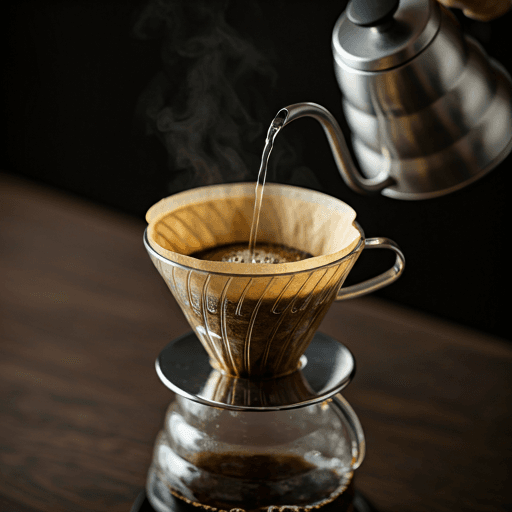
In the chemex vs v60 debate, both brewers are pour-over drippers that make a clean, bright filter coffee, but they get there differently. A Chemex uses a thick, bonded paper filter and a one-piece glass carafe, giving a very clean, light, almost tea-like cup and a slower flow. A Hario V60 is a cone with spiral ridges, a large single hole and thinner paper, so it pours faster, gives you more control and tends toward a brighter, more aromatic cup. Neither is objectively better; they suit different tastes and moments.
Both belong to the wider family of manual pour-over coffee methods, where you pour hot water over a bed of grounds and let gravity draw the brew through paper. What sets them apart is the gear, not the principle. Below we break down the difference between Chemex and V60 attribute by attribute, then help you choose.
Chemex vs V60 at a glance
If you want the short version of pour over Chemex vs V60: the Chemex is the forgiving, one-piece carafe that produces the cleanest, lightest cup and suits a larger batch; the V60 is the compact, technique-rewarding cone that runs faster and delivers more aroma and body. Here is the head-to-head.
| Attribute | Chemex | Hario V60 |
|---|---|---|
| Shape | Hourglass glass carafe, brewer and vessel in one | Cone dripper that sits on a separate cup or carafe |
| Filter | Thick, bonded paper (notably heavier than most) | Thinner cone paper with spiral ridges |
| Drain | Single channel, restricted by the thick paper | Large single hole, open bottom |
| Flow rate | Slower, more forgiving | Faster, pour-technique-dependent |
| Body and taste | Very clean, light, tea-like, smooth | Bright, aromatic, a touch more body |
| Grind | Medium to medium-coarse (roughly) | Medium, often slightly finer |
| Capacity | Suits a larger batch (multiple cups) | Sized 01 and 02 for one to a few cups |
| Difficulty | More forgiving of imperfect pours | Rewards good, controlled technique |
Treat every detail here as a starting point. Roast, grind, water and your own pour all shift the result, so tune to taste rather than chasing a single "correct" cup.
What a Chemex is
A Chemex is an hourglass-shaped glass brewer, first designed in the early 1940s, where the dripper and the serving carafe are a single piece of glass with a wooden collar (or a glass handle) around the middle. You fold its heavy bonded filter into a cone, seat it in the top, add grounds, and pour. The brew collects in the lower bulb, and you lift the filter out and pour straight from the same vessel.
The signature of a Chemex is a very clean, light-bodied, smooth cup. The thick paper traps most of the coffee's oils and fine sediment, so what reaches you is transparent and delicate, closer to a fine tea than to a heavy mug of coffee. It also naturally brews a larger carafe, which makes it a favorite for serving a table rather than a single cup. We keep the step-by-step here brief on purpose; for the full method see our guide to using a Chemex and the broader Chemex coffee maker overview.
What a V60 is
The Hario V60 is a simple cone dripper named for its 60-degree angle. It has three defining features: internal spiral ridges that lift the paper slightly off the wall, a single large hole at the bottom, and a steep cone shape. You sit it on top of any cup or carafe, drop in a thin cone filter, add grounds, and pour. Because the bottom is wide open, the flow is governed almost entirely by your grind and your pour, not by the dripper itself.
That openness is the V60's personality. It runs fast, it is highly responsive to technique, and it produces a bright, aromatic cup with a little more body and texture than a Chemex. It comes in sizes (commonly 01 and 02) suited to one to a few cups, and in glass, ceramic, plastic and metal. For the deep dive on dialing it in, see our Hario V60 guide.
The key difference: filter, cone and flow
The heart of V60 vs Chemex is three linked variables: filter thickness, cone shape and flow rate. The Chemex filter is markedly thicker and more absorbent than a standard cone paper, so it slows the water and scrubs out oils and fines. The V60's thinner paper plus its ridges and big drain let water leave quickly. Everything else, clean cup versus more body, forgiving versus technical, follows from that one contrast in how fast and how filtered the water passes through.
Both, it is worth stressing, are still clean-cup pour-overs compared with immersion methods like a French press or a moka pot. The Chemex is simply the cleanest of the clean, while the V60 keeps a touch more of the coffee's aromatic oils in the cup.
Taste and body
A Chemex leans clean, light and tea-like, prized for clarity and a smooth, almost silky finish; it can make a bright single origin sing without any harshness. A V60 leans bright and aromatic with slightly more weight on the palate, so delicate florals and fruit notes tend to pop. If you love transparency and elegance, the Chemex flatters it; if you love aroma and a fuller mouthfeel, the V60 usually wins. Many people happily keep both for different beans and moods.
Filter
Filters are the clearest line between the two. Chemex papers are thick and bonded, and they come in natural (unbleached) and white; the extra paper is exactly what removes oils and sediment for that pristine cup. V60 papers are thinner and cone-shaped, sized to the dripper. Both give a clean, grit-free cup, but the Chemex removes more. A practical note: rinse either paper with hot water before brewing to knock down any papery taste and preheat the vessel.
Grind
Both want a medium grind in the pour-over range, but there is a nudge in each direction (hedge this against your own gear). The V60 usually likes a medium, often slightly finer grind to control its fast flow. The Chemex tends to prefer medium to medium-coarse, because too fine a grind can clog the base of that thick filter and tip you into over-extraction. If your Chemex is running slow and bitter, coarsen up; if your V60 is thin and sour, go finer or slow your pour.
Flow and control
On flow and control, the two invert each other. The V60's big hole and ridges make it fast and pour-technique-dependent, so your pour speed, pattern and grind directly steer strength and extraction; pour too quickly and it can taste weak and under-extracted. The Chemex's thick paper adds resistance, slowing things down and making it far more forgiving of an uneven pour. If you enjoy the ritual and want to influence every variable, the V60 rewards you; if you want a reliable result with less fuss, the Chemex delivers.
Capacity
Capacity is a real practical difference. A Chemex is built around a larger carafe and shines when you are brewing several cups at once for a group. A V60 comes in 01 and 02 sizes aimed at one to a few cups, and while you can scale technique, it is happiest at smaller volumes. If you usually brew for a crowd, the Chemex fits; if you brew a single excellent cup, the V60 is the natural pick.
Difficulty
Neither is hard, but they sit at different points on the learning curve. The Chemex is more forgiving: its slow, restricted flow smooths over minor mistakes, so beginners tend to get a good cup quickly. The V60 rewards good technique and punishes sloppiness, which is exactly why enthusiasts love it. A gooseneck kettle and a scale help both, but they matter more for the V60.
Chemex or Hario V60: which should you choose?
Choose a Chemex if you want the cleanest, lightest, most tea-like cup, you often brew for more than one person, and you prefer a forgiving, elegant one-piece brewer that doubles as the serving carafe. Choose a Hario V60 if you want a bright, aromatic cup with a bit more body, you usually brew one to a few cups, and you enjoy dialing in your pour and having control over every variable.
There is no wrong answer in Chemex vs V60. They are different instruments for the same clean-cup style, and plenty of home brewers keep both, reaching for the Chemex when guests arrive and the V60 for a focused solo cup. Whichever you pick, fresh beans, good water and a rinsed filter matter more than the brewer itself. Start with a middle-of-the-road grind, taste, and adjust; the perfect cup is the one that tastes right to you.