
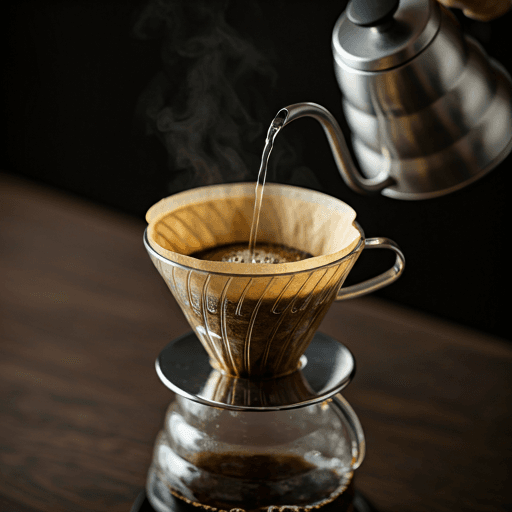
A Chemex coffee maker brews an exceptionally clean, bright cup using a single piece of hourglass-shaped glass and its own thick paper filters. To use one: grind medium-coarse, fold and rinse the filter, add the coffee, bloom it, then pour hot water in slow circles over roughly four to five minutes at about a 1:16 ratio. That is the whole method. Everything below makes each step reliable, so you can pour the same clear, tea-like cup out of the same carafe every morning.
The Chemex is one of the most recognizable brewers in the world, and it earns its fame in the cup. This guide covers what it is, why people love it, and the full pour-over recipe from the first rinse to the last drip.
What the Chemex coffee maker is and why people love it
The Chemex coffee maker is a manual pour-over brewer: a one-piece borosilicate-glass carafe shaped like an hourglass, with a wooden collar and leather tie at the waist where you grip it. You set a thick bonded paper filter in the top cone, add ground coffee, and pour hot water through by hand. There is no machine, no electricity, and no separate carafe to balance — the funnel and the server are the same vessel.
It was designed in 1941 by Peter Schlumbohm, a German-born chemist who wanted a brewer that was both beautiful and scientific. He borrowed the look of a laboratory funnel and flask, and the result became a genuine design icon, displayed in the permanent collection of the Museum of Modern Art in New York. Decades later it still looks modern on a counter.
People love the Chemex coffee brewer for one reason above all: clarity. Its proprietary filters are far thicker than ordinary paper, so they trap more oils and fine particles than most drippers do. What lands in the carafe is a clean, crisp, almost tea-like cup that shows off the bright, floral and fruity notes of a good coffee. If you like nuance and a polished finish rather than a heavy, oily body, this is the brewer for you.
How the thick filters set the Chemex apart
The filters are the single biggest difference between a Chemex pour over coffee maker and a cone like the Hario V60. Chemex filters are bonded, multi-layer paper, noticeably heavier than standard filters. They slow the flow and screen out the tiny "fines" and most of the oils, which is exactly what produces that signature clean cup.
That extra thickness has two practical consequences. First, always rinse the filter before brewing; an unrinsed Chemex filter can leave a papery taste because there is simply more paper in contact with your coffee. Second, because the paper is dense, your grind needs to run a touch coarser than a V60 grind, or the bed will clog and stall. If you already brew with a cone, this is the main adjustment to make. For a side-by-side on the cone method, see our guide to brewing with a V60; the technique rhymes, but the grind and filter differ.
The gear you need for Chemex coffee
You can brew a great cup with very little, but a few tools turn guesswork into consistency.
| Item | Why it helps | Essential? |
|---|---|---|
| Chemex carafe | The hourglass brewer itself. Common sizes hold roughly three, six, eight or ten "cups" (small cups, not mugs). | Yes |
| Chemex bonded filters | The thick proprietary paper that defines the cup. Other brands' filters will not seat or perform the same. | Yes |
| Burr grinder | An even, adjustable grind is the biggest quality lever in any pour over. | Strongly recommended |
| Gooseneck kettle | The narrow spout lets you pour slowly and place water exactly where you want it. | Recommended |
| Digital scale | Weighing coffee and water makes the brew repeatable; a built-in timer is a bonus. | Recommended |
If you are still choosing equipment, a burr grinder matters more than anything else, since an even grind is what keeps the thick filter flowing. Our guide on how to grind coffee beans explains how to dial it in for a Chemex drip coffee maker.
Grind, ratio and water temperature
Grind size
Aim for medium-coarse, roughly the texture of coarse sea salt or kosher salt, distinctly grittier than table salt. This is the variable you will tune most. Too fine and the dense filter stalls, giving a slow, bitter, over-extracted cup; too coarse and water rushes through for a thin, sour brew.
Coffee-to-water ratio
A reliable window is 1:15 to 1:17, one gram of coffee to fifteen to seventeen grams of water. Many brewers settle on 1:16 as a balanced default; a full Chemex is often around 42 g of coffee to about 700 g of water. Use this table as a starting point and adjust to taste.
| Batch | Coffee | Water (total) | Bloom pour |
|---|---|---|---|
| One to two cups | 22 g | ~350 g | ~45 g |
| Small carafe | 30 g | ~480 g | ~60 g |
| Full carafe | 42 g | ~700 g | ~85 g |
Water is measured in grams because one milliliter of water weighs one gram, which is why a scale beats a measuring cup. More water per gram makes a lighter cup; less makes it stronger.
Water temperature
Use water just off the boil, about 195 to 205 degrees F (90 to 96 degrees C). If your kettle has no temperature control, boil it and let it rest for around 30 seconds before pouring. Light roasts like the hotter end of that range; darker roasts can take slightly cooler water.
How to brew with a Chemex coffee maker: step by step
Read this through once, then keep it nearby for your first few brews.
- Fold and seat the filter. A Chemex filter opens into a cone with one side three layers thick and the other a single layer. Place the cone in the top of the carafe with the triple-fold side facing the pouring spout. The extra layers there support the paper against the glass and keep the air channel open.
- Rinse the filter. Pour hot water through the paper until it is fully wet and clings to the glass. This washes away any papery taste and preheats the carafe. Tip out the rinse water through the spout, leaving the filter in place.
- Add coffee and zero the scale. Tip in the grounds, give the carafe a gentle shake to level the bed, set it on the scale, and tare to zero.
- Bloom. Start a timer and pour about twice the weight of the coffee in water, wetting all the grounds. Let it sit 30 to 45 seconds. The bed swells and releases trapped carbon dioxide so the rest of the water can extract evenly.
- First main pour. Pour in slow, concentric circles from the center outward, stopping short of the paper edge. Bring the weight up to roughly 60 percent of your total. Keep a gentle, steady stream, not a flood.
- Finish in stages. As the level drops, pour again up to your full target weight. Two or three calm pours keep the bed even and the flow controlled.
- Let it draw down. Stop at your target weight. A small swirl of the carafe settles the bed. Wait for the stream to slow to occasional drips. Total time, from the start of the bloom, should land around 4 to 5 minutes.
- Lift, pour and serve. Remove the wet filter and grounds, swirl the carafe, and pour. The Chemex doubles as the serving vessel, so the cup comes straight from the same glass you brewed in.
Taste it before you change anything; your palate is the real instrument.
Troubleshooting your Chemex coffee brewer
Almost every Chemex problem comes down to flow rate, and flow rate is mostly grind size. Use this as a quick diagnosis.
| What you notice | Likely cause | Fix |
|---|---|---|
| Drains slowly, tastes harsh, bitter or dry | Over-extraction or a clogged, stalled bed | Grind one notch coarser; pour more gently; agitate the bloom less |
| Drains very fast, tastes thin, sour or watery | Under-extraction, water rushes through | Grind one notch finer; pour a little slower; keep water hot |
| Faint papery or cardboard taste | Filter was not rinsed (the thick paper needs it) | Always rinse the filter thoroughly before adding coffee |
| Water pools and overflows the cone | Grind too fine, or the spout side is blocked | Coarsen the grind; set the triple-fold toward the spout to keep the air channel open |
A simple rule of thumb: sour and weak, grind finer; bitter and harsh, grind coarser. Change one variable at a time so you know what did the work.
The bottom line
The Chemex rewards a little attention with one of the cleanest cups you can brew at home, all from a single elegant piece of glass that has not needed a redesign since 1941. Once the fold, the rinse and the staged pour become muscle memory, the brewer disappears and the coffee takes over. From here, keep exploring brewing fundamentals in our guide to how to make coffee, and if the bright, expressive character of this cup appeals to you, read up on what specialty coffee is to choose beans worthy of the pour.