
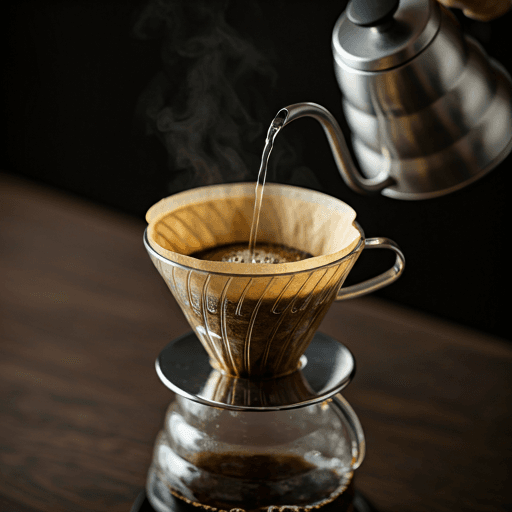
Pour over is a manual brewing method where you slowly pour hot water over ground coffee sitting in a filter, so gravity draws the brew down through the bed and into your cup below. Done well, pour over gives a clean, aromatic, almost tea-like cup, and because you control every variable by hand it is one of the most rewarding ways to brew. This guide walks through the whole method end to end: the gear, the ratio, the grind, the water temperature, and the pour itself.
What is pour over coffee?
Pour over coffee is single-cup filter brewing done by hand. You place a paper (or metal) filter in a cone-shaped dripper, add ground coffee, and pour heated water over it in stages. There is no pump and no pressure — just gravity pulling the water through the grounds and out through the filter. That gentle, even extraction is what gives the style its signature clarity and brightness, and it is why so many specialty cafes brew this way. Because you are steering the water yourself, the pour over method rewards attention: change the grind, the pour, or the temperature, and the cup changes with it.
Pour over is a close cousin to automatic drip, but the hands-on control is the whole point. It suits lighter and medium roasts and single-origin coffees especially well, letting delicate florals, fruit, and sweetness come through.
What you need
The kit is refreshingly simple: a dripper and matching filters, a gooseneck kettle for a slow, aimed pour, a burr grinder for consistent grounds, a scale (ideally with a timer), and a mug or server to brew into. You can start with just a dripper, filters, and any kettle, but a scale and a gooseneck spout make the biggest difference to consistency. For the full breakdown of drippers, filters, and grinders — and how to choose between them — see our pour-over coffee equipment guide. If you only upgrade one thing first, make it the kettle; a gooseneck kettle gives you the pour control everything else depends on.
The numbers: ratio, grind, and water temperature
Three settings do most of the work. Get these in the right zone and the rest is refinement.
- Ratio: aim for roughly 1:15 to 1:17 coffee to water. A reliable starting point is 20 g of coffee to about 320 g of water (1:16), which makes a generous single mug. For a deeper look at scaling up and dialing strength, see our coffee brewing ratios guide.
- Grind: medium-fine, roughly the texture of table salt. Too fine and the water stalls and over-extracts (bitter); too coarse and it rushes through (weak and sour).
- Water temperature: about 93–96 °C (roughly 200–205 °F), i.e. just off the boil. If you do not have a thermometer, boil the water and let it rest for around 30 seconds before you pour.
| Variable | Starting point |
|---|---|
| Coffee-to-water ratio | 1:16 (about 20 g coffee : 320 g water) |
| Grind | Medium-fine, like table salt |
| Water temperature | 93–96 °C (just off the boil) |
| Bloom | About 2× coffee weight (~40 g), 30–45 s |
| Total brew time | About 2.5–3.5 minutes |
How to make pour over coffee, step by step
- Boil and weigh. Heat your water and weigh out your coffee (say 20 g). Grind it fresh to medium-fine just before brewing.
- Rinse the filter. Set the paper filter in the dripper over your mug or server, and pour hot water through it. This washes out any papery taste and pre-heats the vessel. Tip the rinse water out.
- Add the grounds. Tip the ground coffee into the wet filter and give it a gentle shake so the bed is level. Place the whole setup on your scale and tare it to zero.
- Bloom. Start your timer and pour just enough water to wet all the grounds — about twice the coffee weight (around 40 g for 20 g of coffee). The bed will puff and bubble as trapped carbon dioxide escapes; this degassing, called the bloom, lets the coffee extract evenly. Wait 30–45 seconds.
- Pour in stages. Now add the rest of the water in slow, steady concentric circles, starting near the center and spiraling out, then back in — keep the pour off the paper wall. Pour in two or three additions, letting the level drop a little between them, until you reach your target weight (about 320 g).
- Let it draw down. Stop pouring at your target and let the remaining water filter through. Aim for a total brew time of about 2.5 to 3.5 minutes from the first pour. The spent bed should be flat and even, not gouged to one side.
- Swirl, serve, and taste. Give the server a gentle swirl to mix, lift off the dripper, and pour. Taste, then adjust one variable next time based on the troubleshooting below.
Troubleshooting your cup
Pour over is a feedback loop — read the brew and adjust one thing at a time.
- Brews too fast, tastes weak or sour? The water is racing through. Grind a little finer, or slow and steady your pour.
- Brews too slow, tastes bitter or harsh? The water is stalling and over-extracting. Grind a little coarser.
- Uneven, thin, or muddy? You are likely channeling — water carving a fast path through the bed instead of soaking it evenly. Pour more gently, keep the stream in the center, and avoid blasting the filter wall so the grounds stay level.
- Sour and thin overall? Under-extraction. Push the water hotter (toward 96 °C), grind finer, or extend the pour slightly.
Change only one variable per brew so you can tell what actually helped.
Popular drippers: V60, Kalita, Chemex
The dripper shape steers the flow, so it is the piece that most changes your technique. The three you will meet most often:
- Hario V60: a cone with a single large hole and spiral ribs. Fast and flow-sensitive, it rewards a careful pour and is a favorite for bright, clean single origins. If this is your dripper, our how to brew with a V60 walkthrough covers the specifics.
- Kalita Wave: a flat bottom with three small holes and a wavy filter. More forgiving of an uneven pour and very consistent cup to cup.
- Chemex: a glass carafe with a thick bonded filter that brews a very clean, low-body cup and scales nicely to a few cups at once.
They all use the same core method above — ratio, grind, temperature, bloom, and a steady staged pour — so once you have the technique, switching drippers is mostly a matter of small tweaks.
Bringing it together
Pour over looks fussy from the outside, but it comes down to a handful of repeatable moves: weigh, rinse, bloom, and pour slowly and evenly. Nail the ratio, grind, and temperature, keep a mental note of what you changed each morning, and within a week or two the routine becomes second nature — and the cup, unmistakably cleaner and more expressive than anything a machine hands you on autopilot.