
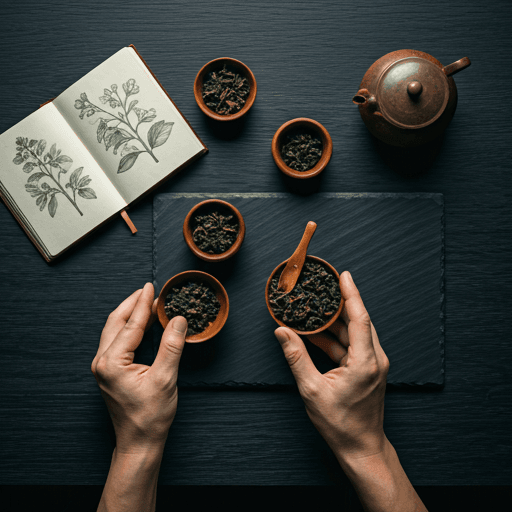
Camellia taliensis is not the tea plant. It is a separate species in the same tight botanical group, native to montane forest in the south-west Chinese uplands and the highlands immediately next door, and its leaves have long been picked and processed into tea-like drinks in the very region where tea itself is native. That combination makes it unusual among tea's wild relatives: it is one that people genuinely drink.
Expectations built on green, black and oolong do not transfer automatically. This is a different species, not a form of the tea plant, and much of what circulates confidently about its flavour, its caffeine or the age of the trees behind it describes material whose botanical identity was never actually established.
What Camellia taliensis is, botanically
Camellia taliensis sits in the same section of the genus Camellia as the cultivated tea plant — the small group of evergreen woody species that botanists cluster around tea itself. It was first published under the old genus Thea and later moved into Camellia, and the epithet points at Dali in western Yunnan through an older romanisation of that place name; Chinese-language sources still call the plant Dali tea. Standard botanical references accept it as a species. Some older treatments handled it instead as a form within the tea plant, and that usage still circulates in tea writing, which is one reason the same tree turns up under two different names in otherwise reputable sources.
For what the tea plant itself is — one species behind green, black, oolong and the rest, with its two familiar broad forms — see our guide to Camellia sinensis, the tea plant. The point here is that this is a different plant, and calling it a variety or a cultivar of tea gets the relationship backwards.
Why the species line is a drinker's problem, not only a botanist's
Coffee makes a useful contrast. The genus Coffea holds a great many wild species, and almost none of them are ever picked, processed or brewed. "Is this really coffee?" is a question only a taxonomist has cause to ask.
Tea is the opposite case, and that difference explains almost everything else about this plant. The tea plant's nearest relatives grow in the same forests on the same slopes. They flush in the same season. In the hand, on a picking day, a shoot from one looks a great deal like a shoot from the other. They are gathered by the same people, withered on the same mats, rolled in the same rooms, pressed into the same shapes and sold through the same channels to the same buyers. By the time the leaf is dry, every step that could have separated them has already been skipped.
So the boundary between "tea" and "not tea" in this corner of the world gets drawn by a botanical argument that the person drinking the result never sees and cannot check. Material offered as wild, forest-grown, old-growth or ancient-tree may be this species. It may be the tea plant standing in an unmanaged forest. It may be a mixture of both off the same hillside. It may be a hybrid of the two. Often nobody in the chain has tested it, and the accurate description of that situation is not concealment: identity in this category is frequently unresolved.
How the two plants actually differ
The characters botanists rely on are real, consistent and almost useless at the moment of picking.
- Ovary and styles. The most-cited difference is that this species has a five-chambered ovary, against three in the tea plant, with the styles following the same count. The fruit follows the flower: a larger, five-chambered capsule.
- Flowers. Creamy to white and conspicuously stamened. One of its informal names describes a bloom that looks like a fried egg, which is a fair account of a broad pale flower built around a dense yellow boss of stamens.
- Habit. In forest it grows as a tree rather than as a maintained plucking table, so the leaf attributed to it comes off branches rather than off a waist-high bush kept flat by shears.
- Leaf. Broadly larger than the small-leaved tea of temperate gardens, and much closer in size to the large-leaved tea of the same uplands — which is exactly why leaf size on its own settles nothing. One study that set the two species side by side reported the taliensis material as yellower-green in bud and leaf, with a denser downy surface than the cultivated tea it was measured against. That is a finding about the plants in that comparison, not a field key you can carry into a forest.
Notice what the dependable half of that list is made of: ovaries, styles, capsules, flowers. Those are precisely the parts a picker does not have in front of them in spring, and they are entirely absent from finished dry leaf. What a leaf even is, and how leaf size and grade get described once it has been processed, is covered separately in our explainer on tea leaves.
Researchers hit the same wall. Recent work on this corner of the genus has had to resolve what taxonomists call morphological species complexes using genomic data — sets of single-copy nuclear genes and whole chloroplast genomes — rather than appearance, and several names in and around tea have been revisited on that basis. When the visible characters run out, the laboratory is the only remaining referee, and a laboratory is not something a picking crew or a market stall has to hand.
Where Camellia taliensis grows
The documented range runs through western and south-western Yunnan and continues into the uplands of northern Myanmar and northern Thailand: subtropical montane evergreen broadleaf forest, on slopes cool and misty for much of the year. A great deal of what gets talked about as wild tea trees in Yunnan sits in exactly this band. Some stands are in remote forest; others are near villages, in old seed-grown groves, or scattered through mixed plantings that successive generations simply kept picking. Survey work on those communities describes structurally stable forest with high species diversity around the tea trees, which is a useful corrective to the idea that these are gardens gone feral.
The naming reflects that ordinariness. Reported local names translate as wild tea, Dali tea or Yunnan broad tea — not the name of a curiosity, but the name of a thing you pick.
Hybrids, and the honest state of the record
Two lines of published evidence make the identity question harder rather than easier.
The first is that the two species cross readily and the offspring sit between them, intermediate in both appearance and chemistry. A hybrid is therefore not an exotic edge case to be set aside; it is a plant that will defeat exactly the characters you would use to sort its parents.
The second is introgression in the wild. Population-genetic work in the upland river basins of Yunnan has reported localised gene flow between wild taliensis stands and the neighbouring large-leaved cultivated tea, which is unsurprising where the two have grown alongside each other for generations. Broader survey work across Yunnan tea accessions goes further, describing this species as a major genetic contributor behind the region's cultivated large-leaved tea and reporting hybrid-derived intermediates in more than one district.
The consequence is worth stating plainly. A tree in a forest in this region is not guaranteed to be cleanly one thing or the other, and a batch of leaf gathered across a slope may hold more than one. Where sources disagree about whether a particular stand is this species, the tea plant, or a mixture of the two and their offspring, the disagreement is the fact — and reporting it is more useful to a drinker than picking a side.
What is honestly known about how it tastes
Less than the confident descriptions suggest. Leaf attributed to this species is reported to be made up in several ways in its home region: withered into white-style tea, oxidised into black tea, and pressed into the compressed styles Yunnan is known for. Those are reports of practice and they are credible. What does not follow is a species-wide flavour profile, for two reasons.
The first is that most tasting notes in circulation describe material whose botanical identity was taken from a seller's label rather than established by anyone. The second is that the laboratory work compares particular plants with particular plants. One published aroma analysis of black tea made from this species traced a tropical-fruit and citrus character to specific volatile compounds in the samples examined — a real, attributable finding about those teas, and not a description of everything the species produces.
The chemistry comparisons are more instructive for the way they disagree. One study set tea from this species against a cultivated large-leaved Yunnan tea and reported lower catechin levels alongside higher phenolic acids and amino acids. Another, comparing the two species directly, reported more EGCG and more GABA in the taliensis material than in the cultivated tea it was sampled beside. Both are published. Both are findings about specific plants rather than species signatures, and a reader who wants one clean number is going to be disappointed by the literature rather than served by it. Tea-breeding work has separately singled the species out as rich in hydrolysable tannins, a compound class the cultivated plant carries in smaller amounts. Caffeine and theanine are both reported present, so this is not a naturally caffeine-free leaf, and no settled species-wide figure for either exists in the public record. Assertions that it is decaffeinated by nature, or that it delivers a defined medical benefit, run well past what has been published.
Carrying tasting vocabulary across from tea is the other mistake. A description built on the tea plant does not automatically describe a different species, however similar the processing. For the reference point of what Yunnan's black tea from the tea plant actually is, that belongs to Dian Hong. And where a seller reaches for leaf colour as evidence of wildness, colour in tea leaf has its own explanation, set out in the purple tea guide.
At a glance
| Character | Camellia taliensis | The tea plant (Camellia sinensis) |
|---|---|---|
| Botanical status | Accepted as a species; some older treatments placed it inside the tea plant | The cultivated tea species |
| Ovary chambers and styles | Five | Three |
| Flower | Creamy to white, broad, densely stamened | Smaller, white, fewer stamens |
| Usual form where it grows | Forest tree, or old seed-grown groves near settlements | Pruned bush in managed gardens; also old trees |
| Documented range | Western and south-western Yunnan into northern Myanmar and northern Thailand | Far wider; grown across the tea-growing world |
| Made into | Reported locally as white-style, black and compressed teas | Every tea category |
| Crossing between the two | Readily; offspring intermediate in appearance and chemistry | Readily, in the same direction |
| An organised crop of its own? | No — gathered and tended, not farmed as a commodity | Yes, worldwide |
| State of the record | Thin and partly contested; identity of traded material often untested | Extensively documented |
It is not a crop in its own right
There is no organised industry built on this species. There is no processing standard for it, no grading system, no separate supply chain, and nothing in the ordinary trade that keeps it distinct from tea before the leaf is dry. What exists is gathering — from forest trees and from old planted groves — plus opportunistic small-batch making, folded into the same trade that handles everything else off those hills.
That is not the same as saying nobody plants it. The conservation assessment on record leans partly on its presence in cultivation in Yunnan, and long-established groves near settlements are tended, harvested and inherited like any other useful tree. The distinction that matters is between a plant that is used and a plant that is farmed as a commodity, with the propagation, pruning, plucking round and processing specification that a commodity implies. The cultivated large-leaved tea of the region is what that whole system was built around, and a tree that grows tall, crosses freely with its neighbours and cannot be relied on to come true from seed is a poor fit for it. The species' role today is closer to a gathered product with an unusually good story than to a farmed one.
Why breeders and conservationists pay attention anyway
The interest is genetic. Published work describes this species as a primitive wild member of tea's own botanical section and as a significant genetic source behind the domesticated large-leaved tea of the region, singling out its stress tolerance as the reason it matters. Comparative genome work across the group has also reported that wild relatives carry more genes in certain families than the cultivated accessions sampled beside them, which is the general shape of what domestication does to a crop and the general reason breeders go back to the wild pool. This is not a museum specimen: breeding studies have already mapped traits inherited from this species, hydrolysable tannin content among them, in tea breeding populations that carry its genetics. That is the species working as a donor, not as a crop.
Conservation is where the record openly disagrees with itself, and it is worth knowing that before repeating either version. The standing Red List assessment classifies the species as Least Concern, reasoning from a range spread across three countries and from its presence in cultivation, while acknowledging habitat fragmentation and harvesting pressure. More recent population-genetic work on particular wild stands reads far less comfortably, describing strong genetic isolation, low diversity within an isolated wild population, and a measurable risk of genetic erosion. Both statements are in print, and neither is a misreading of the other. The reading that survives both is that the species range-wide is not rare, while particular wild stands — the famous ones, the ones the market wants — are under real pressure.
What a label can and cannot tell you
Given all of the above, here is what is actually inferable from a package.
- "Wild", "forest" and "ancient tree" do not name a species. Those words describe how a plant was growing, or how old someone believes it is. Both the tea plant and this species grow wild in the same forests.
- A binomial on a label is a claim, not a test result. It may be accurate. It may be copied from another seller. Unless someone did genetic work, nobody in the chain verified it.
- Mixed material is normal, not sinister. Leaf gathered across a forest slope can include more than one species and their hybrids, and those hybrids are intermediate in both appearance and chemistry. That is a feature of the landscape, not a trick.
- Treat health and caffeine claims with suspicion. Assertions that this leaf is naturally caffeine-free, or that it delivers a specific medical benefit, run past the published evidence.
- The useful questions are narrow. Which mountain or county, gathered or planted, who processed it and how, and whether anyone has actually identified the plant. A seller who answers "we don't know for certain" is being straight with you.
The bottom line
Camellia taliensis is a real species, distinct from the tea plant, growing in south-west Chinese montane forest and the highlands beside it, and genuinely picked and made into drinkable tea by the people who live among it. It is not a crop in any organised sense, its flavour is documented far less thoroughly than the confident notes around it imply, and the characters that separate it from tea are flowers and fruit that never reach a buyer. What makes it more than a botanical footnote is the position it occupies: a wild relative close enough to the crop to be picked, processed and sold alongside it, so that the question "is this tea?" survives all the way into the cup. Where the record is thin, saying so is the accurate answer — and it is a better guide to what is in the pot than a species name nobody checked.