
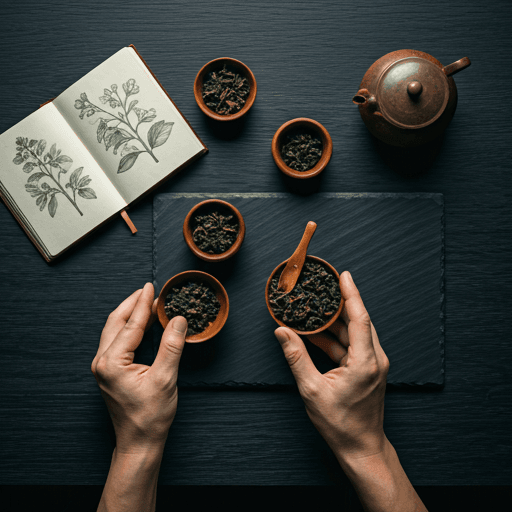
Tea leaves are the leaves and unopened buds of Camellia sinensis, the evergreen tea plant. Every true tea — white, green, oolong, black, yellow and pu-erh — comes from these same tea leaves; the color in your cup depends on how the leaf is processed, not on a different plant. Herbal "teas" like chamomile or peppermint are made from other plants entirely and, as we will see, are not tea leaves at all.
That single idea explains an enormous amount about tea. Once you know that the delicate white tea in one tin and the dark, malty black tea in another were both picked from the same bush, the whole world of tea starts to make sense. Below we cover what tea leaves actually are, how one leaf is turned into so many teas, the grades and forms you will meet on a shelf, and the difference between a whole tea leaf and tea powder.
What Tea Leaves Are
Tea leaves come from Camellia sinensis, an evergreen shrub that, left alone, would grow into a small tree. On plantations it is kept pruned to waist height so pickers can reach the youngest growth. The prized part is the tender tip: the newest unfurled leaves and the small closed bud at the very end of a shoot. The classic hand-pluck is often described as "two leaves and a bud" — the bud plus the two youngest leaves below it, which carry the most flavor compounds and the finest texture.
Those young shoots are what a picker gathers, and everything that happens afterward is processing. Coarser, older leaves lower down the stem are still usable but generally make a plainer, more astringent cup. The plant itself — its two main varieties, where it grows and how it is cultivated — is a bigger story that we hand off to our guide on Camellia sinensis, the tea plant. Here the point to hold onto is simple: a tea leaf is a real leaf from a real plant, and its quality starts in the field with what gets picked.
How One Leaf Becomes Many Teas
If all true tea comes from one plant, why does green tea taste grassy and fresh while black tea tastes dark and malty? The answer is oxidation — the same browning reaction that turns a sliced apple brown. After picking, the leaf's enzymes react with oxygen, and the more that reaction is allowed to run, the darker and deeper the tea becomes. Tea makers control this with a handful of steps:
- Withering: fresh leaves are laid out to lose some moisture and soften, so they can be handled without tearing.
- Firing or steaming: heat quickly stops the enzymes. Do this early and you lock in a green, vegetal character; delay it and oxidation keeps going.
- Rolling and shaping: bruising the leaf breaks cell walls and speeds oxidation, and also gives the leaf its twist, curl or pellet shape.
- Oxidation: the leaves rest and darken for a controlled time — briefly for oolong, fully for black tea.
- Drying: a final low heat brings moisture down for storage.
Slide the dial and you get the whole family. White tea is barely handled — just withered and dried, so it stays pale and soft. Green tea is heated early to keep it green. Oolong sits in the middle, partly oxidized, which is why oolongs range so widely in flavor. Black tea is fully oxidized, giving the robust cup most of the world drinks with milk. Yellow tea adds a gentle "yellowing" rest, and pu-erh is aged and fermented over months or years. Same leaf, different recipe — the entire family of true teas separated only by how far the maker lets that browning reaction run.
Grades and Forms of Tea Leaves
Walk down a tea aisle and the same tea can appear in very different physical forms, and that shape matters as much as the type. Leaf grading mostly describes size and how intact the leaf is, from big and whole to fine and broken:
- Whole leaf: large, intact leaves and buds. They brew more slowly and gently, often reward multiple infusions, and are usually treated as the premium form. Whole-leaf grading (and terms like "orange pekoe") is a topic in its own right, which we cover in the guide to full-leaf tea.
- Broken leaf: leaves cut or broken into smaller pieces. More surface area means a faster, stronger, brisker cup — popular in everyday black teas.
- Fannings: smaller broken bits, finer than broken leaf.
- Dust: the finest particles of all. Fannings and dust brew very fast and strong, which is exactly why they fill so many tea bags.
This is also the difference behind the loose-versus-bag choice. A bag is a convenient pouch usually holding fannings or dust, so it steeps quickly but can taste flatter; loose leaf gives the leaf room to open and release more nuanced flavor. Neither is "wrong" — it is a trade of convenience against range — and we weigh it up properly in tea bags vs loose leaf. Whether you buy loose tea leaves or tea-leaf tea bags, the same graded leaf is inside; only the size of the pieces and the packaging change.
| Leaf form | What it is | Typical use |
|---|---|---|
| Whole leaf | Large, intact leaves and buds | Premium loose teas; slow, layered brews and multiple infusions |
| Broken leaf | Cut or broken pieces | Brisk, stronger loose black teas and quality bags |
| Fannings | Small broken fragments | Fast-steeping everyday tea bags |
| Dust | Finest particles | Standard tea bags; strong, quick cups often taken with milk |
| Tea powder (ground) | Whole leaf stone-ground to a fine powder, e.g. matcha | Whisked into water so you drink the leaf itself |
"Tea Leaf" vs "Tea Powder"
People often ask about the gap between a tea leaf and tea powder, and there are really two different things sharing that word. The first is the fine dust inside ordinary tea bags, which is still just broken-up leaf, as above. The second is genuinely ground tea — whole leaves milled to a fine powder that you whisk directly into water and drink, leaves and all, rather than steeping and straining. Matcha is the famous example. Because you consume the whole leaf, powdered tea tastes more concentrated and intense than the same amount of steeped leaf. It is a distinct enough topic that we keep the deep comparison in a separate guide on tea leaves versus tea powder. For everyday purposes, remember the simple rule: with leaves you steep and pour off; with powder you whisk and swallow.
Herbal "Teas" Are Not Tea Leaves
Here is the caveat that trips up almost everyone. Many drinks sold as "tea" contain no tea leaves at all. Chamomile, peppermint, rooibos, hibiscus, ginger and the like are made from flowers, herbs, roots and fruit — never from Camellia sinensis. The correct name for them is a tisane, or simply a herbal infusion. They are lovely drinks, but botanically they are a world apart from true tea.
The practical difference that matters most is caffeine. Because true tea leaves naturally contain caffeine, white, green, oolong and black teas all have some; most herbal tisanes are naturally caffeine-free (rooibos and peppermint, for instance). So if a label says "tea" but lists only mint or chamomile and no actual tea, you are holding a tisane, not tea leaves — a distinction worth knowing whenever caffeine, or the lack of it, matters to you.
Getting the Most From Your Tea Leaves
Once you understand what you are working with, brewing gets easier. Bigger whole leaves generally want a little more room, slightly cooler water for delicate greens and whites, and short repeat steeps; smaller broken leaf and dust extract fast, so they need less time before they turn bitter. Give loose leaf space to expand — a roomy basket or pot beats cramming leaf into a tiny ball infuser — and it will open up and taste far more complete. Matching the water temperature, the steep time and the amount of leaf to the grade in front of you is what turns the same tea into a great cup rather than a bitter one.
For all their variety, tea leaves come back to one quiet fact: a single evergreen plant, picked young and handled with care, can become dozens of utterly different drinks. Learn to read the leaf — its type, its grade, its form — and every tin on the shelf starts to tell you how it will taste before the water even touches it.