
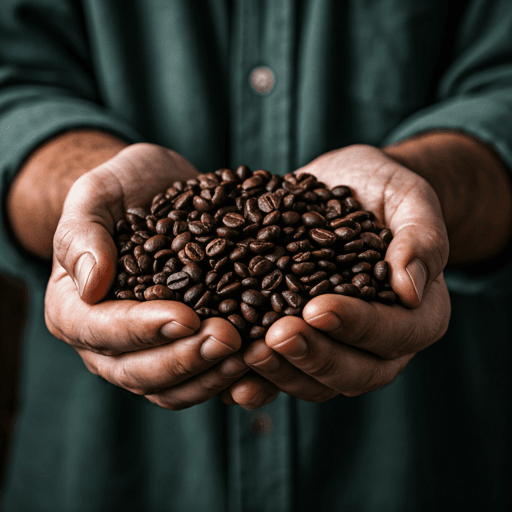
Cambodia does grow coffee. Cambodia coffee is a real crop and a very small one: mostly robusta, planted on the eastern highland plateau, chiefly in Mondulkiri and Ratanakiri provinces. You have almost certainly never seen it on a bag, and the reason is structural rather than agricultural. Cambodia sits directly beside one of the largest coffee producers on earth, and being small next to a giant does far more damage to an origin's visibility than a shortage of good ground ever could.
That is the argument here. This is not an absence story. There are real farms, farmed by real growers, on soil that suits the crop. What there is not is an independent commercial identity, and the mechanism that prevents one from forming is more interesting than any tasting note.
Where Cambodia coffee grows, and why only there
Most of Cambodia is low, flat and hot. The central plain around the Tonle Sap and the Mekong is superb rice country and hopeless coffee country: coffee wants elevation, drainage and a cooler night, and the plain offers none of the three. The exception is the eastern edge, where the land climbs onto a basalt plateau shared with the uplands across the frontier. That plateau is the coffee ground, and it is a narrow exception rather than a national condition.
Two provinces carry the bulk of it. Mondulkiri coffee is the better documented of the two, grown on the red basaltic soils of the highland districts, and it is the name most often attached to any Cambodian lot that reaches a roaster. Ratanakiri coffee comes from the province to the north, on similar volcanic ground, and is described in much the same terms. Both areas are sparsely populated and forested, and both are home to indigenous upland communities, the Bunong of Mondulkiri among them.
The east is not quite the whole map. Cambodian agricultural reporting also lists smaller plantings elsewhere, with Pailin in the west and parts of Kampong Cham mentioned most often, and Pailin in particular is periodically talked up as a second front for the crop. Treat those as secondary and thinly documented rather than as established growing regions with their own identity; the eastern plateau is where the story sits.
How high is that ground? Sources disagree, and it is worth saying so plainly rather than picking a number. Some regional write-ups describe the coffee districts as running well up the plateau; others describe Cambodia as topping out considerably lower and treat that ceiling as the limiting factor for arabica. The honest summary is that the eastern plateau is high by Cambodian standards and modest by the standards of the arabica-growing world, which is exactly why the crop skews the way it does.
At a glance
| Question | What the record supports |
|---|---|
| Does Cambodia grow coffee? | Yes - a small, real crop, not a symbolic one |
| Main growing areas | Eastern highland plateau: Mondulkiri and Ratanakiri |
| Secondary areas reported | Pailin in the west, parts of Kampong Cham; thinly documented |
| Dominant species | Robusta, with small arabica plantings reported at the higher edges |
| Arabica material reported | Catimor-type, in limited and recent plantings |
| Origin of the crop | Introduced during the French colonial period, alongside other plantation crops |
| Twentieth century | A long interruption; the sector had to be rebuilt from a low base |
| Where the coffee goes | Domestic cafes and roasters; some is reported to cross the border informally |
| Export identity | Minimal - most volume never carries the country's name |
| Reliable cup profile | No - descriptions exist, but there is no consistent public tasting record |
| Domestic demand vs supply | Demand outruns the local harvest; the gap is filled by imports |
Being small next to a giant is the mechanism, not the backdrop
It is tempting to explain a tiny origin by saying its neighbour simply grows more. That is true and almost useless. The real effect of a neighbouring mega-producer operates through four separate channels, and each one independently suppresses the smaller origin's ability to build a name.
1. The giant sets the reference
When one country supplies a very large share of the world's robusta, its harvest becomes the market's reference point. Buyers, traders and processors calibrate expectations - quality grades, moisture standards, delivery formats, contract shapes - against that supply. A small neighbour growing the same species does not get judged on its own terms; it gets judged as a variant of the benchmark, and a variant with none of the volume that makes a benchmark useful.
2. The giant owns the relationships
Buyer relationships are slow, sticky assets. Importers who have spent decades working a supply chain do not casually add a source that cannot fill a container reliably, cannot guarantee a repeat lot next season, and has no established grading vocabulary. The neighbour's exporters already answer every one of those questions. For a roaster, sourcing from the established origin is the low-friction default, and the small origin has to overcome that friction before anyone tastes anything.
3. The giant owns the infrastructure
This is the part most readers underestimate. Coffee needs more than trees. It needs drying capacity, hulling, sorting, grading, warehousing, quality control and a working route to a port. A large producing neighbour has all of it, built out over decades and sited close to its own growing regions - which, on a shared plateau, means close to the frontier. A small origin that lacks that chain does not merely have worse infrastructure; it has a functioning alternative sitting a short drive away.
4. So cross-border selling becomes rational
Put those three together and the outcome follows without anyone intending it. A grower on the Cambodian side of the plateau, holding cherry that needs processing quickly, facing a domestic chain that is thin and a foreign chain that is dense and nearby, has an obvious commercial choice. Reporting on the region consistently describes this trade: coffee moving across the border, sold to traders on the other side, frequently as unprocessed or lightly processed cherry, and largely outside formal recording. Cambodian press coverage has gone further and noted that the flow is not systematically tracked precisely because it is informal.
How much? Nobody credibly knows, and anyone who gives you a percentage is guessing. The trade is widely reported and repeatedly described as long-standing and informal - but informal is exactly the word that means unmeasured. What can be said without inventing anything is the consequence: coffee grown in Cambodia can physically leave the country without ever carrying its name. Once a lot is blended into a larger neighbour's export stream, its origin is functionally erased. That is the single clearest reason a reader has never seen Cambodian coffee on a shelf, and it is a reason that has nothing to do with the quality of the beans.
Notice what that does to the usual signals of quality. A traceable origin builds its reputation by repetition: the same region, the same season, the same name on the bag, year after year, until buyers form an expectation. Coffee that leaves anonymously cannot accumulate any of that. Each harvest starts from zero, no reputation compounds, and the origin stays permanently at the beginning of its own story.
Why it is mostly robusta, and what that means
The species split follows the geography. The eastern plateau's elevation and warmth suit robusta comfortably and arabica marginally at best. Small arabica plantings - reported to be Catimor-type material - exist at the higher edges and are described as a recent, deliberate experiment rather than an inherited tradition. If you want the species itself explained properly, how robusta differs from arabica in the field and in the cup, that ground belongs to our guide to what robusta coffee is, and there is no point repeating it here.
Two consequences matter on this page. First, a robusta-dominant origin competes in exactly the segment where the neighbouring giant is strongest, which sharpens every problem described above. A small arabica origin at least sells into a different conversation; a small robusta origin is measured against the benchmark itself.
Second, robusta's specialty pathway is genuinely newer than arabica's. A formal fine robusta evaluation protocol exists, and Cambodian lots have been reported to have been assessed under it - a meaningful milestone, and a small one, since a handful of assessed lots is not an industry. For context on the wider minor-species picture, our explainer on liberica coffee covers how species outside the arabica and robusta duopoly find their niches.
A tree crop that lost a generation
Coffee arrived in Cambodia during the French colonial period, planted as a cash crop alongside the other plantation crops of the era. One plain sentence is all that history needs here, and dressing it up as heritage would be dishonest.
What matters agriculturally is what happened next. Through the middle and later twentieth century, Cambodian agriculture went through a prolonged structural interruption, and the coffee sector was effectively suspended for a generation. The point is not political; it is botanical and institutional, and it is badly underappreciated.
An annual crop can be restarted in a season. A tree crop cannot. When coffee farming stops for that long, three separate things are lost, and they are lost at different speeds:
- The trees. Unmaintained coffee declines, is overtaken by regrowth, or is cleared for something that pays sooner. Replanting means waiting several years before a new planting bears meaningfully.
- The nursery system. Planting material is an institution, not an object - selected mother trees, propagation know-how, a supply of seedlings people trust. Rebuilding that takes longer than rebuilding the fields it feeds.
- The technique. Pruning cycles, shade management, picking selectivity, drying discipline. This knowledge normally passes down by demonstration. When the chain of demonstration breaks, it does not resume; it has to be reconstructed, often from outside.
So restarting is not the right word. Rebuilding is. And rebuilding a tree crop is measured in tree generations, which is why a country that has been actively encouraging coffee for years still has a sector the world market does not notice. It also compounds with everything in the previous section: the years spent rebuilding trees and technique are years in which the neighbour's buyer relationships and processing capacity kept deepening.
What the coffee actually is, and where it goes
Be careful with flavor claims here. Cambodian robusta is commonly described as earthy, nutty, low in acidity and heavy in body, and lots from the volcanic soils of both provinces are often characterized in similar terms. Those are consistently reported descriptions, not an established profile. There is no broad, independent, repeated public tasting record for this origin - too few lots, too little separation, too little continuity season to season. Any confident cup profile you read about Cambodia coffee is better treated as one roaster's experience of one lot than as a national signature.
The same caution applies to the apparatus that usually surrounds an origin page. Cambodia has no widely published national grading system, no established variety roster beyond the broad species split, and no harvest calendar that outside sources state consistently. Where a major origin has decades of documentation, this one has scattered reporting, and it is better to say so than to fill the gap with a template borrowed from somewhere else.
Where the coffee goes is easier to answer. Most of it is drunk at home. Domestic demand comfortably outruns the local harvest, and the shortfall is filled by imports from producing neighbours - which is the quiet irony of the situation: a coffee-growing country whose cafes largely run on someone else's beans.
Local preparation has its own character. Khmer coffee in the traditional street style is roasted very dark, historically with added fat and sugar in the roast, ground fine and brewed through a cloth filter or a small metal drip filter, then served strong over ice with sweetened condensed milk. That style is a real culinary tradition, and it is worth separating in your head from the question of what the country grows. The two are only loosely connected, since the cup in front of you may well have been grown across a border.
How it compares to its neighbours
One line each, because these origins have their own pages and deserve them. The giant next door is the subject of our guide to Vietnamese coffee beans; that scale is the pressure Cambodia grows under, and its production story is told there rather than repeated here. The closest peer is Laos coffee, which shares the same broad predicament of being a small upland origin beside a very large one, but which has built considerably more export identity and arabica reputation than Cambodia has managed.
That last comparison is the useful one, because it shows the outcome is not fixed. A small neighbour can acquire a name. It requires a growing area that outside buyers can point to, enough continuity for a reputation to form, and a processing chain that keeps the coffee inside the country long enough to be labelled with it. Cambodia has the first in a limited way and is early on the other two.
Could the scale change?
Honestly assessed, there are two plausible paths and one implausible one.
The implausible one is volume. Cambodia is not going to become a significant robusta exporter. The suitable ground is limited to a slice of two provinces, and competing on volume against the origin that defines the segment is not a strategy.
The first plausible path is differentiation: a small quantity of carefully processed, identified, traceable coffee sold on its own name rather than its species. That is what the fine robusta pathway offers, and it is what the higher-elevation arabica experiments are reaching for. It is early. The processing gap is real, the volumes are tiny, and continuity across seasons is the hardest part of all.
The second plausible path, and the more realistic near-term one, is domestic. Cafe culture in Cambodian cities has grown quickly, specialty shops have multiplied, and a home market that already imports most of what it drinks is an obvious outlet for a home-grown crop that does not need to cross a border, clear an export chain or beat a benchmark to reach a customer. A grower supplying a domestic roaster keeps the origin attached to the coffee, which is exactly what the cross-border route destroys.
The bottom line
Cambodia grows a genuine, modest, mostly robusta crop on its eastern highland plateau, and its invisibility is a structural outcome rather than a verdict on the coffee. A neighbour that sets the reference, holds the buyer relationships and owns the processing chain makes selling across the frontier the rational move, and coffee that leaves that way loses its name on the way out. Add a tree crop rebuilt from a generational interruption and the picture is complete. If Cambodian coffee becomes something you can buy by name, it will most likely arrive through small identified lots and a growing domestic market, not through volume, and not soon.