
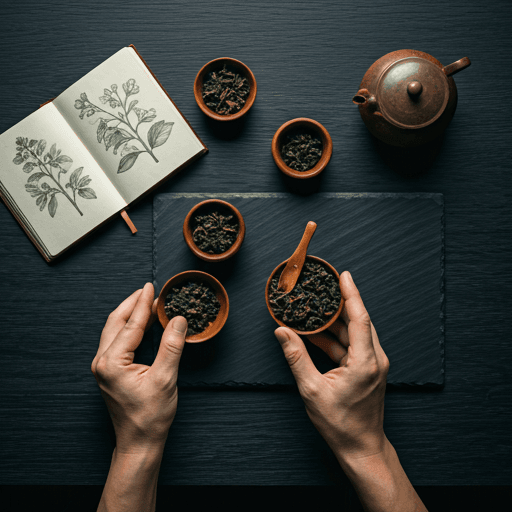
Yerba mate is a traditional South American drink made by steeping the dried leaves of the yerba mate plant (Ilex paraguariensis, a species of holly) in hot water. It is famous for two things: a deep social ritual built around a shared gourd and a metal straw, and a meaningful dose of natural caffeine that sits roughly between a cup of tea and a cup of coffee. Technically it is a herbal infusion rather than a "true tea," yet it stands apart from almost every other herbal drink because it genuinely contains caffeine.
What is yerba mate, exactly?
Yerba mate comes from a holly tree native to the subtropical forests of South America. The leaves and small stems are harvested, dried, sometimes lightly smoked, then aged and milled into a coarse green blend. Pour hot water over that blend and you get mate (pronounced "mah-tay") — an earthy, grassy, gently bitter infusion that is one of the most-loved everyday drinks across Argentina, Paraguay, Uruguay and southern Brazil.
Because it is brewed from a plant that is not Camellia sinensis, yerba mate is classed as a herbal infusion. If you want the broader picture of that category, see our guide to what herbal tea is. The crucial difference is caffeine: most herbal teas are caffeine-free, while mate is naturally caffeinated. That single fact explains why mate is treated less like a soothing nighttime cup and more like a daily lift — closer in spirit to the true teas or to coffee.
Where it comes from
The plant grows wild and is cultivated across a green belt spanning northeastern Argentina, Paraguay, Uruguay and southern Brazil. Indigenous Guarani people drank it long before European contact, and the habit spread through the region to become a genuine cultural cornerstone. Today you will see people carrying a gourd and a thermos of hot water through parks, offices and beaches across the southern cone — and increasingly far beyond it.
The mate ritual: gourd, bombilla and sharing
Half of what makes yerba mate special is how it is served. The traditional vessel is a hollowed-out gourd, itself called a mate (also a guampa, porongo or cuia depending on the country). You fill it most of the way with the dried leaf, then drink through a bombilla — a metal straw with a filtered, perforated end that strains out the leaf so you sip only the liquid.
Mate is usually a shared, social drink. One person, the cebador, fills the gourd, pours in hot water and passes it around a circle. Each person drinks the gourd down completely, hands it back, and it is refilled and passed to the next. The same leaf is topped up many times across a long session, so a single fill keeps a group going for ages. A few unspoken rules: do not stir the bombilla (it clogs the filter), and saying "thank you" traditionally signals you have had enough and want to leave the circle.
The temperature rule
One detail matters for both flavour and safety: the water should be hot but never boiling. Aim for roughly 70-85 degrees C (about 160-185 F). Boiling water scalds the leaf, pulling out harsh bitterness and flattening the taste. Letting the kettle cool for a minute or two before pouring is the single easiest upgrade for a better cup.
What does yerba mate taste like?
The classic flavour is earthy and grassy with a clean, vegetal bitterness — woodsier than green tea and far less acidic than coffee. Lightly smoked yerbas (more common from Brazil and Argentina) lean toasty and robust; air-dried styles taste greener and smoother. The first few refills are the strongest and most bitter; later refills mellow out. If straight mate is too sharp for you, many drinkers add a slice of citrus, a little mint, or a touch of sweetness, and iced versions (often called terere, made with cold water) are popular in hot weather.
Caffeine and the energy from mate
An average cup of mate carries somewhere around 80 mg of caffeine, which places it neatly between most teas (roughly 20-70 mg) and coffee (roughly 95-200 mg). A long, traditional gourd session refilled across an hour can deliver considerably more in total, so strength really depends on how you brew. If you want the wider picture on how this stimulant behaves in the body, see our explainer on caffeine.
What many drinkers notice is the quality of the lift. Alongside caffeine, mate contains theobromine (the same gentle stimulant found in cocoa) and a trace of theophylline. Many people report that this combination feels smoother and more sustained than a coffee jolt — less of a spike, less of a crash — though individual experience varies and the science here is still developing.
A note on the benefits of mate
Yerba mate is rich in plant compounds, including polyphenols and other antioxidants, which is one reason people are curious about its benefits. Research generally observes that, like green tea, it is a source of these antioxidant compounds. Keep the framing realistic, though: mate is a beverage, not medicine, and it makes no sense to treat any single drink as a health fix. Enjoy it for the ritual and the steady energy, and let the rest be a pleasant bonus rather than the point.
How to make yerba mate
You do not need a gourd to enjoy mate. Here are three reliable methods, from traditional to everyday.
Ingredients and gear
- Loose yerba mate (or mate tea bags)
- Hot water, around 70-85 C / 160-185 F — never boiling
- A gourd and bombilla (traditional), or a French press, or a mug for tea bags
- Optional: cold water for terere, plus citrus, mint or a little sweetener
The traditional gourd method
- Fill the gourd about two-thirds to three-quarters with dry yerba mate.
- Cover the opening with your hand, tilt and shake gently so the fine dust settles to one side, then tip the gourd so the leaf sits at an angle, leaving a small hollow.
- Pour a splash of cool or lukewarm water into the hollow first and let it absorb — this protects the leaf from the hot water to come.
- Insert the bombilla into the moistened hollow and do not stir it after this.
- Pour hot (not boiling) water down the side of the bombilla, sip, and refill the same leaf again and again across the session.
The French press method
- Add about 3-5 g of yerba mate per 250 ml of water (start with 4 g if unsure).
- Heat water to roughly 75-80 C and pour it over the leaf.
- Steep for 3-5 minutes, then press and pour. Longer steeps turn bitter.
The tea-bag method
- Use one mate tea bag (or 1-2 teaspoons of loose leaf in an infuser) per cup.
- Pour over hot, not boiling, water.
- Steep 3-5 minutes, remove the bag, and adjust strength to taste.
Is yerba mate safe to drink?
For most healthy adults, yerba mate is fine to enjoy in moderation, as it has been for centuries. You will sometimes read that mate is linked to a higher risk of esophageal cancer. The important nuance — and the reason not to panic — is that the evidence points to temperature, not the herb itself. Health agencies flag the habit of regularly drinking any very hot beverage, scalding above about 65 C / 149 F, as a probable risk, and that applies to very hot coffee and tea too.
The practical takeaway is simple and it is the same one that makes mate taste better: let it cool a little before you drink. Use water that is hot, not boiling, and do not gulp it scalding. Beyond that, mate does contain caffeine, so the usual sensible limits apply — go easy in the evening, and be more cautious if you are sensitive to caffeine, pregnant or breastfeeding, or managing a health condition. This is general guidance, not medical advice.
How yerba mate compares
| Drink | Plant source | Caffeine (per cup) | Typical flavour |
|---|---|---|---|
| Yerba mate | Ilex paraguariensis (holly) | ~80 mg (more over a session) | Earthy, grassy, gently bitter |
| Green tea | Camellia sinensis | ~20-45 mg | Vegetal, fresh, mild |
| Black tea | Camellia sinensis | ~40-70 mg | Malty, brisk, robust |
| Coffee | Coffea (roasted beans) | ~95-200 mg | Roasted, rich, bold |
| Most herbal teas | Various herbs | None | Varies; caffeine-free |
The takeaway
Yerba mate is more than a caffeinated drink — it is a ritual of sharing, a daily rhythm, and a flavour worth getting to know. Brew it warm rather than scalding, start mild, and lean into the slow, sociable way it is meant to be enjoyed. If mate has you curious about other leafy infusions and the antioxidants they offer, wander over to our look at green tea benefits next, or keep exploring the wider world of herbal infusions.