
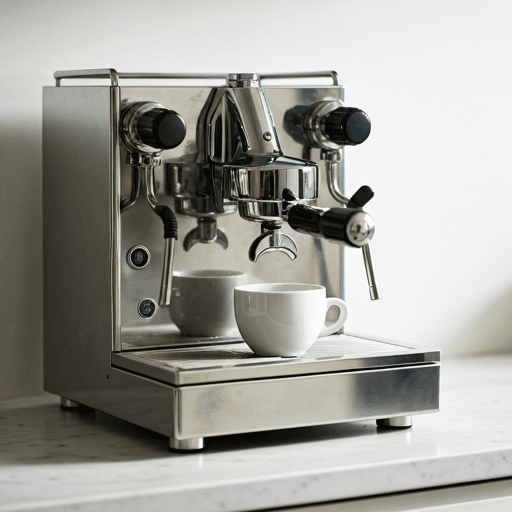
A portafilter is the handled metal device that holds your ground coffee and locks into an espresso machine's group head to brew a shot. It is the piece you fill with coffee, level, tamp and then clamp into place so pressurised hot water can flow through the compacted bed of grounds. Sometimes called the "group handle," the portafilter is where almost every espresso-based drink begins.
What is a portafilter?
Look at any traditional espresso machine and the portafilter is the wand-like handle sticking out of the front. Twist it out of the machine and you are holding a sturdy metal head with a wide basket in the top and, usually, one or two spouts underneath. You dose in freshly ground coffee, tamp it flat, and lock the whole thing back into the group head — the fixed part of the machine that seals against it and pushes near-boiling water through the coffee at roughly nine bars of pressure.
Because it clamps into the group with a bayonet-style twist, some people call it a group handle or filter holder. Whatever the name, the job is the same: hold the coffee, seal it against the machine, and channel the finished espresso into your cup. A well-made espresso portafilter is heavy and often made of chromed brass, which helps it hold heat and keep the shot stable from the first drop to the last.
The parts of a portafilter
Most portafilters break down into three simple parts:
- The handle. Usually wood, plastic or metal, the handle keeps your hand away from the hot group and gives you leverage to lock and unlock the device. Ergonomics matter here because you grip it dozens of times a day.
- The body and spouts. This is the chunky metal head, typically chromed brass for its heat retention. Underneath sit the spouts that direct the espresso downward — or, on a bottomless model, nothing at all.
- The portafilter basket. A removable, perforated metal cup that drops into the top of the body and actually holds the coffee. The basket is where the compacted "puck" of grounds forms, and it lifts out for cleaning or for swapping to a different size.
It helps to picture the body as the frame and the basket as an interchangeable insert. Two machines can share the same body diameter yet take very different baskets, which is why baristas pay close attention to both.
Portafilter spout types
The underside of the portafilter is where you first notice differences between models.
- Single spout. One narrow spout, designed to pour a single shot neatly into one cup.
- Double spout. Two spouts side by side, so you can split a double shot into two cups at once — handy for making two drinks from one pull.
- Bottomless (naked) spout. No spout at all; the base of the basket is fully exposed so espresso pours straight out. This lets you see the extraction and spot uneven flow, but it also sprays everywhere if your technique is off.
The bottomless option is a favourite for dialling in technique because it shows exactly how evenly the water is moving through the puck. We cover its quirks, benefits and the tell-tale spray in our guide to the bottomless portafilter.
Portafilter basket sizes and types
Swap the basket and you change how much coffee the portafilter holds and how the shot behaves. There are two things to consider: how much it holds, and how it builds pressure.
Single, double and triple baskets
- Single basket — holds roughly 7 to 9 g of coffee for one shot. These are the fussiest to pull well because the coffee bed is shallow and less forgiving.
- Double basket — holds about 14 to 18 g for a double (doppio) shot. This is the everyday workhorse and what most people reach for even when making a single drink.
- Triple basket — a taller basket holding around 21 g or more for very large or multiple drinks; less common on home machines.
Pressurised vs non-pressurised baskets
Baskets also come in two mechanical styles:
- Non-pressurised (standard) baskets have a single perforated screen with many tiny holes. They demand a good grind, an accurate dose and an even tamp, but reward you with the cleanest flavour and proper crema. This is what serious and prosumer machines use.
- Pressurised (dual-wall) baskets add a second wall with one small exit hole that builds back-pressure artificially. They are far more forgiving of coarse or pre-ground coffee and inconsistent tamping, which makes them common on beginner machines — though the crema they create tends to be thinner and more bubbly.
Many entry-level machines ship with a pressurised basket so newcomers get a drinkable shot from day one, then let you switch to a non-pressurised basket as your technique improves.
Common portafilter sizes
Portafilters and their baskets are measured by diameter, and a handful of sizes dominate:
- 58 mm — the professional standard, found on most commercial and prosumer machines. Its wide bed spreads the coffee thinly for even extraction, and accessories are easy to find.
- 51, 53 and 54 mm — smaller diameters used on many compact home and entry-level machines. They work perfectly well; you just need tampers, baskets and distribution tools sized to match.
Before buying baskets, tampers or dosing funnels, always check your portafilter's diameter — a 58 mm accessory will not fit a 54 mm machine. The size is often stamped on the basket or listed in your machine's manual.
Portafilter and basket decoder
Use this quick reference to match the right portafilter or basket to the job:
| Type | What it is | Best for |
|---|---|---|
| Single-spout portafilter | One spout underneath | Pulling one shot into a single cup |
| Double-spout portafilter | Two spouts side by side | Splitting a double into two cups at once |
| Bottomless (naked) portafilter | No spout; open base | Watching extraction and improving technique |
| Single basket | Shallow basket, about 7 to 9 g | A single, delicate solo shot |
| Double basket | Deeper basket, about 14 to 18 g | Everyday shots and most drinks |
| Triple basket | Tall basket, about 21 g or more | Large-volume or multiple drinks |
| Non-pressurised basket | Single perforated screen | Fresh-ground coffee and full flavour control |
| Pressurised (dual-wall) basket | Second wall with one exit hole | Beginners and pre-ground coffee |
How to use a portafilter
Using a portafilter follows the same rhythm on almost any machine:
- Dose. Grind fresh coffee straight into the basket, aiming for the weight your basket is built for.
- Distribute. Level the grounds so there are no clumps or gaps. Many baristas use a WDT distribution tool to stir out clumps for an even bed.
- Tamp. Press the coffee flat and firm with a matching tamper so water cannot race through soft spots. Our coffee tamper guide covers pressure and fit.
- Lock in. Slot the portafilter into the group head and twist firmly until it seats, usually somewhere around the "three o'clock" position.
- Brew. Start the pump and let the machine push water through the puck. For the full method, timings and ratios, see how to make espresso at home.
How to clean a portafilter
Coffee oils and fine grounds build up fast, and a dirty portafilter tastes bitter and stale. Keep it clean with a simple routine:
- After every shot, knock the spent puck out into a knock box, then wipe or rinse the basket so no grounds cling to the walls or rim.
- Daily, pull the basket out and rinse both it and the body under hot water; a small brush clears the spouts.
- Regularly, backflush machines that support it. This uses a blind (holeless) basket and a little espresso-machine detergent to flush coffee oils back out of the group and portafilter, followed by a deep soak of the basket and body in a cleaning solution.
Leaving the portafilter seated in the warm group between shots keeps it hot, but never store it packed with a wet puck — that breeds off flavours and mould.
Troubleshooting a portafilter
Two problems come up again and again.
The portafilter will not lock in properly
If it turns too easily, you have probably under-dosed; if it will barely go in, you have over-dosed and the puck is jamming against the group screen. Adjust your dose until the handle seats with firm but comfortable resistance. A worn or hardened group gasket can also make locking feel loose or sloppy.
Espresso leaks around the edge
Water escaping around the rim instead of through the spout usually means a tired group gasket that no longer seals, a basket rim crusted with old grounds, or too much coffee holding the portafilter off its seat. Wipe the rim clean before locking in, ease off the dose slightly, and replace the rubber group gasket if the leaks persist.
The heart of every shot
For such a simple-looking tool, the portafilter shapes almost everything about your espresso: how evenly the coffee packs, how the water flows, and how the shot lands in the cup. Learn its parts, match the basket and size to your machine, and keep it scrupulously clean, and this humble handle becomes the most reliable tool on your counter. Get comfortable with the portafilter and the rest of espresso starts to fall into place.