
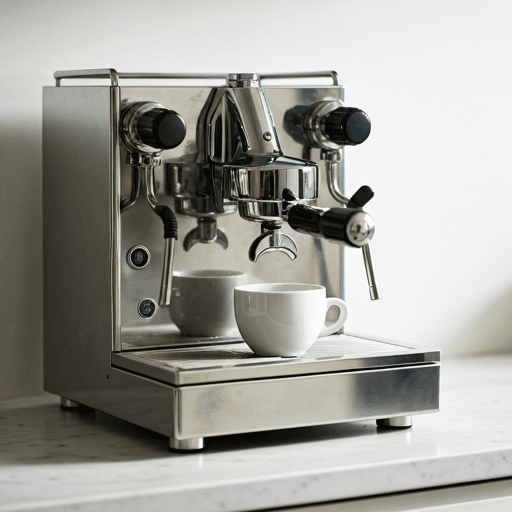
A coffee tamper is the small hand tool that presses your dose of ground coffee into a flat, even puck inside the portafilter, so hot water flows through the bed evenly instead of blasting a channel down one side. Choosing one mostly comes down to matching the diameter to your basket, picking a base shape, and deciding whether you want a calibrated model. The good news: how you tamp matters more than which tamper you own.
This guide covers both. First, what a tamper is and how to choose one. Then a step-by-step on coffee tamping that actually fixes uneven shots.
What a coffee tamper is and why it matters
Pull the basket out of your portafilter and you have a loose pile of grounds. Espresso works by forcing pressurized water through a compacted bed of coffee, and water is lazy: it always takes the path of least resistance. If the bed is loose, uneven, or higher on one side, water tunnels through the weak spot. That is called channeling, and it gives you a thin, sour, under-extracted shot even when everything else is dialed in.
A tamper compresses the dose into a level, uniformly dense puck so the whole surface resists the water equally. That single job is why an espresso tamper is the cheapest piece of gear with an outsized effect on the cup. To see how the tamp fits into the wider workflow, our espresso explainer walks through dose, grind, and extraction together.
How to choose a coffee tamper
There is no single "best" tamper, but there is a right size for your machine and a few features worth understanding. Work through size first, then base shape, then build and any calibration.
Match the size to your basket
This is the one spec you cannot fudge. The tamper diameter must match the inside diameter of your filter basket. Too small and it leaves an uncompressed ring around the edge that channels immediately; too large and it simply will not fit. The standard commercial and prosumer size is 58 mm, but smaller machines use smaller baskets.
| Tamper size | Common on |
|---|---|
| 58 mm | The industry standard: E61 machines, La Marzocco, Gaggia Classic, Rancilio Silvia, most prosumer gear |
| 54 mm | Breville / Sage Barista series (Express, Pro, Touch) |
| 53 mm | Some Breville and other compact machines |
| 51 mm | DeLonghi Dedica and many entry-level home machines |
| 49 mm | Older or very small single-boiler machines |
The numbers on a box are nominal, so do not trust them blindly. Measure your basket's internal diameter and aim for a tamper about 0.2 to 0.4 mm smaller. A snug fit that still drops in cleanly is what you want; a visible gap means trouble.
Base shape: flat, convex, or ripple
The base is the part that touches the coffee, and you will see three styles:
- Flat is the default and the right choice for almost everyone. It applies even pressure across the whole puck face.
- Convex (C-curve) is gently domed and pushes grounds toward the basket wall first. The theoretical benefit rarely shows up at home, and it can hide edge channeling rather than fix it.
- Ripple or grooved bases leave concentric ridges in the puck and claim better water dispersion. In practice the effect is mostly cosmetic.
Material, weight, and handle
Most quality tamper bases are stainless steel; handles range from aluminum and steel to wood and resin. Heavier tampers feel reassuring and let gravity do some of the work, but weight is preference, not performance. What matters is a flat, well-machined base and a handle that sits comfortably so you can press straight down without tilting. Cost tracks materials and machining, from budget all-in-one tampers to premium machined sets, but a mid-range flat 58 mm tamper performs as well as anything for home use.
Calibrated, spring-loaded, and palm tampers
A calibrated or spring-loaded tamper has a mechanism that clicks or stops at a preset pressure, so every tamp lands the same. They are genuinely useful for beginners building muscle memory and for anyone chasing repeatability. A palm tamper is a low, mushroom-shaped tool that sits in your palm; many are self-leveling and are popular in single-dose and WDT workflows. Once your technique is consistent, a plain fixed tamper does the job perfectly.
| Tamper style / base | What it does | Best for |
|---|---|---|
| Flat base | Even pressure across the entire puck | The default; almost every setup |
| Convex (C-curve) | Domed; seats grounds toward the edge first | Niche; marginal benefit at home |
| Ripple / grooved | Leaves textured ridges in the puck | Mostly cosmetic |
| Calibrated / spring-loaded | Clicks at a set pressure | Beginners and consistency |
| Palm tamper | Low, self-leveling, sits in the palm | Single-dose and WDT workflows |
| Fixed flat-handle | Classic tamper, no mechanism | Once your tamp is repeatable |
How to tamp espresso, step by step
Coffee tamping is a quick, repeatable routine, not a feat of strength. Here is the sequence that produces an even puck:
- Dose and settle the grounds. Grind into the basket, then give the portafilter a gentle tap on the bench to settle the bed before you level it.
- Distribute and level first. Most unevenness is fixed before the tamp. Break up clumps and spread the grounds flat using a WDT tool (fine needles stirred through the bed) or a simple side-to-side and front-to-back (NSEW) leveling motion with your finger or a distribution tool. This step prevents more channeling than the tamp itself.
- Seat the tamper level. Rest the base on the coffee and check by eye that it sits flat, not tilted. A tilted tamp creates a dense side and a loose side, which is a direct invitation to channel.
- Press straight down. Push down with steady pressure, keeping the tamper perfectly vertical. Stop when the bed feels firm and stable. Forearm aligned over the tamper, wrist neutral.
- Stop overthinking the force. Aim for a firm, repeatable press and move on (more on the pressure myth below).
- Finish and wipe. A light polish or quarter-turn is optional and, frankly, debated, because twisting can crack the surface; if you do it, keep it gentle. Wipe stray grounds off the basket rim so the portafilter seals cleanly, then lock in and brew.
Bust the "exactly 30 pounds" myth
The most repeated tamping tip is to press with 30 pounds of force, and it is the least useful. There is no magic number, only the point where the puck is stable. What actually matters is that your tamp is level and consistent shot to shot. Bouncing between 28 and 32 pounds will not ruin your espresso; bouncing between 15 and 45 pounds will. Pressing harder does not extract more flavor, it just earns you a sore wrist. Levelness beats force every time.
Common coffee tamping mistakes
- Wrong tamper size. A 57 mm tamper in a 58 mm basket leaves an unpacked ring that channels on every shot.
- Tilted tamp. The single biggest avoidable cause of uneven extraction. Watch the base, not the handle.
- Skipping distribution. Tamping over clumpy, mounded grounds bakes the unevenness in. Distribute first.
- Chasing a pressure number. Consistency and level matter far more than any exact force.
- Tapping the side after tamping. A hard knock to "level" a tamped puck cracks it. Level before, not after.
If you want proof of how your tamp is landing, a bottomless portafilter reveals channeling in real time: an even tamp pours a single steady stream, while a tilted one squirts and sprays. It is the fastest feedback loop in espresso.
Putting it together
A coffee tamper is simple gear with a clear job: match it to your basket, keep the base flat, and tamp level and consistently rather than hard. Get distribution and levelness right and most "bad shot" problems disappear. From here, pull it all together with our guide to making espresso at home, and once you are pulling shots regularly, a coffee knock box makes clearing the spent puck quick and tidy. The tool is small; the technique is everything.