
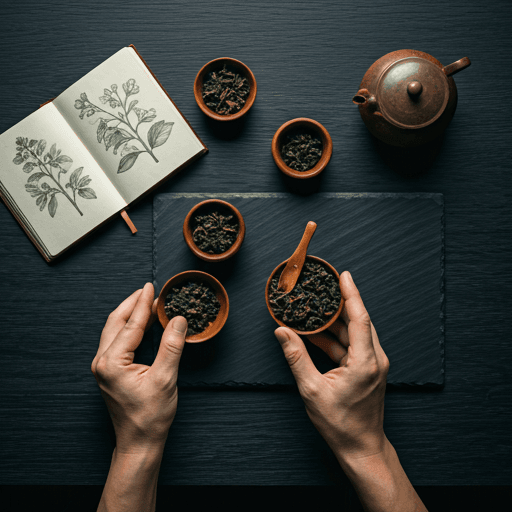
Vietnamese tea is the green, black, and specialty leaf grown across the misty highlands and river valleys of Vietnam, one of the world's largest tea nations. Most of it is drunk as fresh, grassy green tea at home, while a good deal of black and machine-made leaf is shipped abroad. But the reason tea people seek out Vietnam is narrower and more romantic: centuries-old wild tea trees in the far-northern mountains, and a lotus-scented green tea from Hanoi that is one of the most painstaking luxuries in the tea world.
Quick note before we start: this is a guide to the tea, not the famous Vietnamese coffee. Different plant, different subject entirely. Here we are talking about Camellia sinensis and the leaf it makes.
What is Vietnamese tea?
Vietnamese tea is simply tea grown and made in Vietnam, and like all true tea it comes from the Camellia sinensis plant, the same species behind green, black, white, and oolong everywhere. What makes the country distinctive is scale plus a couple of genuinely rare specialties. Vietnam is a heavyweight producer: it is commonly ranked among the world's top five or six tea exporters and the top ten producers, and it is one of the world's leading exporters of green tea specifically. Much of its bulk black and CTC leaf feeds blends and tea bags sold far from Vietnam, while the more interesting single-origin material stays closer to home.
Domestically, green is the everyday cup. Vietnam sits inside the same six-family tea map as everywhere else, so if you want the wider category picture, our guide to the types of tea explained lays it out. What follows here is what is true of Vietnam and almost nowhere else.
Where it grows, and why the land matters
Vietnam runs long and mountainous, and tea climbs the cooler, higher ground away from the tropical lowlands. Gardens spread from the northern hills near the Chinese border down to the Central Highlands. Altitude and cloud do the heavy lifting: cool air and near-constant mist slow the leaf down, concentrating aroma and sweetness, and the highest ancient-tree groves sit close to 1,000 to 1,400 m (roughly 3,300 to 4,600 ft). A handful of regions carry the story:
- Thai Nguyen (northeast) is the heartland of everyday Vietnamese green tea, prized for a brisk cup with a toasted young-rice (com) aroma and a signature bitter-then-sweet finish.
- Ha Giang and Yen Bai (the far north, including the village of Suoi Giang and the Hoang Lien Son range) are the home of the ancient shan tuyet trees, the country's most famous leaf.
- Moc Chau, on the Son La plateau in the northwest, is a cool, misty highland known for oolong and green tea.
- Lam Dong and the Central Highlands make up the largest planted area, turning out much of the black and oolong leaf, some of it on old colonial-era estates.
Shan tuyet: Vietnam's ancient "snow-cloud" trees
This is the fact worth remembering. In the northern mountains grow shan tuyet tea trees, many of them hundreds of years old, some reputed to be older still. The name translates roughly as "snow of the mountain": tuyet means snow, and it refers to the fine silvery-white down that coats the young buds, giving the dried leaf a frosted look. These are not neat waist-high bushes but genuine trees, often several meters tall, so harvesters climb them and pick by hand. The plant is a big-leaf, downy-tipped highland type related to the assamica varietal rather than the small-leaf China bush, which is part of why the cup is so full.
Because the trees stand at altitude in cold, cloud-wrapped forest, pests struggle and many groves are effectively wild and unsprayed. The same leaf is worked into several styles, most often a green tea, but also white, oolong, and even aged pu-erh-like cakes. What ties them together is body: shan tuyet tends to be thick, honeyed, and floral, with a soft sweetness the everyday lowland green teas do not reach. It is Vietnam's answer to the ancient tea-forest teas of Yunnan across the border in China, and it is entirely hand-made.
Tra sen: the lotus-scented green tea of Hanoi
The country's other signature is a luxury of patience. Tra sen is green tea perfumed with lotus, and the most celebrated version comes from around West Lake (Ho Tay) in Hanoi, made with the local hundred-petal lotus, Sen Bach Diep. It is not flavoured with oil or essence. Instead, artisans layer dry tea with the tiny fragrant white anthers from the heart of freshly picked lotus blossoms, the part locals call gao sen, or "lotus rice." The tea drinks in the perfume, the spent flower is removed, and the process is repeated in cycles, traditionally somewhere between five and eight times over roughly three weeks, until the leaf is saturated with scent.
The arithmetic is what makes it a delicacy: it can take well over a thousand lotus blossoms, by many accounts somewhere around 1,000 to 1,500, to scent a single kilogram of tea, and the lotus only blooms for a few weeks in summer. A simpler home version stuffs tea inside a single lotus flower to steep in its fragrance overnight. Either way the result is the same idea: a clean green tea carrying a soft, sweet, heady floral note. It is a close cousin, in method, to the jasmine-scented green teas of Fujian in China, but the flower, and the ritual around it, are unmistakably Hanoi.
Vietnamese tea at a glance
| Aspect | What defines it |
|---|---|
| Main types | Mostly green tea at home; black and CTC leaf largely for export; growing oolong, white, and specialty output |
| Signature specialties | Shan tuyet (ancient wild highland trees) and tra sen (lotus-scented green tea) |
| Key regions | Thai Nguyen (green), Moc Chau/Son La (oolong, green), Ha Giang & Yen Bai (shan tuyet), Lam Dong (black, oolong) |
| Altitude | Lowland gardens up to ancient trees near 1,000-1,400 m (about 3,300-4,600 ft) |
| Plant | Small-leaf and large-leaf stock; shan tuyet is a big-leaf, downy-tipped highland type |
| Flavour | Brisk grassy green with a bitter-then-sweet finish; shan tuyet fuller and honeyed; lotus tea softly floral |
| Caffeine | Present; green tea sits at a moderate level |
| World standing | Among the top tea exporters and producers; a leading exporter of green tea |
What Vietnamese tea tastes like
The everyday Thai Nguyen green is the taste most people mean by "Vietnamese tea": a lively, vegetal, slightly astringent cup that opens with a clean bitterness and closes on a lingering sweetness, carried by that toasted young-rice aroma. It is brighter and more brisk than the mellow, nutty pan-fired greens of China and completely different from the marine, umami-rich steamed greens of Japan. Shan tuyet is the plusher end of the spectrum, thick and honey-sweet with a floral lift and almost no harshness. Lotus tea keeps a green-tea backbone but wraps it in perfume. On caffeine, Vietnamese green behaves like any green tea, present at a moderate level; our green tea guide covers what that means in practice.
How to brew Vietnamese tea
Green tea is the default, and it rewards a gentler hand than black tea. A few simple moves:
- Cool the water. Aim for about 175-185 F (80-85 C) for everyday green and shan tuyet green. Water off a hard boil scorches the leaf and pushes the bitterness too far forward.
- Go light on leaf, short on time. Roughly a teaspoon per cup, steeped 1 to 2 minutes, then taste. Vietnamese greens can turn sharp if oversteeped.
- Re-steep. Good shan tuyet and loose green will give several infusions, each a little different, so do not throw the leaf away after one pour.
- Lotus tea, gently. Treat tra sen like a delicate green and keep the water cool so the floral note stays soft rather than stewed.
For the fundamentals that apply to any whole-leaf tea, see how to brew loose-leaf tea.
How it compares to its neighbours
Vietnam shares a border and a lot of tea history with China's southwestern tea lands, and it shows. Its ancient shan tuyet trees echo the old tea forests of Yunnan, and its lotus scenting rhymes with Chinese jasmine tea. But Vietnam's everyday green has a character of its own, brisker and more openly astringent, with that com sweetness on the finish. Against Japan, the contrast is sharper still: Japanese greens are steamed for a grassy, oceanic taste, while Vietnamese greens are pan- and wok-fired. And where much of the country's black and CTC leaf disappears into anonymous blends, its oolong is a quieter success. If oolong is the piece you want to understand, our oolong tea guide is the place to start, and Moc Chau is the region making it.
The bottom line
Vietnamese tea is two stories at once. One is scale: a top-tier producer whose green tea fills cups at home and whose black leaf travels the world in blends. The other is rarity, and it is the one to chase, ancient snow-cloud trees hand-picked in the northern mountains, and a lotus-scented green from Hanoi built one flower at a time. Start with a fresh Thai Nguyen green to learn the house style, then reach for a shan tuyet or a real tra sen when you want to taste what only Vietnam makes.