
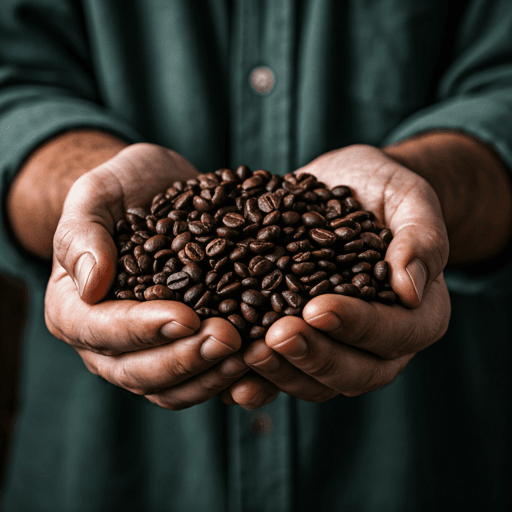
The TR4 coffee variety is not a seed variety at all. It is a selected clone of Coffea canephora — robusta — taken from a single mother tree in Vietnam's Central Highlands and multiplied vegetatively, by rooted cuttings or by grafting, so that every TR4 plant in the ground is a genetic copy of that one original tree. That single fact explains nearly everything else about it.
Arabica varieties travel as seed. You can hand someone a bag of Bourbon seed and, with reasonable care, the seedlings will look like Bourbon, because arabica is self-pollinating and largely breeds true. Robusta cannot do that. It is self-incompatible: a robusta flower will not set fruit with its own pollen, so every seed on a robusta tree is a cross, and every seedling is a genetic gamble. Vegetative propagation is the industry's workaround. A clone is how robusta gets a stable identity at all — and TR4 is one of the best-known examples of it.
What the TR4 coffee variety is, and where it came from
TR4 belongs to a numbered series of robusta selections carrying the "TR" prefix, developed by Vietnam's Western Highlands agroforestry research institute — usually abbreviated WASI — and released for planting in the Central Highlands. Only a handful of the series has a full entry in the main English-language variety catalog; other TR numbers circulate in Vietnamese-language extension material and trade listings without corresponding documentation in English. That asymmetry is worth flagging up front, because it runs through this entire topic: the Vietnamese-language record is much richer than the English one, and English summaries paraphrase it loosely. Even the institute's English name appears in more than one form across sources.
What is reasonably well documented is the selection method. TR4 was not bred by crossing two named parents. It was found. Researchers identified outstanding individual trees within existing open-pollinated production populations — World Coffee Research's catalog entry states that TR4's mother tree originated on a farm in Dak Lak province in the Central Highlands — then put those candidates through comparison and multi-location trials before submitting the best of them for official national variety recognition. That same catalog gives 2006 as the year TR4 was approved as an official national variety. Treat the year as reported by the catalog rather than independently corroborated across sources.
This matters for how you read TR4's "lineage." It does not have one in the arabica sense. There is no named parentage, no cross number, no pedigree diagram. The catalog describes it simply as a selection of a mother tree from an open-pollinated population in cultivation, multiplied vegetatively. If a bag or a nursery list claims a specific parentage for TR4, that claim is not supported by the public record. For the species-level background — where robusta sits against arabica, what it is agronomically, why it dominates certain markets — see what is robusta coffee; this page is about the clone.
Why clonal robusta is a different kind of "variety"
Self-incompatibility is the whole story here. In practical terms it means three things at once.
First, seed is unreliable. Sow seed from a great robusta tree and you get a field of half-siblings, each a different cross, each with a different habit, ripening date, bean size and vigour. A block like that is impossible to manage as one unit and impossible to sell as a named variety.
Second, the fix is vegetative. Take cuttings from orthotropic (upright) shoots and root them under mist, or graft budwood onto a vigorous seedling rootstock, and the resulting plants are identical to the mother. Now a "variety" name means something: a TR4 block ripens together, prunes the same way, and behaves predictably. Grafting also lets a grower keep a root system chosen for one job — vigour, or tolerance of a difficult soil — under a canopy chosen for another. The mechanics of that operation are covered on coffee grafting.
Third, and this is the catch, a single-clone block cannot pollinate itself. Every tree in it is the same genotype and carries the same incompatibility alleles, so a pure stand of TR4 will flower heavily and set very little fruit. World Coffee Research states the point bluntly in its TR4 entry: it must be planted together with other clones to enable fruit set. That is not a footnote — it is a planting instruction. Growers deploy TR4 alongside complementary clones, interplanted so that pollen moves between compatibility groups rather than circulating within one. The design goal is a small, deliberate set of clones known to pollinate one another and to ripen close enough together to be picked in the same passes — not a random assortment of whatever the nursery had available.
Brazil arrived at the same answer independently with its conilon robusta, where clonal blocks and multi-clone planting are also standard practice — see Espírito Santo coffee for that parallel. Two producing countries, no shared germplasm programme, the same structural solution, because the plant's biology forces it.
TR4 at a glance
| Attribute | What the record says |
|---|---|
| Species | Coffea canephora (robusta) — a clone, not a seed variety |
| Type | Selection of a mother tree from an open-pollinated population; no named parentage |
| Origin of mother tree | Reported as a farm in Dak Lak province, Central Highlands, Vietnam |
| Developed by | Vietnam's Western Highlands agroforestry research institute (WASI); English name reported inconsistently |
| Official recognition | Catalog entry gives 2006 national variety approval; not independently corroborated here |
| Propagation | Rooted cuttings or grafting only |
| Pollination | Self-incompatible — must be planted with other compatible clones |
| Plant habit | Catalog lists dwarf/compact; the same entry notes strong secondary branching, and field descriptions emphasise vigour |
| Bean size | Described as medium (a mid-teens screen range in the catalog listing) |
| Reported altitude band | Roughly 500–800 m in catalog listings; typical of Central Highlands robusta country |
| Planting density | Catalog suggests a roughly one-to-two-thousand-plants-per-hectare band under single-stem pruning |
| Leaf rust | Intermediate resistance — not a resistant variety |
| Nematodes, berry borer | Rated unknown; no published assessment |
| Nutrition demand | Described as high; it is a variety that rewards inputs and punishes neglect |
| Documented planting at scale | Vietnam's Central Highlands |
How TR4 behaves in the field — documented versus claimed
The honest summary is that TR4 is described as a vigorous, heavily branching, high-yielding clone with medium beans, wide adaptation across sites, and a healthy appetite for fertiliser and water. Most of that is repeated consistently enough across sources to be usable. Three things deserve more care.
Stature reads differently depending on the source
Catalog listings classify TR4 as dwarf or compact. The same listings also credit it with strong secondary branching, and field and trade descriptions tend to stress a dense, vigorous, well-furnished canopy rather than a small tree. These are not contradictory so much as differently framed: "compact" here is almost certainly relative to older tall robusta selections, and a compact tree with heavy secondary branching still needs real pruning discipline. If you are reading a variety sheet for planting purposes, the local extension recommendation on spacing and stem count beats any English-language summary, including this one.
Yield numbers exist but are ceilings, not expectations
You will find specific per-hectare yield figures for TR4 in circulation, including in the main variety catalog. They come from trial and demonstration conditions under full management: good clone-mix design, irrigation, nutrition, pruning, healthy soil. They are potential, not a forecast, and they are the single most misquoted class of number in variety literature. A clone does not deliver a yield; a management system does, and the clone sets the ceiling. Treat any headline figure attached to TR4 as a research result rather than a promise, and be especially wary of one quoted without the management assumptions attached.
It is not a disease-resistant variety
This is the correction most worth making. Popular listings tend to blur the TR series together and attribute "good rust resistance" across the board. The catalog rates TR4's coffee leaf rust resistance as intermediate — better than nothing, well short of resistance — and it rates the other well-documented clones in the series the same way, so there is no rust-proof member of the family to switch to. For nematodes, coffee berry borer and other pressures, the catalog answer for TR4 is simply "unknown," which is a real and honest answer: nobody has published a rating. Planting TR4 and skipping monitoring on the assumption that a modern clone is protected would be a mistake.
What clonal replanting actually looks like
TR4's role is best understood through replanting. Robusta plantings decline with age: yields fall, trees accumulate disease and borer damage, canopies get woody and unproductive, and stumping only buys so much time. Large parts of Vietnam's robusta area were established in a compressed boom period, which means large parts of it aged out at roughly the same time — the reason a national replanting effort became a policy priority through the 2010s, targeting the main Central Highlands provinces.
In practice, replanting with a clone runs roughly like this:
- Clear and rest the land. Old trees come out; the ground is often rotated or fallowed to knock back nematodes and soil-borne disease before new coffee goes in.
- Source real planting material. Rooted cuttings or grafted plants from an accredited nursery. This is where clonal systems succeed or fail — mislabelled material is a permanent problem, because you will not discover it for years.
- Design the clone mix. Several complementary clones planted in a deliberate pattern so cross-pollination works, rather than one clone in a solid block.
- Set spacing and stem count together. Density and pruning system are one decision, not two: the catalog band for TR4 assumes single-stem pruning, and a multi-stem system implies a different plant population.
- Wait. New plants typically carry their first meaningful crop a couple of years after planting, and take longer to reach full bearing. That gap is the real barrier to replanting, and it is why growers hesitate to pull out trees that are still producing something.
Vietnam's answer to that bottleneck was TRS1, a seed-propagated polyclonal variety. The variety catalog lists TR4, TR9, TR11 and TR12 as its parent clones, established in polyclonal seed gardens where the clones interpollinate and the resulting seed is harvested and distributed. Seed can be multiplied and shipped far faster than rooted cuttings, so a seed variety can supply a replanting programme at a speed clonal nurseries cannot match — at the cost of the uniformity a clone guarantees, because polyclonal seedlings vary. That trade-off, fidelity versus scale, is the central tension in robusta planting material, and TR4 sits on both sides of it: a clone in its own right, and a parent of the seed variety built to outrun clonal nursery capacity.
What a grower gains and gives up with a single clone
| Gains | Gives up |
|---|---|
| Uniform ripening — fewer, cleaner picking passes | Uniform vulnerability — one pest or disease can hit every tree equally |
| Predictable stature, pruning and spacing | Dependence on nurseries for true-to-type material |
| Consistent bean size and lot presentation | No seed saving; you cannot propagate a clone from its own seed |
| Known performance ceiling to plan management around | A narrow genetic base across a whole region if everyone plants the same few clones |
That last row is the strategic risk in clonal robusta. Vietnamese robusta is generally described as descending from a limited founding introduction rather than from a broad sample of the species' African diversity, and large-scale clonal replanting can narrow that base further. The counterweight is deliberate diversity in the clone mix, plus newer selections aimed at drought and heat tolerance rather than yield alone.
What TR4 tastes like — in honest terms
Nothing in the public record supports a cup-score claim for TR4, and you should be sceptical of any you see; catalog entries speak in general terms about yield and quality being high and stable, which is a breeding assessment, not a cupping result. What can be said fairly is that well-grown, properly ripe-picked and carefully dried robusta of selected clonal origin gives a heavier body, lower perceived acidity, more grain, cocoa and dark-woody character, and a longer, more bitter finish than arabica. Poorly processed robusta gives rubber, wood and harshness — and that difference is mostly picking and drying, not genetics.
Which is the point that matters most for anyone reading a label: a variety name is not a quality grade. TR4 on a bag tells you about plant genetics and, indirectly, about a farm that replanted with certified material. It tells you nothing about ripeness at harvest, drying discipline, storage or roast. Two lots of the same clone from neighbouring farms can be a full grade apart. For how Vietnamese robusta reaches the cup more broadly — regions, processing and the trade around it — see Vietnamese coffee beans.
How TR4 sits among its documented siblings
| Selection | How the catalog record describes it |
|---|---|
| TR4 | Selected clone; high yield, wide adaptation, strong secondary branching, medium beans, intermediate rust resistance |
| TR9 | Selected clone approved later than TR4; large beans, very high yield and cup quality, rust resistance also rated intermediate |
| TR11 | Selected clone approved alongside TR9; listed as tall rather than compact, medium beans, very high yield and quality, intermediate rust resistance |
| TR12 | Named as one of the parent clones of the TRS1 seed variety; its own catalog record is thinner |
| TRS1 | Not a clone — a seed-propagated polyclonal variety from TR4, TR9, TR11 and TR12, for fast, large-scale seedling supply |
| Other TR numbers | Circulate in Vietnamese-language sources and trade material; not documented in the English-language catalog and best treated as unverified here |
A caution on distribution claims: variety catalogs sometimes list a clone as "commercially available" in a long list of producing countries. Availability from a nursery or a germplasm collection is not the same as a documented planted area, and the two are routinely conflated. The place TR4 is verifiably grown at scale is Vietnam's Central Highlands, and a claim that it is an established commercial planting anywhere else needs its own evidence.
Bottom line
TR4 is worth understanding less as a variety and more as an argument. Robusta cannot fix its own genetics through seed, so the entire concept of a named robusta variety rests on cuttings and grafts — and the moment you fix the genetics, you also fix the weaknesses and lose the plant's ability to pollinate itself. TR4 is what that compromise looks like in the field: a strong, well-tested, input-hungry, only moderately rust-tolerant clone that has to be planted in company to produce a crop at all. The English-language record on it is thin, and thinner still for most of its siblings. What is solid is the shape of the system around it, and that shape is the same wherever robusta is grown seriously.