
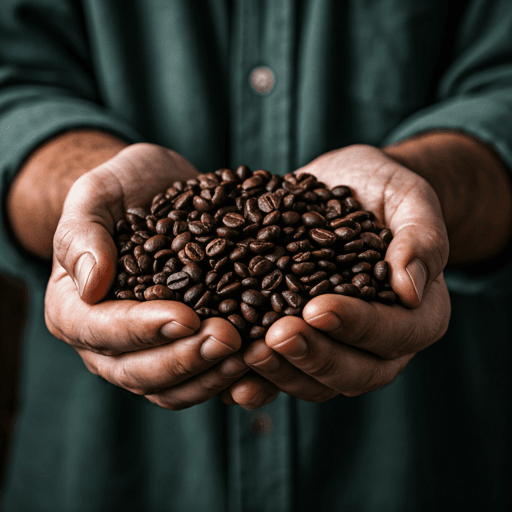
Seychelles coffee is not an industry. The archipelago produces a negligible quantity of coffee — so little that it does not appear in the standard international production tables at all — and what does exist on the islands is best understood as heritage and hospitality rather than agriculture. The Seychelles import their coffee, as they import most of their food, and that is a rational outcome rather than a failure.
What makes this origin worth a page is the reason behind the absence. Most small or vanished coffee origins have a hardship story: the trees died, the buyers left, a rival crop paid better, a disruption emptied the countryside. The Seychelles story is the opposite, and it is genuinely unusual. Here, coffee did not lose to another crop. It lost to the entire economy moving somewhere else.
Why Seychelles coffee never became a crop
Three things have to line up before a country develops a coffee sector: land that suits the plant, labor that is worth more in the field than elsewhere, and a reason to prefer growing over importing. The Seychelles fail all three, and the third one decisively.
The granitic inner islands — Mahé, Praslin, Silhouette and their neighbors — are geological oddities. They are the world's only mid-ocean islands built on ancient continental granite rather than on young volcanic rock or coral, which gives them dramatic scenery and comparatively thin, quick-draining soils on steep ground. The interiors rise abruptly from narrow coastal plateaus into forested ridges. There is very little flat arable land anywhere in the country, and what flat land exists sits close to the sea, where every other possible use competes for it.
Then there is what sits on the slopes. An unusually large share of the national land area is under formal protection — commonly reported at more than two-fifths of the country's territory, which puts the Seychelles among the most heavily protected states anywhere. On Mahé the mountainous interior is national park; Silhouette is very largely national park as well. The very ground a coffee agronomist would look at first — cooler, shaded, well-watered upland — is the ground that conservation policy has spent decades keeping out of cultivation, because it holds the last significant stands of endemic forest. Coffee is not being kept out by hostility to farming. It is being kept out by the fact that the islands' upland forest is worth more standing.
Climate is the least of the obstacles. The Seychelles are hot, humid and close to the equator, with no real cool season. Arabica generally wants elevation to compensate for low latitude, and the country's high ground is limited in extent, protected, and steep. Robusta tolerates lowland heat far better, but a lowland robusta block on land within sight of the water is competing against uses that will always out-bid it. If you want the underlying theory of why site, altitude and climate interact the way they do, that argument belongs to coffee terroir rather than to this page.
What the islands actually farmed
Coffee was present in the early colonial period, but never central. Nineteenth-century accounts of the islands list coffee inside a mixed basket — cotton, spices, coffee, tobacco, rice, maize and coconuts — grown in the decades before roughly 1850. Coffee is mentioned in the same breath as half a dozen other experiments, not as a pillar.
Two things then pushed the islands away from crops like coffee. The first was labor. Emancipation in the 1830s removed the coerced workforce the early plantation system had been built on, and the standard account of the period is that planters responded by shifting out of cotton and grains and into crops that needed far fewer hands per unit of output. Coffee, which needs many hands at precisely the wrong moment, was on the losing side of that shift.
The second was freight. The crops that actually made the colonial economy were cinnamon, which naturalized so thoroughly on the hillsides that harvesting it became a low-input rural occupation; coconut, processed into copra, which dominated exports for decades; vanilla, which surged late in the nineteenth century; and patchouli, grown for the perfume trade, which had its own run in the mid-twentieth century. Each was better suited than coffee to a small, remote, labor-scarce archipelago. Cinnamon grew semi-wild. Copra was storable and shippable. Vanilla and patchouli packed extraordinary value into very little weight.
That last point matters more than it looks. For an island group far from any major buyer, freight economics reward crops with a high value-to-weight ratio. Coffee, sold as a bulk agricultural commodity, is exactly the wrong shape for that constraint — heavy, storable but not precious, and measured against enormous continental producers. Vanilla and perfume oils were the right shape. Coffee was not, and the planters appear to have worked that out early.
The spine: an island that stopped needing agriculture
The plantation economy did not so much collapse as get out-competed. Through the middle of the twentieth century roughly a third of the workforce still worked on estates. Then the international airport opened in the early 1970s, and within a generation the country's economic center of gravity moved to tourism and industrial fisheries. By the mid-2000s the share of the labor force in plantation agriculture had fallen to a small fraction of what it had been, and agriculture now contributes only a minor slice of national output.
Three displacements did the work, and they are worth separating because together they explain the whole page.
Land. In a country where flat ground near the coast is scarce, that ground has an obvious highest-and-best use, and it is not a coffee block. A parcel of accessible coastal or near-coastal land supports accommodation, services and infrastructure. Nothing an agricultural crop can produce competes with that. Coffee also needs land for years before it yields anything at all — several seasons from planting to a first real harvest — which makes it the least competitive possible claimant on contested ground.
Labor. The Seychelles have the highest income per person in Africa, built on services. A young Seychellois can work in hospitality, fisheries, logistics, public administration or the financial sector. Coffee is one of the most labor-intensive crops in world agriculture — selective hand picking, repeated passes through the same trees, careful post-harvest work, all of it concentrated into a few weeks. That labor profile only functions where field work is competitive with the alternatives. In the Seychelles it is not, and no amount of enthusiasm changes the arithmetic. The same constraint that emancipation exposed in the 1830s is still the binding one, for entirely different reasons.
Food strategy. A small archipelago that imports the large majority of its food — commonly reported at around nine-tenths of what is consumed — is not making an error. At this scale, importing is cheaper, more reliable and less land-hungry than domestic production for most commodities, and the scarce land that is farmed goes to vegetables, fruit and livestock, where freshness actually rewards growing on the islands. Coffee is among the easiest things to import, since green coffee ships and stores well and comes from dozens of competing suppliers. There is no food-security argument for domestic coffee, no import-substitution argument, and no export argument. The crop simply has no job to do.
At a glance: what the Seychelles have versus what coffee needs
| What a coffee sector needs | What the Seychelles have | Verdict |
|---|---|---|
| Substantial arable land | Steep granitic interiors, narrow coastal flats, very little cultivable area | Missing |
| Accessible cool uplands | Limited high ground, much of it inside national parks | Effectively off-limits |
| Available, affordable field labor | High-income service economy with better-paid alternatives | Missing |
| An economic reason to grow rather than import | Most food imported by policy and by logic | Absent |
| Freight economics that suit a bulk crop | Remote islands that historically favored high-value, low-weight exports | Unfavorable |
| Export infrastructure for green coffee | Built around tuna, tourism and inbound goods | Not applicable |
| A domestic reason to keep trying | Scarce farmland better used for perishables | Works against coffee |
What coffee actually exists in the Seychelles today
Here the public record thins out badly, and it is better to say so than to invent. What can be said with reasonable confidence is that any coffee growing in the Seychelles is small-scale: garden and smallholding plantings, heritage interest around historic estate properties, and occasional demonstration or interpretive plantings of the sort that sit alongside cinnamon, vanilla and coconut in agricultural heritage settings. National agricultural summaries of the country list coconut, cinnamon, vanilla, tea, fruit and vegetables; coffee generally does not appear in them at all.
Coffee is nonetheless reported by an assortment of travel and lifestyle pages to be grown in small quantities on Mahé, often with a confident variety name and a confident flavor description attached. Those reports are not supported by production statistics, and several of them visibly repeat one another. One recurring tell is worth naming: some of these descriptions identify the "main growing region" of Seychellois coffee using a place name that actually belongs to Mauritius, a different island group with a genuine, documented micro-plantation of its own. Another strand of the same material asserts a nineteenth-century liberica episode in the islands without pointing at a source. Treat any confident description of a Mahé coffee estate, a named cultivar or a defined cup profile with real caution.
What is far better documented is the other direction: the Seychelles import coffee, and the visible coffee culture of the islands is a consumption culture. Coffee is encountered as a hospitality product — served, brewed, presented — rather than as a farm output. If a visitor drinks something described as Seychellois coffee, the honest assumption is that it is either a very small heritage planting, a blend, or imported green coffee roasted on the islands. None of those is dishonest in itself, but none of them constitutes an origin in the sense that a coffee buyer means the word.
There is no evidence in the public record of a commercial Seychelles coffee export trade, no established grading system, no harvest calendar worth publishing, and no defensible regional flavor profile. Saying so plainly is more useful than manufacturing one.
Indian Ocean island coffee: how the Seychelles sit among their neighbors
The western Indian Ocean is a real coffee region, but the Seychelles are not part of it in any production sense.
- Madagascar is the regional heavyweight and the obvious contrast: a large landmass with genuine highland and lowland growing zones and a functioning, if volatile, export sector. It is a coffee country in a way the Seychelles have never been.
- Coffea mauritiana is the regional reminder that the western Indian Ocean islands are a center of endemic wild coffee diversity — a species reported from the Mascarenes, not from the Seychelles, and there is no basis for implying it grows here.
- St Helena is the emblematic remote-island micro-origin, and its one transferable lesson is the economics of micro-volume: extreme remoteness plus tiny output means an origin only works when scarcity itself is the product.
The botanical footnote: conservation, not commerce
The islands of the western Indian Ocean are one of the world's centers of wild Coffea diversity, with a large share of described species occurring on Madagascar, the Mascarenes and the Comoros. The Seychelles' role in that story is not a production role and, on the available record, not obviously a wild-coffee role either. The archipelago is not usually listed among the recognized centers of Coffea endemism; its own celebrated endemics in the coffee family belong to other genera entirely. Any claim that a particular endemic Coffea species occurs in the Seychelles should be treated as reported rather than established.
What the Seychelles do have is an extraordinary endemic flora of their own and an unusually strong conservation regime around it. The relevant point for coffee is structural: in an archipelago where the botanical priority is protecting what is already there, the interest in Coffea and its relatives is a conservation and biodiversity interest, not a commercial one. That is a legitimate contribution to the coffee world. It is simply not an agricultural one.
Could Seychelles coffee ever become an industry?
Almost certainly not, and it is worth being clear about why the usual optimistic answers do not apply.
The specialty-scarcity argument — that a tiny, remote origin can succeed precisely because it is tiny and remote — is the one route that is not absurd. It has worked elsewhere for micro-origins. But it requires a critical minimum: enough trees to make a repeatable lot, consistent post-harvest processing, someone whose full-time job is the crop, and a market willing to pay extra for the story. In the Seychelles, the land constraint caps the first, the labor constraint blocks the third, and the same visitor economy that would happily pay for the story is exactly what makes the land and labor unavailable. The demand and the supply obstruction come from the same source. That is a tighter trap than most marginal origins face.
A more plausible future is smaller and more honest: heritage plantings maintained for interpretation and cultural continuity, alongside cinnamon and vanilla, with coffee treated as part of the islands' agricultural memory rather than their agricultural present. Working plantation-era properties already function that way for other crops. That is a real thing, it is worth doing, and it does not require anyone to pretend that a coffee industry exists.
Climate pressure argues the same way. Warmer conditions, erratic rainfall, saltwater intrusion on low-lying farmland and increasing storm exposure are not making small equatorial island agriculture easier, and where scarce land must be allocated, food crops have a stronger claim than a beverage crop that can be imported without difficulty.
The bottom line
Seychelles coffee is a footnote, and the footnote is the interesting part. This is not a country that failed at coffee; it is a country that succeeded at something else so thoroughly that agriculture itself became optional. Granite, slope and protected forest limited where coffee could ever have gone; colonial-era labor and freight economics preferred cinnamon, copra and vanilla; and then tourism and fisheries out-bid farming for land and labor outright. If you are offered Seychellois coffee, enjoy it, ask what it actually is, and do not expect a documented origin behind it. The absence is not a gap in the record. The absence is the record.