
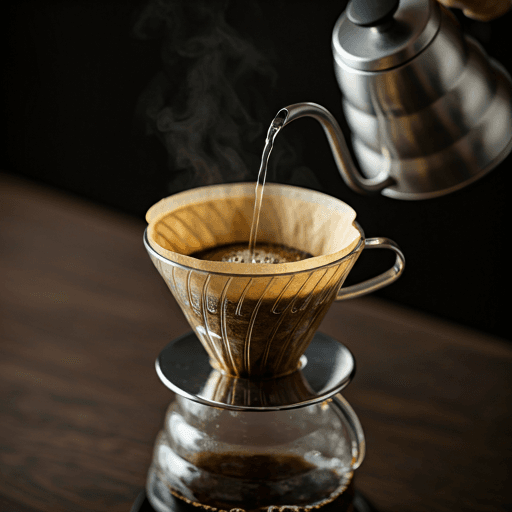
Pour over vs drip coffee comes down to one simple thing: who is holding the kettle. Both methods brew the same fundamental way — hot water passes through a bed of ground coffee and a filter, then drips into the vessel below — so the difference between pour over and drip coffee is not really the chemistry, it is who controls the pour. Pour-over is a manual method where you pour the water by hand for a bright, clean, nuanced cup, while a drip coffee maker is an automatic machine that heats and pours the water for you at the push of a button, trading some control for convenience and volume.
Pour over vs drip coffee: the short answer
The whole debate around pour over vs drip coffee can be summed up in two words: control versus convenience. With pour-over, you decide the grind, the water temperature, how you wet the grounds, and how fast the stream flows — every choice nudges the flavor. With a drip machine, those decisions are baked into the appliance, and you simply add water and grounds and walk away. Neither is “wrong.” One is a hands-on ritual that rewards attention; the other is a reliable pot you can start half-asleep. Which one suits you depends far more on how you like to spend your morning than on any rule about “good” coffee.
Both belong to the same family, too. Pour-over is technically a form of drip brewing — gravity pulls water down through grounds and a filter in both cases. The split is simply manual pouring versus an automated one, and that single difference ripples out into taste, effort, gear, and how much coffee you make at once.
What pour-over coffee is
Pour-over is a manual brewing method: you set a filter into a cone-shaped dripper, add ground coffee, and slowly pour hot water over it by hand, usually in a steady spiral. Popular drippers include the single-cone Hario V60 and the elegant glass Chemex, and most sessions make one or two cups at a time rather than a full pot. Because you are in charge of every step — the initial “bloom” that wets the grounds and lets them release gas, the pour rate, the water level, and the total brew time — you can tune the cup to taste from one brew to the next.
That control is the appeal. Slow down the pour and you extract more; speed it up and you get a lighter, brighter result. The trade-off is that pour-over asks for your hands and a few minutes of attention, and it typically needs a gooseneck kettle for an accurate stream. If you want the full step-by-step ritual, our pour-over coffee guide walks through the technique in detail — this article stays focused on how the method compares to automatic drip.
What drip coffee is
Drip coffee, in everyday use, means coffee made by an automatic drip machine — the classic countertop coffee maker with a water reservoir, a heating element, a filter basket, and a glass or thermal carafe. You fill the reservoir, add grounds to the basket, press a button, and the machine heats the water and showers it over the grounds, letting the brewed coffee drip into the carafe hands-free. It is the workhorse of home and office kitchens precisely because it is so undemanding: measure, press, and come back to a full pot.
The strength of drip is consistency and scale. The same machine, the same button, roughly the same cup every day, and often eight to twelve cups in one cycle. For a fuller look at what defines the style, see what is drip coffee, and for choosing a machine, our drip coffee maker guide covers the features that matter — we will not rehash either here.
The key difference: control versus convenience
Strip everything else away and the drip vs pour over question is manual control against automatic ease. In pour-over, you are the machine: you choose how the water meets the coffee and can adjust mid-brew. With an automatic drip maker, the appliance makes those calls the same way every time, so you gain repeatability and lose the ability to fine-tune. This is why baristas and hobbyists gravitate toward pour-over when they want to chase a specific flavor, while busy households lean on drip when they just want reliable coffee without thinking about it.
Pour-over vs drip coffee compared
| Attribute | Pour-over | Drip (automatic) |
|---|---|---|
| Who pours the water | You, by hand | The machine |
| Method type | Manual drip | Automatic drip |
| Typical batch size | 1–2 cups | A full pot (often 8–12 cups) |
| Control over the brew | High — grind, temp, pour, timing | Low — preset by the appliance |
| Flavor tendency | Cleaner, brighter, more nuanced | Consistent, rounded, can taste flatter |
| Effort per cup | Hands-on for a few minutes | Press a button, walk away |
| Attention needed | Yes, rewards technique | No, largely unattended |
| Core gear | Cone dripper, gooseneck kettle, filters | Countertop machine, filters |
| Best suited to | A mindful single cup | Fuss-free volume for a group |
Treat the flavor rows as tendencies, not guarantees — a skilled hand can pull a dull cup from a fancy dripper, and a well-made drip machine can brew a genuinely delicious pot. Results vary with the beans, the grind, and the specific equipment.
Taste: which cup tastes better?
Because you control saturation and timing, a good pour-over tends to be cleaner, brighter, and more nuanced, with the delicate top notes of a coffee coming through clearly — it is the method people reach for to show off a single-origin bean. Drip coffee, by contrast, is often described as consistent and mellow but a touch flatter, partly because the automated water flow is less even than a careful hand pour.
Water temperature is the other big factor. Coffee generally extracts best around 195–205°F (about 90–96°C). Many inexpensive drip machines under-heat the water, sometimes reaching only the 160s or 170s, which can leave the brew under-extracted and a little dull or harsh. A better machine that hits proper temperature narrows the gap considerably. So the honest answer to “is pour over better than drip” is: pour-over gives you a higher ceiling for a bright, expressive cup, but a quality drip maker with hot enough water can be excellent — and far more convenient.
Effort and volume
This is where the practical difference bites. Pour-over rewards attention one cup at a time; it is a small ceremony, wonderful when you have a quiet ten minutes and less appealing when three people want coffee at once. Drip flips that: it makes a whole pot unattended, so it scales effortlessly for a family, a house full of guests, or an office. If your mornings are a scramble, the machine's walk-away convenience is hard to beat. If brewing is part of how you slow down, pour-over's hands-on rhythm is the point rather than a chore.
Gear and cost
Pour-over has a low barrier to entry in terms of equipment — essentially a cone dripper and filters — though most people add a gooseneck kettle for pour accuracy and a scale for consistency, and it is worth a decent grinder since fresh grounds matter. A drip setup is a single countertop appliance plus filters; it takes up more space and has moving parts to clean and eventually replace, but it consolidates the kettle, timer, and brewer into one device. Both can be simple or elaborate depending on how deep you go, so there is no single “cheaper” answer — it depends entirely on which pieces you already own and how far down the rabbit hole you travel.
Which should you choose?
Choosing pour over or drip coffee is really about matching the method to your life. Reach for pour-over if you enjoy the process, drink one or two cups at a time, want maximum control over flavor, and like coaxing the best from special beans. Reach for a drip machine if you value convenience, brew for more than yourself, want a consistent cup with zero fuss, or simply do not want to stand over a kettle before you are fully awake. Plenty of people keep both: a drip maker for weekday volume and a dripper for a slow weekend cup.
It is also worth remembering that pour-over is not the only manual method worth comparing. If you are weighing hands-on brewers against each other, our look at pour-over vs French press covers a different fork in the road — full immersion versus the clean, filtered clarity of a pour.
The takeaway
Pour over vs drip coffee is not a fight between good and bad coffee — it is a choice between how much you want to be involved. Pour-over hands you the controls and rewards care with a brighter, more expressive cup; automatic drip hands the controls to a machine and rewards you with a reliable pot and your time back. Decide how you like to spend the few minutes before that first sip, and the “right” method chooses itself.