
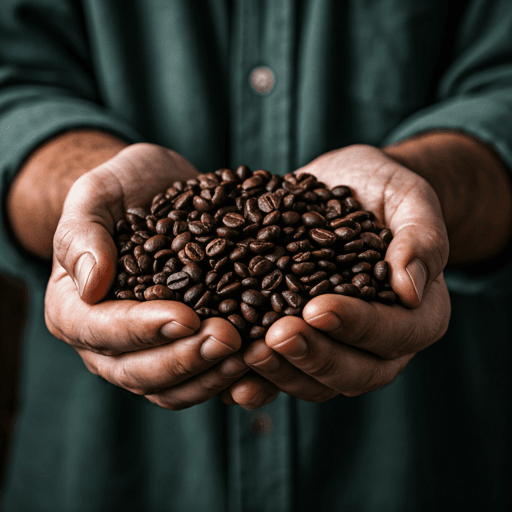
The potato defect is a cup fault — most often reported in coffees from the African Great Lakes region — in which one affected bean gives the finished drink the smell of raw, freshly peeled potato. It is not a roasting mistake and not a brewing error. A single affected bean can carry a whole cup, and the reason it gets that far is uncomfortably simple: that bean looks exactly like every other bean in the bag.
The trade shortens it to PTD, for potato taste defect; PTD coffee is loose shorthand for lots from origins where the fault is known to appear. If you have ever ground a bag and thought this coffee tastes like potato, or caught a raw potato smell rising off a fresh brew, this is what you met.
What the fault actually smells like
The descriptor is unusually literal. Affected coffee smells of potato that has just been peeled — the wet, starchy, faintly earthy air above a peeling board, or the water potatoes have been sitting in. Some tasters land on green pea or pea pod; a few get closer to green capsicum. The common thread is a cold, raw vegetable character in a drink meant to smell roasted.
Two things surprise people who meet it for the first time. It is not subtle — roasters describe catching it from across a room the moment a grinder runs, and anyone worrying they might be missing it almost certainly is not. And it is an aroma before it is a taste: you get it in the dry grounds, then in the steam, and only then as a flat vegetal weight on the palate. It does not read as damage the way sour, ashy or medicinal notes do; it reads as though a different vegetable had been quietly added.
It is also intermittent, which separates it from nearly everything else that goes wrong. A lot-wide fault tastes the same in every cup from the bag. This one turns up once and then does not reappear for a week.
Why the potato defect defeats sorting
Coffee has built an elaborate apparatus for removing bad beans, and nearly all of it works on what a bean looks like or how it behaves physically: cherries floated so the light ones separate, hand-picking off drying tables and belts, screening for size, density tables, and optical and laser sorters that eject anything the wrong colour. Grading then counts what remains — the taxonomy of blacks, sours, broken and insect-damaged beans is covered in our guide to coffee defects and how they are graded.
Every one of those controls is blind to this fault. An affected bean is commonly described as visually indistinguishable from a sound one: same colour, same size, no reliable difference in density. Some beans that carry it do show insect damage or a discoloured patch, and those get removed — but the fault does not require a visible mark, so removing the marked ones lowers the odds without closing the door. Screens, gravity tables and colour sorters are very good at their jobs and simply have nothing to work with here.
A compound that passes straight through the roast
The aroma is generally attributed to a methoxypyrazine, usually named as 2-isopropyl-3-methoxypyrazine and shortened to IPMP — sources number it both ways, and you will also see it written as 3-isopropyl-2-methoxypyrazine. A close relative, 2-isobutyl-3-methoxypyrazine, the green-capsicum note familiar from some wines, is also reported in affected samples. Both are extraordinarily potent odorants that register at trace concentrations, which is exactly why one bean's worth is enough to define a cup.
What matters for sorting is that the roast does not get rid of it. Methoxypyrazines are commonly described as thermally stable, and affected coffee is affected after roasting as surely as before. Sources differ on the detail. Some describe the compound as already present in the green seed, with the roast merely revealing what was always there; others describe it as forming as the bean heats. Laboratory analysis by gas chromatography is generally reported as the only reliable way to identify the fault in green coffee, which sits more comfortably with the first account, while trade descriptions of the note appearing under heat sit with the second. The practical consequence survives the disagreement intact: the one process that rebuilds almost every aroma compound in a coffee bean — creating some from nothing, driving others off entirely — leaves this one alone. Most taints are at least blunted by heat. This one arrives on the other side undiminished.
Detection is therefore retrospective
Put those two facts together — nothing to see in the green bean, nothing removed by the roast — and the consequence follows. Laboratory instruments can find the compound, but that is a destructive test on a small sample, not something a whole container can be passed through bean by bean, and no commercial sorter reads aroma chemistry at line speed. So the fault is found the way a dropped glass is found: afterwards. You grind the coffee and smell it, or you brew it and smell that. By then the coffee is made.
Sampling makes this worse rather than better. A buyer's sample is a small scoop from a very large lot. If affected beans are scattered rarely and at random, a clean sample is not evidence of a clean lot, and a sample containing one is not proof the lot is bad. Published estimates of how often the fault occurs vary between sources and are best treated as rough orders of magnitude rather than figures anyone can plan around. Cupping a lot is, in this one respect, a lottery.
What that does to everyone in the chain
The picker cannot see it, so care at harvest can only target the wounded and unripe cherries it travels with. The mill's sorters cannot see it, so their work reduces exposure without finishing the job. The grader has no box on the form for it, because the grading system counts visible defects. The roaster cannot certify its absence, however careful the sourcing. And the barista meets it perhaps one cup in some unknown number, usually with a customer waiting, with no way of knowing whether the problem is this bag, this dose, or the dose before it.
That last point matters mechanically. In whole-bean form the fault is reported to stay put — it does not migrate between beans in a hopper. Grinding spreads it: one affected bean ground into a dose distributes the compound through all of it, and residue in the burrs and chute can carry into the next dose, so a single bean can look like a run of three. Purging the grinder after an affected dose is standard practice for exactly that reason.
At a glance
| Question | Answer |
|---|---|
| What it is | A cup fault: a raw-potato aroma carried by individual beans |
| Primary aroma | Freshly peeled potato; sometimes green pea or capsicum |
| Compound named | A methoxypyrazine, usually identified as IPMP |
| Where reported | Mainly Rwanda, Burundi, eastern DR Congo and Uganda; source lists differ at the edges |
| Visible in green coffee | No — described as indistinguishable from sound beans |
| Survives roasting | Yes; methoxypyrazines are described as thermally stable |
| Removed by sorting | Not reliably; colour, size and density controls cannot see it |
| When it is detected | After grinding or brewing, by smell |
| Nature of the problem | A flavour fault, not a safety problem |
| Realistic controls | Field and mill practice upstream; smelling grounds downstream |
The causal chain, as far as it is agreed
The outline most sources accept has three steps: something wounds the coffee cherry, microorganisms enter through the wound, and the compound ends up in the seed. Beyond that, the record is genuinely unsettled, and the confident single-sentence explanations in circulation are running ahead of the evidence.
The insect most often named is the antestia bug, a shield-shaped stink bug that feeds on developing cherries and is a serious pest across the same region — its biology, life cycle and field management are covered in our guide to the antestia bug. Survey work has repeatedly linked the fault's incidence to antestia numbers and feeding damage, and that is the association reported most consistently. Other insects that pierce or bore into the cherry, the coffee berry borer among them, have been raised as possible routes in, but the evidence tying them to this particular fault is thinner.
The microbial half is less settled than it is usually presented. A species in the genus Pantoea has been formally described and named for its association with the fault, and is now widely cited as the cause. But survey work sampling affected beans has recovered a mixed community of Enterobacteriaceae rather than a single organism, stopping short of confirming that species as the culprit — one such effort noted it could not establish whether the beans had been invaded through insect feeding or by some other route. Other work has gone looking at the fungi present in affected beans instead. The tidy one-organism story is the leading hypothesis, not a closed case.
A second disagreement concerns who actually makes the compound. One account has the microorganisms synthesising it inside the bean; another has the plant producing it as a wound or stress response to being fed on. These are not the same claim, and they imply different points of intervention. Experimental work has also reported the fault appearing after purely mechanical damage to cherries, with no insects involved at all — which, if it holds up, shifts the emphasis away from one particular insect and towards the wound itself, whatever makes it.
Treat any unqualified explanation with caution, then. The chain from wound to cup is well attested in outline. The specifics — which organisms, by which route, and whether the insect is cause or courier — are still being argued.
Why some regions and not everywhere
The fault is reported overwhelmingly from the African Great Lakes: Rwanda, Burundi, eastern DR Congo and Uganda, with occasional reports from Tanzania and Kenya. The first two are among the most admired washed-arabica origins anywhere in their own right — see our guides to Rwandan coffee and Burundi coffee for what those cups are like.
The geography is a genuine puzzle. Antestiopsis species occur in coffee across much of Africa, so the presence of the insect alone does not explain why the fault concentrates where it does. Proposed contributors include which species of the bug dominates locally, altitude and climate favouring larger populations, canopy density and pruning practice, and which microorganisms happen to be present in a given growing environment. None has been established as the deciding one.
Reporting is also not neutral. Where the fault is named and screened for, it gets recorded; where nobody is looking, an odd cup is written off as something else. The regional pattern is well attested at its core, and rests on much thinner documentation at its edges — which is why lists of affected origins differ from source to source.
Telling it apart from other green and vegetal notes
Several faults produce something a taster might call green, and they are told apart less by the note itself than by how it behaves across a bag.
| Fault | What it smells like | Visible? | Pattern across the bag |
|---|---|---|---|
| Potato defect | Raw peeled potato, pea pod, cold and starchy | No | Intermittent — one cup affected, the next clean |
| Quakers (underdeveloped beans) | Papery, cereal, raw peanut; no sweetness | Yes — pale after roasting | Scattered, but you can pick them out of roasted beans |
| Baggy or aged green coffee | Flat, cardboard, old sack, woody | Green beans often faded | Consistent — every cup from the lot |
| Grassy from an underdeveloped roast | Hay, cut grass, raw cereal | Roast colour often light | Consistent, and changes when the roast changes |
| Mould or must | Damp cellar, mildew, stale earth | Often discoloured beans | Usually consistent across the lot |
| Over-fermented or phenolic | Vinegar, boozy, or medicinal and iodine-like | Sometimes sour-looking beans | Usually consistent, tied to processing |
The most useful test is repetition. Brew the same coffee again after purging the grinder. If the potato note is gone, you met one bean. If it persists cup after cup, look at the roast, the age of the coffee or the storage instead, because a lot-wide vegetal character has a different cause.
Where in the chain it can and cannot be caught
The useful controls sit at the two ends. The middle offers very little.
- In the field. Growers manage the insect with the ordinary tools of grove management — monitoring and scouting, pruning and canopy work, shade, grove hygiene, spacing and general plant health. Fewer wounded cherries means fewer affected beans. It does not mean none.
- At harvest. Picking ripe and picking clean — leaving over-ripe, dried and visibly damaged cherries out of the lot — reduces exposure.
- At the wet mill. Floating cherries separates the light and hollow ones, many of them insect-damaged; hand sorting on tables and belts removes what can be seen.
- At the dry mill. Screening, density separation and optical or laser sorting remove visibly defective beans. Some operators report laser sorting has helped in specific cases; reported gains vary, and none of it amounts to elimination.
- At the cupping table. A sample may or may not contain an affected bean. A clean cupping is reassuring, not conclusive.
- In the roastery. Nothing in a roast profile removes it. Reports differ on whether a darker roast masks the note and a lighter roast exposes it — and masking is not removal.
- At the grinder. The one genuinely reliable check available to anyone drinking the coffee: grind, smell the grounds, brew only if they smell right.
Between the mill and the grinder there is essentially nothing. That gap is the whole shape of this fault.
How producers, buyers and roasters live with it
People who work with these origins long-term have mostly stopped treating each occurrence as a scandal and started treating it as a known characteristic of the region, managed rather than solved: sorting hard at origin and accepting the residual; testing bag by bag rather than condemning a lot on one small sample; grinding in small doses in cafes and training staff to smell every one; purging the grinder when a dose is affected; and, among importers, standing arrangements to replace coffee that has to be discarded.
For anyone drinking the coffee, the practical version is short. Buy whole beans rather than pre-ground, because ground coffee removes the one check you have, and smell the grounds before you add water. If a cup is affected, that cup is affected — the bag is not necessarily ruined, and the next brew will very probably be fine. What nobody can offer is a guarantee: any claim that a process, machine or treatment eliminates the fault outright deserves scepticism, because the available controls reduce how often it appears, which is a different thing.
Is it a safety question?
No — it is a flavour fault rather than a safety problem, and the trade handles it as a quality defect like any other off-note. Affected coffee tastes wrong, which is reason enough on its own to tip it out.
The bottom line
The potato defect matters out of all proportion to how often it occurs, because it is the one coffee fault the industry's entire quality apparatus cannot see. A bean carrying it is the same colour, size and weight as its neighbours; the roast that transforms everything else in the bean leaves the note untouched; and it becomes findable only after the coffee has been ground. Everything upstream reduces the odds; everything downstream comes down to one person smelling the grounds before the water goes in. Between those two points the fault travels unobserved — which is why coffees from a region capable of some of the world's most distinctive washed arabicas still carry an asterisk that no amount of sorting has removed.