
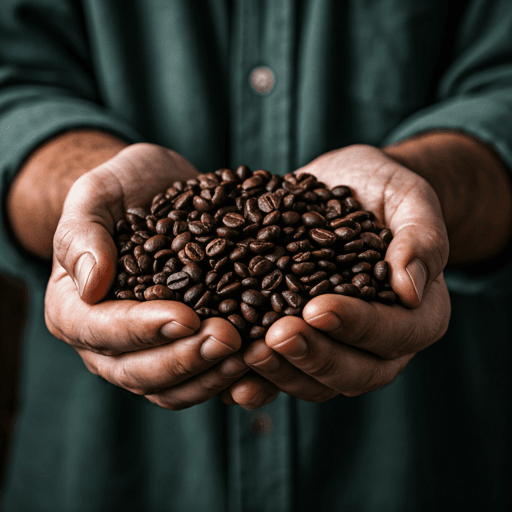
Muyinga coffee comes from the north-eastern corner of Burundi, on the Tanzanian side of the country, from a plateau province that sits east of the Congo-Nile crest rather than on it. That one geographic fact explains most of what follows: the land trends lower and drier than the celebrated northern highlands, the washing-station network is thinner and younger, and the name is emerging rather than established. Muyinga is the best place in the country to work out what altitude actually buys a Burundian lot.
Two things are worth saying at the outset. First, emerging here describes the market, not the farming. The material planted in Muyinga is the same Bourbon-family stock grown on the crest, picked by smallholders working the same way, and the difference in reputation is a function of infrastructure and elevation rather than skill. Second, the specialty record on this province is genuinely thin. There is no authoritative public dataset of Muyinga station counts, farmer numbers, hectares or average cup scores that can be quoted honestly, so this page hedges where the evidence hedges rather than inventing precision.
Where Muyinga sits, and why the north-east is not the crest
Muyinga is a province in the far north-east of Burundi. It borders Tanzania to the east and Rwanda to the north, with Kirundo to the north-west, Ngozi to the west, and Karuzi and Cankuzo to the south. It covered roughly 1,836 square kilometres and comprised seven communes: Buhinyuza, Butihinda, Gashoho, Gasorwe, Giteranyi, Muyinga and Mwakiro. The provincial capital, Muyinga town, sits at about 1,731 m.
Burundi is usually described in terms of natural regions, which are landform belts rather than administrative units, and that is where the story sharpens. Most of the province falls in Bweru, the north-eastern arm of Burundi's central plateau belt, generally placed in the 1,500 to 1,800 m band and described as agriculturally rich, with steep slopes and deeply cut watercourses rather than genuinely flat plateau. A strip in the north falls instead into Bugesera, the lower depression country that continues into Kirundo, commonly described as averaging nearer 1,300 m, though published figures for it vary by a few hundred metres between sources.
Compare that with the neighbours. Kayanza's western communes lie in Mugamba, the Congo-Nile ridge proper and the highest ground in the country, with its eastern side in Buyenzi. Ngozi is mostly Buyenzi, the northern plateau, with its eastern edge already sliding into Bweru. In other words, the boundary between the crest and the north-east runs through the northern provinces rather than neatly around them, which is exactly why Muyinga and Ngozi coffees can sit closer together than a map of provinces suggests.
Rainfall follows the same broad gradient, and here the numbers deserve suspicion. The Congo-Nile range is generally the wettest ground in the country and the northern and eastern depressions the driest, with Bweru itself often given at around 1,300 mm a year against a national range spanning roughly 700 to 2,000 mm. A pronounced dry season runs from about June to September. Yet one washing station operating inside Muyinga publishes a 1,500 to 1,800 mm figure for its own catchment. Both cannot be a provincial average, which is the point: treat any single rainfall number attached to this province as a local estimate, not a fact about the region.
What altitude actually buys a Muyinga coffee
Altitude does not act on coffee directly. It acts through temperature. Cooler nights slow the plant's metabolism, stretch the interval between flowering and ripe cherry, and give the seed longer to accumulate sugars and aromatic precursors while staying dense. That is the whole mechanism behind the specialty industry's altitude fixation, and it is why the Congo-Nile crest, which is cool, wet and steep, produces the country's most structured, most acid-driven cups.
Muyinga sits one step down that ladder. Warmer plateau nights mean a shorter, faster ripening window; the same Bourbon material planted densely on the same red clay hills tends to yield a bean that is a touch softer and a cup that reads rounder and less acid-driven than a crest lot. That is a description, not a demotion. Roundness, sweetness and body are qualities plenty of buyers actively want, and they are what the north-east delivers most reliably.
Here is the honest complication, and it matters. Station-declared altitudes coming out of Muyinga overlap heavily with those quoted for Kayanza, and they do not even agree with each other. The company running the largest cluster of wet mills in the north-east publishes a 1,500 to 1,800 m band across its stations. The Kavugangoma station's own material places it at about 1,720 m on Kavugangoma Hill, with the hills it draws from in the 1,700 to 1,750 m range, while importer listings for that same station advertise a catchment stretching from roughly 1,650 m to 2,100 m. Murago is given at about 1,720 m by its operator, and at 1,650 m by a seller who puts area farms between roughly 1,600 and 1,800 m. None of those are lowland numbers, and the spread between descriptions of a single site is a warning about the source material: much of what circulates is seller copy rather than survey.
So the reliable difference is not that every Muyinga hill sits below every Kayanza hill. It is that Muyinga has no crest. This is plateau country with a drier northern fringe and no equivalent of the Mugamba ridge that Kayanza's western communes occupy, so it lacks any substantial block of land at the elevations that ridge reaches. The provincial average moves down; the individual hill may not.
The practical consequence is that the province name is a weak predictor here and the processing site is a strong one. Burundi's traceable unit is the washing station rather than the farm, a point the Kayanza guide works through in full, so read the station and its declared elevation before you read the province on the label.
Muyinga coffee at a glance
| Attribute | What the record supports |
|---|---|
| Location | North-eastern Burundi; borders Tanzania (east) and Rwanda (north); neighbours Kirundo, Ngozi, Karuzi, Cankuzo |
| Natural region | Mostly Bweru (north-eastern plateau, generally 1,500 to 1,800 m); a northern strip in the lower Bugesera depression |
| Altitude | Generally toward the lower end of Burundi's roughly 1,250 to 2,000 m coffee band; station declarations cluster in the mid-1,600s to low-1,800s and conflict with each other |
| Rainfall | Lower than the Congo-Nile crest; marked June to September dry season; published figures for the province conflict sharply |
| Farm structure | Smallholder plots, frequently under a hectare and counted in trees rather than rows; cherry delivered to washing stations |
| Varieties | Red Bourbon dominant; smaller amounts of Mibirizi, Jackson, Kent and SL selections in the national stock |
| Processing | Predominantly fully washed with extended fermentation and raised-bed drying; some naturals and honeys where drying capacity allows |
| Typical cup | Milk chocolate, caramel and brown sugar, cooked red fruit, soft citrus; medium to full round body; gentler acidity than crest lots |
| Market status | Emerging; lots normally travel under a station or lot name, with the province as secondary context |
| Administrative note | Folded into the new Buhumuza Province under Burundi's 2025 provincial reform |
Who actually makes it: a thinner, younger station network
Production here looks like production almost everywhere in Burundi: a very large number of very small growers, plots often measured in fractions of a hectare, trees counted in dozens rather than rows. Nobody in this province is running an estate. Cherry is carried to a central washing station, weighed and pooled, which is why the station and not the farm is what a bag can name.
What differs in the north-east is the density and the age of that network. Kavugangoma, in Mwakiro commune, is the clearest documented case: construction began in February 2008 and took roughly four years, and the station's own account of why it was needed is blunt, describing growers who had been walking a great distance to reach a washing station and waiting once they arrived. Around eighteen surrounding hills now deliver to it. That is the infrastructure gap in one sentence, and it is a quality constraint before it is a marketing one, because cherry that travels for hours in the sun before it is pulped starts the day at a disadvantage no processing skill can fully recover.
The national arc behind the network as a whole, from state construction through the regional management companies to privatisation and recentralisation, along with the potato defect and Burundi's harder history, belongs to the Burundi coffee guide rather than to a provincial page. What matters locally is the residue: a young, thin and repeatedly reorganised station network is exactly the sort of thing that stops a region's name from consolidating in the market.
The largest single presence in the north-east is a family company founded in 2012, when a Burundian woman and a partner acquired a cluster of seven wet mills; she died in 2022 and the business is now run by her family. Two of those seven stations are in Muyinga, Butihinda and Murago, against five next door in Kirundo, and that two-to-five split is a fair picture of how patchy the provincial network is. Its published numbers are best read as station declarations rather than census data: Murago reports cherry from roughly 1,670 smallholders, Butihinda from about 1,400, and the company reports that more than 80 percent of the farms supplying two of its stations are owned or managed by women. The general mechanics of how grower-owned and grower-supplying organisations pool cherry, share milling and negotiate as a block are covered in the guide to coffee cooperatives.
Varieties and processing in the north-east
The planting stock is old and narrow. Red Bourbon dominates across Burundi, much of it descended from early introductions rather than recent replanting, and Muyinga is no exception. Smaller quantities of Mibirizi, Jackson, Kent and SL selections appear in the national picture. Mibirizi is worth a footnote of its own: it is routinely lumped in with Bourbon in Great Lakes marketing copy, but World Coffee Research's genetic testing indicates a strong relationship to the Typica group instead, most likely because the original material reached the region via Guatemala. Robusta is grown in Burundi at lower elevations, but the specialty conversation in Muyinga is an arabica one.
Processing is overwhelmingly fully washed. The regional pattern is a float sort on delivery, pulping the same day, an extended fermentation, then grading in washing channels and drying on raised beds. Published drying times from stations in the north-east run from about ten days to a fortnight, and longer where weather is against them. Some stations with enough drying real estate now run naturals and honeys, and a few operators in the region have experimented with sealed and anaerobic ferments.
Dry milling is where you might expect a Muyinga lot to lose its provincial identity, and parchment does travel to private mills in Ngozi and Gitega. But the north-east has something better, and it is the single most encouraging fact about the province: Burundi's first purpose-built specialty dry mill, operating since 2013, sits in Gashoho commune inside Muyinga itself, at around 1,730 m, sited deliberately for altitude and low humidity so that stored coffee holds its condition. It was built to handle small traceable microlots, which is precisely the kind of infrastructure a region needs before its name can come to mean anything.
What Muyinga coffee tastes like
Descriptions from roasters who have bought here cluster around milk chocolate and cocoa, caramel and brown sugar, cooked red fruit, with raspberry and red plum turning up repeatedly, vanilla, and a citrus character that reads soft and orange-toned rather than sharp. Body is medium to full and notably round. Acidity is present but rarely the leading edge, which is the practical signature of the lower, faster-ripening north-east.
Sources genuinely conflict on how distinct this is. Some sellers describe Muyinga profiles as closely comparable to Kayanza's, complete with florals and refined structure; others frame the province as the rounder, lower-toned option. Both can be true, because a well-run station on high ground in Butihinda has more in common with a crest lot than with a hurriedly processed lot from the drier north of the same province. Station, cherry-selection discipline and drying management swamp the provincial average more often than not.
For roasting, the practical read is that these lots tend to be forgiving. A rounder, sweeter, less acid-driven green is generally more tolerant of a medium roast than a taut high-crest lot, and the sugars carry well without a heavy development that would flatten the fruit.
Muyinga versus its neighbours
| Region | Landform | Position | Typical cup emphasis | Market standing |
|---|---|---|---|---|
| Kayanza | Mugamba crest in the west, Buyenzi plateau in the east | North-west, on the Congo-Nile ridge | Structured, acid-forward, floral, layered | Burundi's most established specialty name |
| Ngozi | Mostly Buyenzi; eastern edge in Bweru | North-centre, west of Muyinga | Sweet and balanced; a bridge profile | Well established; a milling centre |
| Muyinga | Bweru, with a Bugesera fringe in the north | North-east, toward Tanzania | Round, chocolatey, red-fruited, softer acidity | Emerging; usually sold under a station name |
| Kirundo | Largely Bugesera | Far north, lakes country | Softest and sweetest; least acid structure | Small volume; the thinnest record of the four |
Read that table as a gradient rather than four boxes. Moving north-east from the crest, elevation falls, rainfall falls, the ripening window shortens, acidity softens and body rounds out, and the density of processing infrastructure falls with it. Muyinga and Kirundo are usually grouped together in trade discussion for exactly this reason, and the pairing is geographic, not a judgement about either. For the neighbouring plateau case, the Ngozi guide covers the province that straddles the boundary.
A thin record, and a province that just changed its name
Anyone researching this region should expect to hit the limits of the public record quickly. Muyinga has no authoritative published count of active washing stations, no reliable provincial production share, no farmer census in the specialty literature and no body of cup scores broad enough to characterise a regional average. Nearly everything circulating online traces back to individual roaster and importer product pages, which are marketing documents and often recycle each other's numbers, sometimes inconsistently for the same site. Where this page gives a figure, it is either an administrative statistic or a station's own declaration, and neither should be read as a regional norm.
There is also a moving target on the map. Under Burundi's 2025 administrative reform the eighteen provinces were consolidated into five, and Muyinga was merged with Cankuzo and Ruyigi into the new Buhumuza Province, with Cankuzo as its capital and Muyinga as its largest town. Coffee naming conventions lag administrative maps by years, and the trade keeps using regional names long after they leave the gazetteer, so expect Muyinga to persist as a coffee designation regardless. Just be aware that a search for the province today may return a governance story rather than a growing region.
The bottom line
Muyinga coffee is Burundi's north-eastern case study in what elevation and infrastructure actually contribute to a reputation. The province sits east of the Congo-Nile crest on plateau ground that trends lower and drier, with a genuinely dry fringe in the north; its ripening window is shorter, its Bourbon-derived lots read rounder and sweeter with softer acidity, and its washing stations are fewer, younger and further apart than those on the celebrated highlands. None of that is a statement about the growers. Judge a Muyinga lot on the station and the elevation it declares rather than on the province, and read emerging as a description of how much market attention the north-east has received, not as a verdict on what is in the cup.