
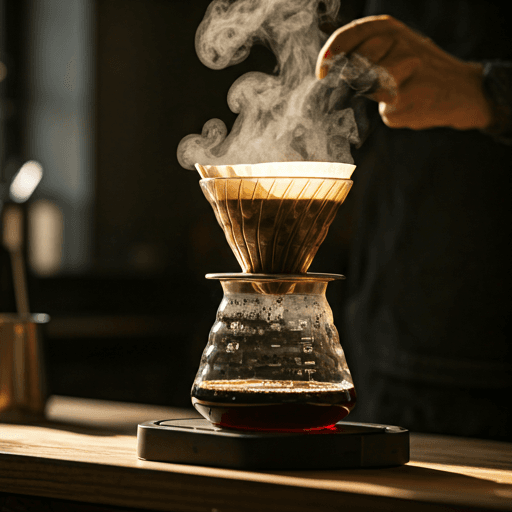
Kayanza coffee comes from the province in Burundi's far north, pressed against the Rwandan border, and it is the zone that produces the bulk of the country's competition-winning lots: high-altitude washed Bourbon with dense sweetness and red-fruit acidity. What makes it distinctive is not a famous estate — Kayanza has essentially none — but the washing station, which is the traceable unit here instead of the farm.
That single structural fact explains almost everything else about how these coffees are grown, sold and labelled. A grower in Kayanza may own a few hundred trees on one hillside. Nobody exports a few hundred trees' worth of cherry on its own. So the coffee is pooled, day by day, at a station on the hill — and the station's name, not the farmer's, is what ends up on the bag.
Where Kayanza sits
Kayanza is in north-central Burundi, sharing its entire northern edge with Rwanda. Cibitoke and Bubanza lie to the west, Muramvya and Gitega to the south, and Ngozi — the neighbouring province, and the other name you will see on Burundian specialty bags — to the east. It is a small province by area, recorded at roughly 1,233 square kilometres, and a densely populated one, with just under 600,000 people counted in the 2008 census. It was divided into nine communes — Butaganzwa, Gahombo, Gatara, Kabarore, Kayanza, Matongo, Muhanga, Muruta and Rango — and those commune names turn up constantly in lot documentation.
One administrative note worth knowing, because it is already appearing in trade paperwork: in a reorganisation that took effect in 2025 and cut Burundi from eighteen provinces to five, Kayanza was merged with Ngozi, Kirundo and part of Muramvya into a larger province called Butanyerera, with Ngozi town as its capital. The coffee trade has not fully followed suit. "Kayanza" remains the origin label in everyday use because it describes a growing zone with a coherent altitude, climate and cup — not a current administrative boundary. You will now see both names on paperwork, sometimes on the same document.
Why the land matters
Burundi's geography is organised into named natural regions rather than flat districts, and Kayanza straddles three of them. Most of its coffee sits in Buyenzi, the high northern plateau it shares with Ngozi; the western strip climbs into Mugamba, the cool ridge country along the Congo-Nile divide; and the southern sections touch Kirimiro. Buyenzi is the coffee heartland, and it is the reason Kayanza's reputation exists.
Farms here generally sit between about 1,700 and 2,000 metres above sea level, and individual washing stations are documented at similar heights. Kibingo station, in Kayanza commune, is recorded at 1,893 metres, with the hills that supply it spanning roughly 1,700 to 1,900 metres. Heza station, on Gitwe hill in Matongo commune, is documented at about 1,960 metres. Bwayi, also in Matongo, sits lower at around 1,760 metres. That spread of two or three hundred metres inside one small province is one reason two Kayanza lots can taste noticeably different.
Mean annual temperature in this part of Burundi runs somewhere around 18°C — cool enough that cherry ripens slowly and accumulates sugar. Rainfall nationally averages on the order of 1,200 millimetres a year, concentrated in a long wet season that builds through the early months and peaks around April, with a dry stretch through the middle of the year. That rhythm is precisely why the harvest window sits broadly between March and July, shifting with altitude and with the year.
The western edge of the province abuts the Kibira montane rainforest, one of the last large stands of natural forest in the region and a continuation of Rwanda's Nyungwe. Its practical effects on nearby coffee are real but modest and hard to quantify: cooler nights, reliable spring water, more cloud cover. Heza, built into a slope overlooking the Kibira, draws its process water from springs fed off that forested ridge. Treat the Kibira as context for the growing conditions, not as a flavour claim in itself.
Why Kayanza coffee is a meaningful label
Origin labels only mean something when they correspond to a real difference in the cup, and in Burundi the useful unit of difference is smaller than the country and larger than the farm. A bag of Burundian specialty coffee typically names three things: the province, the washing station, and often the hill or commune the cherry came from. Read in that order, they tell you an altitude band, a processing regime and a specific community of growers.
The province is the coarsest of the three, but it is not decorative. Kayanza's altitude range, its cool mean temperature and its Bourbon-dominated tree stock make its coffees recognisably different from lower-lying Burundian zones such as the Bugesera plain in the northeast, which sits several hundred metres lower and tends to cup rounder and less bright.
The competition record supports the reputation without needing exaggeration. In the 2018 Burundi Cup of Excellence, twenty-nine lots from five provinces made the winners' list, and Kayanza stations took all ten of the top places — the top lot came from Rubagabaga station in Gatara commune, with Munkaze, Bwayi and Nemba filling out the places behind it. Roughly four in five of the twenty-nine winning lots overall were Kayanza, the remainder coming from Ngozi and Muramvya. The following year's edition was less lopsided but still Kayanza-heavy: the province took most of the top ten and a clear majority of the winners overall, with Ngozi taking the rest, including first place. That is a documented pattern in a specific competition, and it is worth stating plainly — it is not the same thing as a claim about national production share, which varies by year and by who is counting.
The Kayanza washing station model
Almost all Kayanza coffee is grown by smallholders. A typical household tends something on the order of a couple of hundred trees — the growers around Nemba station are described as averaging about 150 trees each, and Bwayi's are described as farming under half a hectare on average — usually intercropped with beans, bananas, taro or cassava on a steep hillside plot. Cherry is carried on foot or by bicycle to a nearby station or to an outlying collection point.
The scale of the pooling is what matters. Kibingo's documentation describes about 1,700 registered growers spread across eighteen hills, organised into groups of roughly thirty under a farm leader. Bwayi reports on the order of 4,000 producers delivering directly or through around ten collection points. Nemba lists over 3,000 smallholders. Businde, a smaller and more recent station, collects from a few hundred growers living within a short walk of the site. Those are the numbers that define the system: many growers, small deliveries, one processing point.
What the station does — pulping, fermenting, washing, grading, drying, and the quality decisions embedded in each step — is the same everywhere the wet method is used; if you want the mechanics, our guide to the coffee washing station covers them in full. What matters here is the consequence. Because cherry from hundreds or thousands of farms is combined before processing, the station is the smallest unit that can be reliably separated, tracked and cupped. Separation still happens below that level — by delivery day, by hill, by density grade off the washing channel — and those separations are how a "microlot" from Kayanza is actually constructed. It is a lot from a station, on a date, from a named group of hills. It is rarely a lot from one farm.
Ownership of those stations is mixed and has shifted more than once. SOGESTAL Kayanza — one of five regional station-management companies set up in 1991 to run the stations the state had built — still sits behind a number of them, including Bwayi; alongside it are farmer cooperatives, exporter-operated groups and privately built stations such as Heza and Businde. That national story of state building, privatisation and re-centralisation, along with the well-known potato-taste defect that Burundian coffee has had to manage, belongs to our Burundi coffee guide rather than being retold here.
How to read a Kayanza bag
A worked example makes the structure concrete. Suppose a label reads: Burundi — Kayanza — Bwayi Washing Station — Matongo — Red Bourbon — fully washed. Taken in order, that tells you four useful things and one thing you should hold loosely.
- Kayanza sets the altitude band and the broad climate — high, cool, Buyenzi plateau.
- Bwayi is the actual production unit: the pulper, the tanks, the beds, the staff and the quality decisions that made this coffee what it is. If you liked it, this is the word to remember.
- Matongo narrows it to a commune of supplying hills, which is as close to a "farm" as most Burundian lots get.
- Fully washed tells you the processing style, and by extension roughly what to expect: clarity and structure rather than heavy fruit.
- Red Bourbon is the piece to hold loosely — see the varieties section below.
Two lots carrying the same province and the same variety but different station names are genuinely different coffees. Two lots from the same station on different delivery dates can differ too. That is why experienced buyers track station names season to season the way buyers elsewhere track estates.
The varieties actually planted
Kayanza's tree stock is overwhelmingly Bourbon, usually sold as Red Bourbon. That is a Burundi-wide fact rather than a Kayanza distinction, and the lineage, cup tendencies and agronomic trade-offs of the variety are covered on our Bourbon coffee variety page.
Two honest caveats. First, the origin story usually told — that Bourbon reached the region from Réunion in the 1930s, via missionaries, as coffee planting spread under colonial administration — is widely repeated in trade literature but rests on a thin documentary record; treat it as received tradition rather than verified history. Second, "Red Bourbon" on a Kayanza bag is a commercial description, not a genetic certificate. Older Bourbon-derived selections associated with the wider region, such as Jackson and Mibirizi, are named inconsistently across Burundian and Rwandan paperwork, and much of the planted material is old, mixed and undocumented at the plot level. The tree stock is genuinely Bourbon-dominated; the sub-varietal precision implied by a lot tag is usually more than anyone can evidence.
Processing
Fully washed is the default and still the dominant style. The typical Kayanza sequence is disc pulping, a fermentation running anywhere from around twelve hours to two days depending on the station and the weather, a wash through grading channels that sort parchment by density, often an overnight soak in clean water, then slow drying on raised beds under regular turning and midday or rain covers — commonly one to three weeks.
Published station routines differ in exactly the ways you would expect. Nemba's runs a long underwater fermentation of around two days, then a final wash, an overnight soak and roughly a fortnight on beds. Heza ferments in tanks fed by spring water off the Kibira ridge, in staged cycles of roughly half a day each before the final rinse. Businde's coffees are described as drying on African beds for as long as three weeks. None of this is exotic; it is the same wet method run with different amounts of time and water, and the differences are audible in the cup.
Naturals and honeys have grown from a curiosity into a regular part of the Kayanza offering, and anaerobic, yeast-inoculated and extended-fermentation lots now appear too. They remain the minority. If you are trying to understand what Kayanza tastes like as a place, the washed lots are the better reference point, because they show the fruit and structure of the coffee rather than the fingerprint of the process.
Kayanza at a glance
| Attribute | Detail |
|---|---|
| Location | North-central Burundi, on the Rwandan border; folded into Butanyerera Province in the 2025 reorganisation, but still traded as "Kayanza" |
| Natural regions | Mainly Buyenzi; western strip in Mugamba; southern sections in Kirimiro |
| Altitude | Roughly 1,700-2,000 m for most coffee; stations documented from about 1,760 m to about 1,960 m |
| Climate | Mean around 18°C; long wet season peaking near April, drier mid-year; roughly 1,200 mm rainfall nationally |
| Farm structure | Smallholders, commonly a couple of hundred trees each on well under a hectare; no meaningful estate sector |
| Traceable unit | The washing station, refined by hill, commune and delivery date — not the individual farm |
| Varieties | Bourbon-dominated, sold as Red Bourbon; older regional selections named inconsistently |
| Processing | Predominantly fully washed on raised beds; growing minority of naturals, honeys and experimentals |
| Harvest | Broadly March to July, varying by altitude and year |
| Typical cup | Red fruit, black tea, floral top notes, cane-sugar sweetness, crisp juicy acidity, dense body |
What Kayanza tastes like
At its best, a washed Kayanza Bourbon is bright without being thin. The acidity reads as juicy and slightly tart rather than sharply citric — red currant, raspberry, sometimes ripe cherry or plum — carried on a body with more weight than the acidity would lead you to expect. Sweetness tends toward cane sugar, honey and dried red fruit. Black tea and a floral lift are common in the high-scoring lots, and cocoa or baking-spice notes usually show as the cup cools or as the roast goes slightly darker.
Compared with Ethiopian washed coffees, Kayanza is generally denser and less overtly floral. Compared with the classic bright-and-clean Central American profile, it is fruitier and more tea-like. The closest comparison is across the border: Rwandan coffee from the northern and western hills shares the altitude, the Bourbon stock, the washing-station structure and much of the flavour vocabulary. In practice, careful cuppers often find Burundian lots a touch heavier-bodied and Rwandan lots slightly more delicate, but the overlap is large enough that station and processing matter far more than the border does.
How Kayanza differs from its neighbours
| Zone | Position | What tends to distinguish it |
|---|---|---|
| Kayanza | Far north, Rwandan border, mostly Buyenzi | The highest concentration of high-altitude stations and of competition-winning lots; bright red-fruit acidity with dense sweetness |
| Ngozi | Immediately east, same Buyenzi plateau | Very similar altitude and profile; historically fewer top-placing lots, so the name is less familiar to buyers |
| Muramvya / Kirimiro | South and central | Cooler, mountainous, more variable rainfall; often rounder and more chocolate-leaning |
| Bugesera (Kirundo) | Northeast lowlands | Several hundred metres lower; softer acidity, less structure |
| Mumirwa (Bubanza / Cibitoke) | Western escarpment toward the Rift | Very wide altitude spread and warmer temperatures; more variable, with chocolate and nut notes at lower elevations |
A word on context that should never be dressed up as a selling point: Burundi is a small, landlocked, densely populated country that went through a long civil conflict from 1993 into the mid-2000s, and coffee households in Kayanza absorbed that disruption along with everyone else. Trees were abandoned and replanted; stations stopped and restarted; institutional arrangements were rebuilt more than once. It is part of why the sector's structures look the way they do, and it is stated here as fact, not as a flavour note.
The bottom line
Kayanza earns its reputation on straightforward grounds: high land, cool temperatures, an old Bourbon population, and a dense network of washing stations that has learned to separate lots carefully. If you are drinking or sourcing from this province, read past the province name to the station and the hill — that is the level at which the coffee is actually made, and the level at which two Kayanza lots can taste genuinely different from each other. Start with a fully washed lot from a named station, expect red fruit and real sweetness rather than delicacy, and treat the station name as the thing you look for again next season.