
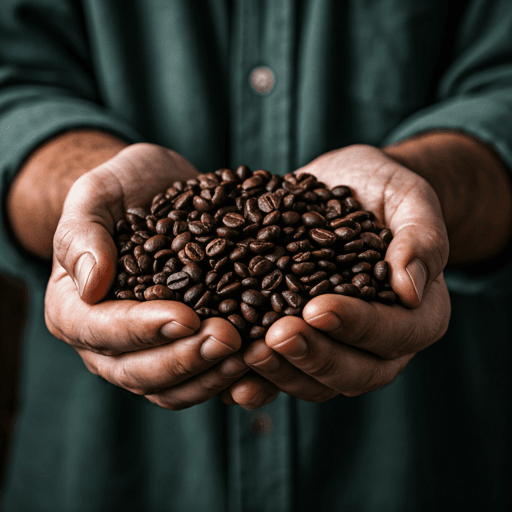
Most of Kenya's coffee reputation was built by smallholders — tens of thousands of families delivering a few sacks of cherry each to a village wet mill, pooled and sold under a factory name. Kiambu is the county that never quite fit that story. Sitting on the southern, Nairobi-facing shoulder of the central highlands, Kiambu is the most estate-dominated of the classic Kenyan growing counties: coffee here has historically come from named, single-owner farms of tens or hundreds of hectares, with their own pulperies, drying tables and dry mills. It is also the county being eaten alive by the city. Understanding Kiambu means holding both facts at once — a distinctive, softer style of Kenyan coffee, and a growing region that is physically shrinking year by year.
Where Kiambu sits
Kiambu County wraps around the northern and western approaches to Nairobi, running from the Aberdare foothills near Lari and Limuru down through Githunguri, Kikuyu, Ruiru, Juja and Thika. Coffee occupies a belt generally cited between roughly 1,500 and 1,800 m, with the county as a whole spanning a wider range — figures from around 1,520 m up to about 2,200 m appear in regional overviews, though the upper end tilts into tea and dairy country rather than coffee.
That altitude band matters. It is high enough for slow cherry maturation and the dense, hard beans Kenya is known for, but it is meaningfully lower than the 1,700–2,000 m plantings that dominate Nyeri's coffee slopes further north. Lower and warmer generally means slightly faster ripening, and in Kiambu's case a cup that trades some of the piercing acidity of the northern counties for body and sweetness. The soils are the familiar deep red volcanic clays of the central highlands — free-draining, iron-rich, high in organic matter — laid down by the same Aberdare and Mount Kenya volcanic systems that underwrite the rest of the country's coffee. Rainfall is bimodal, with long rains around March–May and short rains around October–November, producing a main crop harvested roughly October to December and a smaller fly crop mid-year.
The estate inheritance
Kiambu's structure is a direct artifact of colonial land policy. Its cool, well-watered, fertile plateau was among the first areas alienated for European settlement in the early twentieth century, and by the 1910s plantations of several hundred acres were already established around Kiambu town, Ruiru and Thika. Towns in the county grew up around processing and shipping infrastructure rather than the other way round. After independence many of these farms passed into Kenyan ownership — some to individuals, some to companies, some to land-buying groups — but crucially, most were transferred largely intact rather than being fragmented into smallholdings.
The result is a county where the recognizable production units carry estate names rather than cooperative factory names: Oaklands and Tatu around Ruiru, Fairview, the Sasini group's holdings around Kiambu and Tinganga, and a long tail of smaller family farms. Some of the largest were assembled into corporate plantation groups running a dozen or more properties. Smallholder cooperatives do exist in Kiambu — the Githunguri and Komothai areas are the usual examples — but they have never defined the county's identity the way they define Kirinyaga's or Nyeri's.
Ruiru also gave Kenyan coffee something else: research. The Coffee Research Institute, now part of the national agricultural research organization, sits in Ruiru in Kiambu County, and the disease-resistant hybrid varieties Ruiru 11 (released in the mid-1980s) and Batian (released around 2010) both carry the fingerprints of that station. A county that is losing its coffee acreage is, awkwardly, still the address where much of the country's varietal future was bred.
Estate versus smallholder: what actually differs
| Dimension | Kiambu estate model | Smallholder/cooperative model |
|---|---|---|
| Ownership | Single farm, one owner or company | Hundreds to thousands of member farms |
| Lot identity | Named estate, sometimes a single block or variety | Named factory (wet mill) aggregating many members |
| Processing control | On-farm pulpery; owner sets fermentation and drying protocol | Factory manager processes on behalf of members |
| Traceability | Farm-level, occasionally plot-level | Factory-level; individual farms rarely separable |
| Consistency | Usually high year to year | Varies with membership and factory management |
| Experimentation | Easier — naturals, honeys, single-variety lots | Slower; requires cooperative agreement |
Varieties: SL28, SL34 and the newer generation
Kiambu plants the same core Kenyan material as the rest of the country. SL28 is the celebrated one — a Scott Laboratories selection with Bourbon-type ancestry, drought-tolerant, low-yielding, and responsible for much of the blackcurrant intensity people associate with Kenya. SL34 is the workhorse partner: another Scott Laboratories selection, generally reported to handle heavier rainfall better and to perform strongly at the wetter end of the growing range, with a cup that tends slightly rounder and less strident than SL28.
Kiambu's climate arguably suits SL34 particularly well, and estate lots from the county are among the more common places to find SL34 offered on its own rather than blended in behind SL28. K7 appears in older plantings, and Ruiru 11 and Batian have been planted where leaf rust and coffee berry disease pressure or replanting economics made the traditional selections hard to sustain. Estates, with the capital to replant a whole block at once, have generally moved faster on new varieties than smallholders have.
Processing: the double-washed Kenyan method
Kiambu processes the way Kenya processes. Cherry is pulped, then fermented under water — often in two stages, with an intermediate washing and re-fermentation — before being washed through grading channels and then held in clean water for a soak that can run many hours. Only then does the parchment go to raised drying tables, where it is turned by hand and shaded during the fiercest part of the day, drying slowly over one to two weeks.
That extended, water-heavy sequence is a variant of the standard washed process, and it is a large part of why Kenyan coffee tastes like Kenyan coffee: exceptionally clean, transparent, and acid-forward. On an estate the whole chain sits under one manager, which is why Kiambu farms have been among the earlier Kenyan adopters of natural and anaerobic-natural experiments alongside their conventional washed production — a single decision-maker can dedicate a block to an experiment without convincing a membership.
In the cup: Kenya with the volume slightly down
If Nyeri is the county of sharp elbows — blackcurrant, tomato-leaf savouriness, an acidity that can feel almost carbonated — Kiambu is the same language spoken more softly. The typical Kiambu profile is fuller-bodied and rounder, with grapefruit and red-berry fruit rather than screaming cassis, a molasses or brown-sugar sweetness, and a distinct cocoa or dark-chocolate underlay that persists through the finish. Acidity is present and structured but reads as juicy rather than electric.
This makes Kiambu a useful entry point for drinkers who find classic Kenyan lots too aggressive, and a good choice for milk drinks, where the chocolate and body survive dilution better than a razor-thin high-acid profile would.
| County | Structure | Typical altitude | Cup character |
|---|---|---|---|
| Kiambu | Estate-dominated | ~1,500–1,800 m | Full body, grapefruit and red berry, cocoa, molasses sweetness |
| Nyeri | Smallholder cooperatives | ~1,700–2,000 m | Intense blackcurrant, dense structure, high acidity |
| Kirinyaga | Smallholder cooperatives | ~1,600–1,900 m | Bright citrus and berry, floral lift, silky body |
Cup character is also filtered through Kenya's screen-size system before it reaches anyone's grinder. AA, AB, PB and the rest describe bean size, not quality, though the categories correlate loosely with lot selection and are how Kenyan lots are presented at auction and in export catalogues — worth understanding before reading too much into the letters, which our explainer on coffee grading unpacks in detail. Kiambu estates frequently release AA, AB and PB separations from the same harvest, which makes the county a good place to taste what screen size does and does not change.
The county the city is eating
The defining pressure on Kiambu coffee is not weather or disease. It is Nairobi. The county sits directly in the path of the capital's expansion, and land under coffee is worth far more with houses on it than with trees. Studies of land-use change in Kiambu consistently find large tracts of farmland converting to residential and commercial use across recent decades — one widely cited figure puts the loss around Kiambu town at well over a third between the mid-1990s and the late 2010s — with the Kikuyu, Kiambaa–Ruaka, Ruiru and Thindigua corridors among the fastest to change. Whole estates have been subdivided and rebranded as gated developments and satellite cities; some of Kenya's best-known new urban projects sit on ground that grew coffee within living memory.
Several forces push the same direction. Estate coffee is labour-intensive and its returns swing unpredictably from one harvest to the next; the workforce that once picked it has better-paid options in Nairobi; ageing trees need capital-heavy replanting; and planning enforcement has struggled to keep pace with speculative subdivision. Meanwhile the national picture has tilted the other way — smallholder counties further from the capital now account for a growing share of Kenya's crop, while Kiambu's estate acreage contracts. It is a reversal of the mid-century arrangement, when Kiambu was reportedly nicknamed the "Brazil of Kenya" for the sheer scale of its plantations.
Some estates have adapted rather than sold. Agritourism, farm tours within easy reach of the capital, on-site roasting, and direct relationships with international roasters all give a surviving Kiambu farm reasons to keep the trees standing. Others have kept a coffee core and converted the margins. But the trajectory is clear enough that Kiambu lots increasingly carry a documentary quality: they are coffees from a landscape in the middle of becoming something else.
What to look for on a label
Because Kiambu is estate country, the most informative thing on a Kiambu bag is usually the farm name — it is a real, findable place with a consistent management style, unlike a cooperative factory name that aggregates hundreds of variable farms. Look for the estate, the variety separation if there is one (an SL34-only Kiambu lot is genuinely worth seeking out), the screen grade, and the harvest year. Kenyan coffee ships to a strict standard, and Kiambu's estate lots tend to be among the more consistent expressions of it.
If you are working through Kenya systematically, Kiambu is best tasted alongside a northern county rather than alone. Put it next to Nyeri and the contrast does the teaching — same varieties, same processing tradition, same national grading system, and a noticeably different centre of gravity in the cup. For the broader context of how these counties, cooperatives and auctions fit together, start with our overview of Kenyan coffee and work outward from there.