
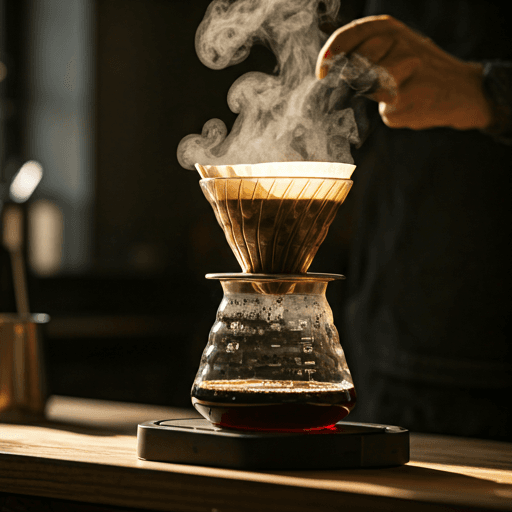
Iceland grows no coffee. Every bean in the country arrives as green coffee by ship or plane and is roasted after it lands, which makes Iceland coffee a story about importing, roasting and drinking rather than farming. The interesting part is the twist: Iceland is the one country where the objection people reach for first — heating a greenhouse in a cold place — has already been removed. Geothermal water heats glasshouses that carry tomatoes through the dark winter and have ripened bananas for decades. Coffee still does not work.
The reason travels well beyond the North Atlantic, which is why it is the useful part. Heat is the cheap part of growing coffee under glass. Area and time are not, and no volume of hot water from the ground fixes either of them.
Does Iceland grow coffee outdoors? Not remotely
The outdoor question has a short answer. Iceland is a subpolar oceanic island lying just south of the Arctic Circle: a short, cool summer, persistent wind, frost possible outside a narrow midsummer window, and no month reliably warm enough for a tropical evergreen shrub. Outdoor farming there is grass and hay above all, plus hardy roots and brassicas — potatoes, turnips, carrots, cabbage, kale — with barley at the margins of the season. Coffee, arabica or robusta, wants a frost-free year and warmth that never stops. Nothing about the Icelandic outdoors comes close, and no clever siting changes it.
So the whole question moves indoors — and in Iceland that is not a stunt. Geothermally heated greenhouse horticulture has been the mainstream of the country's fruit and vegetable growing for generations, which is why the indoor question deserves a real answer rather than a shrug.
What Iceland coffee actually is: a drinking culture, not an origin
Set the farming aside and there is still a great deal here. Iceland's per-person coffee drinking is among the highest in the world by most accounts — the Nordic countries cluster at the top of those comparisons and Iceland sits inside that group. Where exactly it lands shifts depending on whose data is used, so treat any single position as approximate; the comparative picture belongs to our guide to coffee consumption trends.
What the habit looks like in practice is more telling than a number. Coffee is the default gesture of hospitality: offered on arrival, refilled without asking, attached to the working day rather than reserved as a treat. Nordic coffee culture runs on the repeated everyday cup rather than the ceremonial one, and Icelandic coffee drinking follows that pattern. Alongside it sits a roasting and café scene unusually independent for a country of this size — much of what is poured is roasted domestically, and the cafés are largely locally owned rather than branches of international chains.
One naming note, since it causes confusion: "Icelandic coffee" is also the name of a spirit-spiked, cream-topped after-dinner coffee, usually built on brennivín, the local caraway-flavoured schnapps, though vodka or whiskey are used too. That drink is not the subject here.
How a treeless North Atlantic island became a coffee country
Iceland's relationship with coffee was built entirely by trade. The drink arrived during the era when the island's commerce ran through a small number of licensed trading posts controlled from Denmark, so Icelandic households received whatever that channel carried — and coffee, dry and durable, travelled well.
The oldest known documentary trace is unusually specific: a letter written to the manuscript collector Árni Magnússon in 1703 in which coffee is mentioned changing hands. Icelandic reference sources, including the University of Iceland's public science service, cite that letter as the earliest surviving evidence of coffee in the country rather than as proof of a first arrival — the drink may well have reached the island unrecorded before it. Better attested is the arc that followed: coffee began as a rarity among officials and the well-off and became ordinary over the following century. By the middle of the nineteenth century a roaster and a grinder were common household equipment, home roasting was a domestic skill with strong opinions attached to it, and a chicory-based coffee additive known as kaffibætir was commonly mixed into the grounds to stretch them and to give the bitterness Icelandic drinkers had grown used to. Home roasting gave way to commercial roasting around the middle of the twentieth century, though accounts differ on when the shift finished.
The pattern recurs wherever a heavy-drinking country grows nothing: the habit followed the shipping route, not the isotherm. Coffee is a crop of the tropics and a drink of the cold latitudes, and trade is the only reason both are true.
Heat is the cheap part. Area and time are not
A greenhouse is a box of manufactured climate, and it only makes sense when the crop inside does three things: turns the enclosed space over quickly, delivers a lot of value per square metre of floor, and ideally does both repeatedly within a year. Look at what Icelandic growers actually fill their houses with and the logic is transparent — tomatoes, cucumbers, peppers, lettuce, herbs, strawberries, cut flowers and potted plants. Fast crops, harvested within months of planting, many picked again and again from the same stems, all of them sold fresh close to where they grew.
A coffee tree does close to the opposite of everything a greenhouse rewards.
Area occupied — permanently
Coffee is not a plant you slot into a growing bench. It is a woody perennial shrub that grows tall if left alone, kept lower by pruning but still tall, wide and widely spaced. The structure therefore has to be tall as well as heated, and heated volume is a different order of commitment from heated floor. Worse, the footprint is permanent: no succession planting, no clearing the house between crops, no using one square metre for a winter salad and a summer fruiting crop. The tree holds its ground continuously, through the dark months as well as the productive ones — and Iceland's dark months mean supplementary electric lighting, which the tree consumes whether or not it is doing anything useful.
Years occupied before anything is harvested
A greenhouse cucumber is cropping within weeks of planting. A coffee tree takes years from seedling to first pickable cherries, and even then it does not produce on demand. Flowering is triggered by seasonal cues, typically a dry period followed by rain, and once a bloom sets the fruit stays on the branch for months before it ripens — the sequence is laid out in our guide to coffee flowering. Under glass at Iceland's latitude that dry-then-wet signal would have to be manufactured deliberately, and the plant would still be counting in years. In the same span, a cucumber house has turned over many times.
Value harvested — a tiny mass of seed
Then there is what the tree finally hands over. A mature plant's annual output is a small quantity of seed, and reported figures vary so widely that no single number is worth quoting. That seed still has to be pulped or dried, hulled, sorted and roasted, losing weight at every step, and what emerges competes in a global commodity market supplied by open-field farms where sunlight, land and a twelve-month growing year need no building or maintaining at all.
One more structural point quietly settles it. Icelandic tomatoes and cucumbers make sense because of freshness: a tomato picked nearby beats a tomato that has travelled, and no import can undo that. Green coffee is the opposite kind of product — dry, stable, built to travel, and at its best when roasted close to the drinker, which Iceland already does. Growing it there would add nothing that importing does not already deliver.
So the binding constraints are area occupied, years occupied and value harvested, and free geothermal heat touches none of the three. That is why greenhouse coffee never scales anywhere. Iceland is simply the cleanest demonstration, because it has already deleted the one variable everyone assumes is decisive.
At a glance: what Iceland offers, what coffee asks for
| Requirement | What Iceland can supply | What a coffee crop needs |
|---|---|---|
| Warmth | Abundant, constant, geothermal — the easy part | Year-round warmth, no frost |
| Winter light | Must be supplied electrically through the dark months | Steady light while it occupies the space, productive or not |
| Floor area per plant | Scarce under glass; benches turned over fast | A tall, wide, permanently spaced shrub |
| Structure height | Built for row crops and vines | Headroom for a shrub, heated as volume not floor |
| Time to first harvest | Weeks to months for the crops actually grown | Years from planting |
| Harvest rhythm | Repeated picking, several turnovers a year | One main crop, held on the branch for months |
| Freshness advantage | Decisive for tomatoes, cucumbers, herbs, flowers | None — green coffee ships perfectly well |
Shelter is not the same as manufacturing a growing year
Two different things both get called "growing coffee under cover". At the crop's northern edge, shelter and greenhouses are a genuine answer: Japan grows small quantities on its southern islands, where the climate is already nearly good enough and the grower is protecting a crop against events — a cold snap, storm wind — rather than inventing a climate, the situation described in our guide to Japanese coffee growing. Shelter buys a margin against a bad week; it does not create a growing year where none exists, and Iceland would need the entire year built and then held indefinitely.
The European comparison makes the same point. Commercial coffee farming does exist in Europe, in one sheltered valley in the Canary Islands — outdoors, at a subtropical latitude that already supplies the year. Iceland has no equivalent valley and no prospect of one.
Are there coffee plants in Iceland at all? Yes — and that is not an industry
There are real coffee plants in Iceland, and they live where you would expect: under geothermal glass at Reykir in Ölfus, near Hveragerði, the greenhouse town at the centre of Icelandic horticulture. Reykir is the country's horticultural school, and its tropical greenhouse — known locally as the banana house — has carried an exotic collection for decades, with bananas alongside figs, cocoa and coffee. Icelandic national broadcasting has reported open days at the school at which freshly brewed coffee from beans grown on the premises was served to visitors, with the banana house and the other greenhouses open alongside. That same planting has fed a long-repeated claim that Iceland holds the largest banana planting in Europe; the claim is disputed and poorly evidenced, and is better treated as a local legend than a fact. Occasional single coffee plants also turn up in private greenhouses.
All of that is worth knowing and none of it is an industry. A teaching collection proves that a coffee plant will live and can fruit under geothermal glass at high latitude. It says nothing about scale, and scale is the whole question. There is no commercial Icelandic coffee crop, no growing regions, no harvest calendar, no processing infrastructure and nothing to export.
Could this ever change?
Nothing physically forbids coffee plants in Iceland, because they already exist there. What is missing is any route from a handful of plants to a crop, and the missing pieces are structural rather than technical. More heat cannot help; it is already effectively free. What would have to change is the plant. A crop that stayed short, bore within a season, cropped repeatedly and delivered a great deal from a small footprint would be a candidate for Icelandic glass. Breeding does pursue more compact, earlier-bearing coffee, but even a dwarf coffee tree is a slow perennial holding its space for years, which leaves the arithmetic where it was.
The realistic future is already visible. Icelandic growers keep testing new crops under geothermal glass, and the ones that stay are fast, high in value and better fresh. Coffee is none of the three. What Iceland adds to coffee is the roast, the grind, the brew and the café, all of it downstream of the farm. Expect more coffee plants as exhibits. Do not expect an origin.
The bottom line
Iceland imports all of its coffee, roasts much of it domestically and drinks it at a rate most comparisons place among the world's highest — while growing none. The case matters not because absence is surprising at that latitude, but because Iceland removes the excuse. Heating is solved there and coffee still does not work, which names the real barriers everywhere: the space a tree occupies, the years it occupies it for, and the small mass of seed it finally yields into a market that open fields supply without any of the effort. Bananas under Icelandic glass are a genuine curiosity. Iceland coffee is, and will stay, an import.
Frequently asked questions
Does Iceland grow coffee?
No. Iceland has no coffee-growing region, no harvest calendar and nothing to export. All of its coffee is imported as green beans and much of it is then roasted domestically. Outdoor cultivation is nowhere near possible at that latitude, and the greenhouse route fails for reasons of space and time rather than temperature.
Could Iceland grow coffee in its geothermal greenhouses?
It can keep coffee plants alive and even fruiting, but not at any meaningful scale. A greenhouse only makes sense when the crop turns its space over quickly and yields a lot per square metre, which is why Icelandic houses are full of tomatoes, cucumbers, peppers, herbs and cut flowers. A coffee tree is tall, holds its footprint permanently, takes years to bear and yields a small mass of seed that must compete with open-field farms. Free heat solves none of that.
Are there any coffee plants in Iceland?
Yes, as teaching and demonstration specimens rather than as a crop. The tropical greenhouse at Reykir in Ölfus, near Hveragerði, has grown coffee alongside bananas, figs and cocoa for years, and Icelandic national broadcasting has reported open days there at which coffee from beans grown on site was brewed for visitors. Occasional plants also live in private greenhouses. None of it amounts to production.
Is Icelandic coffee roasted in Iceland?
Much of it is. Iceland has an unusually independent roasting and café scene for a country of its size, with domestically roasted beans in a large share of cups and locally owned cafés rather than international chains. Roasting, brewing and serving are where Iceland adds its own work to coffee; the growing happens in the tropics.
What is "Icelandic coffee" as a drink?
The phrase does double duty. Most often it means coffee as drunk in Iceland: strong, everyday, offered as hospitality and refilled freely. It is also the name of a spirit-spiked, cream-topped after-dinner coffee, usually made with brennivín, the local schnapps. Neither meaning implies the coffee was grown there.