
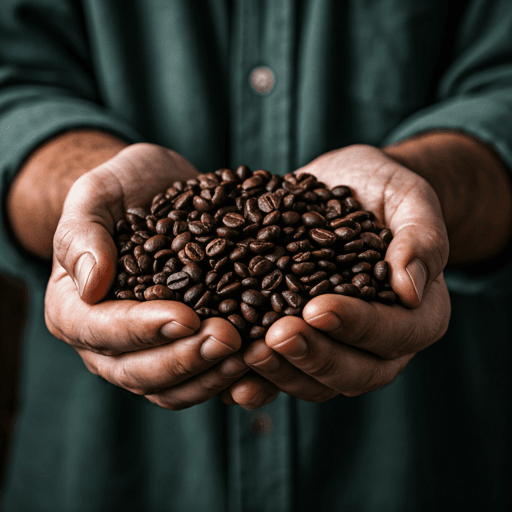
Yes — coffee really is grown commercially in the Canary Islands, and canary islands coffee comes from one place: the Agaete valley on the northwest corner of Gran Canaria. It is very widely described as the only spot in Europe where coffee is farmed at anything like a commercial scale, by a community of smallholders rather than on a single novelty plot — a claim that needs one qualification, which this page comes back to below. Everything else interesting about it follows from a single fact: the crop does not have a landscape of its own. It grows inside other people's orchards.
What canary islands coffee actually is
Strip away the tourism language and the picture is simple. In a single sheltered ravine running down to the Atlantic, coffee trees stand between and beneath bananas, citrus, mango, avocado and other subtropical fruit. Some growers tend what could fairly be called a coffee plot; many others have a handful of bushes along a terrace edge or under a mango canopy, harvested by the same family that picks the fruit above them. The valley's total output is tiny by any producing-country standard — small enough that the usual apparatus of an origin, an export grade system, a shipping calendar, a set of exporting houses, simply does not exist here.
That is not a failure. It is what the geography permits, and it is the reason the place is worth writing about at all. Agaete is not a small version of Colombia. It is a demonstration that the conditions coffee needs can assemble themselves in an unlikely spot, on a scale of a few hillsides, and stay there for generations.
One valley, not a region
The Agaete valley cuts inland from the northwest coast of Gran Canaria, a steep volcanic cleft with a stream bed, terraced slopes and high walls on either side. Four things stack up in it, and coffee needs all four at once.
The first is shelter. The ravine walls block the desiccating winds that come off the African mainland to the east, and they trap moisture. The second is oceanic moderation: the Atlantic sits at the valley mouth, and the water keeps the temperature swing narrow — no hard heat spikes, no cold snaps, no frost. The third is volcanic soil, deep and free-draining, on terraces that generations of farmers built for other crops entirely. The fourth is the shade itself, which is not natural forest but planted orchard.
Take any one of those away and the crop fails. That is the whole argument of this page, and it is why the answer to "where is coffee grown in the Canary Islands" is a valley rather than an island or an archipelago. The other islands, and most of Gran Canaria, are either too dry, too windy, too exposed or too high in the wrong way. The conditions do not repeat.
A latitude exception that runs on microclimate, not on the belt
Most coffee grows in a band either side of the equator where warm temperatures, reliable rainfall and an absence of frost normally occur together. That band is a rule of thumb about where those conditions usually coexist — not a boundary drawn on the ground, and not a law. The full explanation of why the band exists, and what it does and does not predict, belongs to our guide to the coffee belt; this page does not re-teach it.
Gran Canaria sits north of the latitudes where that rule comfortably applies, off the northwest shoulder of Africa, in a part of the Atlantic that ought to rule the crop out. It works anyway, and the reason is worth stating precisely: the belt describes a climate, and a microclimate can reproduce that climate locally even where the latitude says it should not exist. A latitude limit is a statistical summary. A climate limit is the real constraint, and it is satisfied or not satisfied field by field. Agaete is a pocket where the ocean, the ravine and the planted canopy together manufacture conditions the surrounding landscape does not have.
That is a different mechanism from the one most origin pages describe. Elsewhere, growers reach for quality by climbing — higher ground means cooler air, slower ripening and denser beans, an argument our guide to altitude and coffee sets out in full. Agaete's exception does not come from altitude. It comes from latitude and shelter: a valley whose walls, water and canopy do the work that elevation does in the tropics. That inversion is what makes this origin genuinely unusual rather than merely obscure.
The crop lives inside somebody else's orchard
Here is the part that no other producing origin quite duplicates. In most of the world, coffee is planted in dedicated blocks, sometimes with shade trees added over it. In Agaete, the shade came first and the coffee was fitted in underneath.
Bananas were the valley's commercial crop, and coffee was tucked into the plantation understorey, along field borders and among the fruit trees. Accounts of the valley consistently describe the same mixed canopy — bananas, oranges and lemons, mango, avocado, guava and other subtropical fruit, with coffee trees growing tall and leafy in the filtered light beneath. Growers describe picking cherries at ground level and overhead on the same tree, because the plants are not kept to a convenient commercial height; they are pruned, if at all, to fit the orchard around them.
Three consequences fall out of that, and they explain almost everything about the origin's scale and character:
- The planted area cannot expand independently. More coffee means more orchard, and the valley floor is finite. The crop is capped by somebody else's land use, not by demand.
- Nothing can be mechanised. You cannot run machinery through a mixed canopy on terraces. Every cherry is selected and picked by hand, over a long, uneven ripening window.
- Coffee is rarely the household's main crop. It is one line in a mixed subtropical farm. That has kept the trees alive through periods when a monocrop would have been pulled out — and it has also kept the whole thing small.
It is worth being clear about the direction of causation. Shade coffee elsewhere is usually a deliberate choice: growers plant or retain a canopy because it moderates temperature, slows ripening and protects soil. In Agaete the canopy was already there for its own commercial reasons, and coffee was slotted into the light that remained. The agronomic benefits are real either way, but they were a by-product rather than a plan — agroforestry arrived at sideways. It is also a clean illustration of what growers mean when they talk about place shaping a coffee: the canopy, the soil and the sea air are not decoration around the plant, they are the growing conditions. Our explainer on coffee terroir covers that idea properly.
At a glance
| Question | What the record supports |
|---|---|
| Is coffee grown in the Canary Islands? | Yes, commercially, but in one valley only |
| Where | The Agaete valley, northwest Gran Canaria |
| Growing system | Interplanted under bananas, citrus, mango, avocado and other fruit |
| Why it works | Sheltered ravine, oceanic temperature moderation, volcanic soil, planted shade |
| The unusual part | The exception comes from shelter and latitude, not from altitude |
| Variety | Commonly described as typica-type arabica; rests on local tradition rather than published verification |
| Harvest and processing | Hand-picked selectively; natural drying and small-batch roasting are what sources describe |
| Where it goes | Reported to be almost entirely consumed or sold on the islands |
| Scale | A valley, not a region; no export infrastructure |
| Best description | An agricultural oddity and a living local tradition, not a commercial origin |
What the coffee is reported to be
The variety usually named in accounts of the valley is an old typica-type arabica, described as material descended from plants brought to the archipelago from elsewhere and kept going locally ever since. That account is repeated consistently across island sources, which is a point in its favour, but it rests on local tradition rather than on published genetic verification, and it is better read as the standard description than as an established fact. The same goes for the timeline: the usual telling puts coffee's arrival in the archipelago in the late eighteenth century, by way of another island, with Gran Canaria coming considerably later — though the retellings vary and largely repeat one another.
Flavour is where restraint matters most. Descriptions of Agaete coffee do circulate — mild acidity, light body, sometimes chocolate or dried-fruit notes — but they come mostly from sellers and from island tourism writing, not from any broad, independent tasting record. There is no meaningful body of published cupping data for this origin, and a coffee grown in scattered understorey plots, dried in the open and roasted in very small lots will vary from grower to grower and year to year regardless. The honest position is that no reliable, generalisable profile exists for canary islands coffee, and anyone who states one confidently is describing a particular lot rather than an origin.
As for where it goes: almost none of it leaves. The volumes are too small to interest an importer, the labour behind every harvest is enormous, and the islands themselves absorb what there is through village outlets, farm visits and local specialty roasters. Occasional micro-lots are reported to surface further afield, but the working assumption should be that this is a coffee encountered where it is grown.
"The only coffee in Europe" — a claim worth unpicking
You will see two claims made about this valley, often in the same paragraph, and they cannot both be true as usually stated.
The first is that Agaete grows the only coffee in Europe. The second is that it is the most northerly coffee in the world. The problem is the Azores: on the island of São Jorge, in the Portuguese Atlantic, coffee has been grown for generations on small family holdings in the coastal fajãs, and São Jorge lies substantially further north than Gran Canaria. If the Azores counts as Europe — and it plainly does — then Agaete is not the northernmost. If Agaete is the northernmost, then it is not the only European coffee.
The defensible version is narrower and more interesting: Agaete is the only place in Europe where coffee is grown as a commercial crop by a meaningful number of separate growers, rather than as one or two families' tradition. It is also among the most northerly commercial coffee anywhere. But "the northernmost in the world" is a claim that deserves qualification rather than repetition, and reporting the tension is more useful than picking a side.
What growing outside the belt demands
Marginal conditions are not free. Everything that makes Agaete possible also makes it small and difficult.
Ripening is slow and uneven. Cooler average conditions at the northern edge of viability stretch out maturation, so cherries on one tree ripen across a long window and pickers pass through the same trees repeatedly. Yields per tree are modest, partly because old typica-type material is not a heavy-bearing plant and partly because a shaded understorey is not an optimised growing environment. Every stage is hand work: selective picking, drying in small quantities, roasting in batches sized for a village rather than for a market.
A worked comparison makes the difference concrete. In a conventional producing region, a grower who wants more coffee plants more coffee: land is cleared or converted, rows go in at a chosen spacing, and the limiting factors are capital, labour and rainfall. In Agaete, a grower who wants more coffee has to find light beneath an orchard that is already doing a commercial job, on a terrace that was cut for that orchard, in a valley with walls on both sides. The expansion question is not "how much land is available" but "how much unused shade is available" — and the answer is very little.
So there is no route to scale. A valley with fixed terraces, planted to fruit trees that pay their own way, cannot be turned into a coffee district without becoming a different place. That constraint is structural rather than a matter of ambition.
The nearest comparison on this site is Cape Verde coffee — another Atlantic island micro-origin that survives on a local pocket of favourable conditions rather than on a favourable region. The contrast is instructive: Cape Verde's ceiling is set mainly by water, while Agaete's is set by land, because its coffee has to share ground with the orchard that shelters it.
Could the scale ever change?
Probably not in any way that would register beyond the islands, and the reasons are worth being clear about.
The physical ceiling is the valley. Interest in the crop has grown, agricultural research in the archipelago is reported to have examined the potential of subtropical crops including coffee, and visitors now come specifically to see the plantings — all of which strengthens the case for keeping the trees. None of it creates new land with the right combination of shelter, water, soil and canopy. Meanwhile the crop's standing on the islands rests precisely on its rarity and its story, which gives nobody a strong reason to chase volume even if the ground existed.
What could realistically change is quality and consistency: better drying, more careful sorting, more deliberate processing choices, closer attention to picking only ripe cherry in a canopy that ripens unevenly. Those improve what comes out of the valley. They do not make it bigger.
Bottom line
Canary islands coffee is real, it is commercial, and it is genuinely unusual — but it is an agricultural oddity rather than an origin in the trading sense. One volcanic ravine on Gran Canaria assembles, by luck and by generations of orchard-building, the narrow set of conditions coffee needs at a latitude where it should not survive. The crop grows under bananas and mango because that is the only space available to it, and that single structural fact explains its scale, its labour intensity, its resistance to mechanisation and the near-total absence of exports. Read it as what it is: a working demonstration that the coffee belt describes a climate rather than a fence, and that a valley can occasionally build one for itself.