
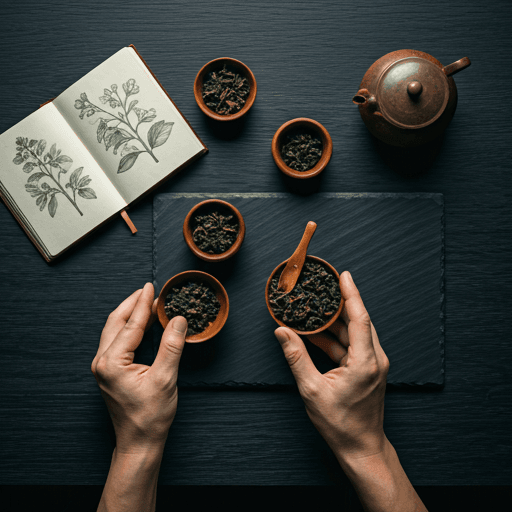
The best way to store loose leaf tea is to protect it from its four enemies — air, light, moisture and heat — plus strong odours. In short, how to store loose leaf tea comes down to keeping it in an airtight, opaque container in a cool, dark, dry cupboard, away from the stove, the kettle's steam and anything fragrant like coffee or spices. Do that and most teas stay fresh and full of flavour for many months.
Loose leaf tea is essentially dried plant material, and like any dried herb it slowly loses its aromatic oils once it meets air, warmth and damp. Good storage will not make a tea better than it was — but it stops a lovely tea from fading into a flat, papery shadow of itself before you have finished the bag. Here is how to keep tea fresh, step by step. If you are still getting to grips with the format itself, our guide to what loose leaf tea is covers the basics.
How to store loose leaf tea: protect it from four enemies
Every rule below comes back to the same idea — reduce contact with air, light, moisture, heat and odours. This quick table is the whole philosophy of loose leaf tea storage on one screen, and the sections that follow simply turn it into easy habits.
| Enemy | Why it harms tea | What to do |
|---|---|---|
| Air (oxygen) | Slowly oxidises the leaves and carries off the volatile aromatics that make tea smell alive. | Use an airtight tin, caddy or sealed jar; keep less empty space above the leaves. |
| Light | Daylight and UV bleach colour and stale the flavour, hitting green and white teas hardest. | Choose an opaque container and keep it inside a dark cupboard. |
| Moisture | Tea is hygroscopic — it pulls in humidity, which leads to mustiness and, in the worst case, mould. | Keep it in a dry spot, seal the lid every time, and stay away from the sink and kettle. |
| Heat | Warmth speeds up staling and drives off the delicate aromatic oils faster. | Store somewhere cool — never above the stove, oven or on a sunny windowsill. |
| Odours | Leaves readily absorb surrounding smells, so tea can start to taste of its neighbours. | Keep tea well apart from coffee, spices, herbs and cleaning products. |
Step 1 — Choose an airtight, opaque container
Air is the biggest culprit, so the single most useful move is to keep your tea sealed. An airtight tin, a caddy with a tight inner lid, or an opaque jar with a good gasket all work well. Non-reactive, opaque materials such as tin, stainless steel, dark glass or glazed ceramic are the classic choices; many people avoid everyday plastic for long-term storage, since it can trap odours and rarely seals as tightly.
Opaque matters just as much as airtight. Clear glass jars look lovely lined up on an open shelf, but daylight quietly fades and stales the leaves — a green tea in a sunny jar can lose its bright character within weeks. If you love the look of glass, keep it inside a closed cupboard. We go deeper into shapes and materials in our tea caddy and storage guide, so this article stays focused on the habits rather than the hardware.
Step 2 — Store loose leaf tea in a cool, dark, dry cupboard
Once the tea is sealed, location does the rest. A cool, dark, dry cupboard is the ideal home — somewhere roughly at room temperature and out of direct light. A pantry shelf, a drawer or a closed kitchen cabinet is perfect, as long as it is away from heat sources.
The kitchen has a couple of traps worth naming. Do not keep tea on a shelf directly above the stove or oven, where heat builds up, and keep it clear of the sink, the kettle and the coffee machine, where steam and humidity linger. Because tea hates damp, a cabinet away from all that moisture is the safest bet for storing loose leaf tea for the long run.
Step 3 — Keep tea away from strong odours
Tea leaves are little sponges for aroma — it is exactly why scenting works, and why jasmine blossoms can perfume a green tea so beautifully. The flip side is that unwanted smells transfer just as easily. Store your tea apart from ground coffee, jars of spices, dried herbs, and anything strongly scented like onions or cleaning products.
An airtight container handles most of this on its own, but a second layer of care helps: give tea its own shelf or box rather than crowding it in with the paprika and the coffee bag. If you keep several teas together, seal each one individually so a smoky lapsang or a spiced blend does not lend its character to a delicate white.
Step 4 — Skip the fridge and freezer for everyday tea
It is tempting to treat the fridge as a freshness machine, but for most loose leaf tea it does more harm than good. Fridges and freezers are humid, and every time you take a container out, condensation can form on the cool leaves as they meet warm room air — inviting the exact moisture you are trying to avoid. For everyday black, oolong, herbal and pu-erh teas, a cupboard beats the fridge comfortably.
There is a narrow, hedge-worthy exception. Some people do cold-store delicate Japanese green teas or matcha to slow their fade, but this only works if the tea is properly vacuum-sealed and, crucially, brought back to room temperature while still sealed before you open it. If there is any doubt, keep it simple: a cool, dark cupboard is the reliable default, and cold storage is an advanced move rather than a rule.
Step 5 — Use the original pouch or small containers
Air trapped inside the container matters too. The more empty space (headspace) above your leaves, the more oxygen sits in contact with them, so a large tin holding a small scoop of tea is not ideal. Two easy fixes: keep tea in its original resealable, foil-lined pouch and press out the extra air before sealing, or decant into a container sized to the amount you actually have.
It also helps to open only what you will drink soon. If you buy in bulk, keep the main stash sealed and well filled, and work from a smaller day-to-day caddy that you top up as needed. Less air, opened less often, is the quiet secret to loose leaf tea storage that keeps a tea tasting the way it did on day one.
Step 6 — Label and rotate your tea
Once teas are decanted into matching tins, they can become anonymous fast. A small label with the tea's name and the date you opened it turns storage into a system. It tells you what is inside, and it reminds you which tins to drink first.
Rotation is the companion habit: use older tea and faster-fading types sooner, and drink down what you have before opening a fresh pouch of the same tea. This first-in, first-out rhythm means nothing quietly ages out at the back of the cupboard. When you do come to brew, our guide on how to brew loose leaf tea helps you get the most from a well-kept leaf.
How long does loose leaf tea keep?
Stored well, most loose leaf tea stays enjoyable for many months, and some types much longer — but shelf life varies a lot by tea. As a rough, hedge-it guide, the delicate teas fade fastest while the more robust ones hold on:
- Green and white teas and other delicate leaves are the most fragile — best enjoyed within roughly six months to a year of opening, when their fresh, grassy character is at its peak.
- Black and oolong teas are sturdier and often keep their flavour well past a year when sealed and stored cool.
- Pu-erh is the outlier: this dark, post-fermented tea from Yunnan is actually meant to mature over years, so aging it is a feature rather than a fault.
These are freshness windows, not hard safety dates, and a tea that has gone flat is usually stale rather than spoiled. For the fuller picture on best-before dates and how to tell when a tea is past its best, see does tea expire.
The takeaway
Storing loose leaf tea well is refreshingly low-tech. Seal it away from air in something opaque, tuck it into a cool, dark, dry cupboard, keep it clear of steam and strong smells, skip the fridge for everyday leaves, and label what you open so you drink it in good time. Get those habits right and the best way to store tea stops being a chore — it simply becomes the reason every cup tastes as good as the first.