
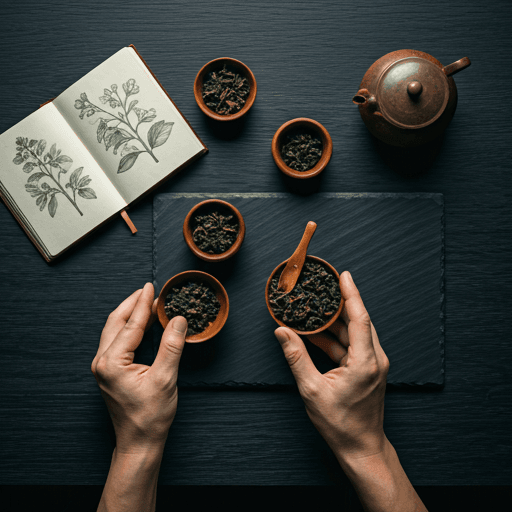
Here is how to make scabious tea in one line: gather a small handful of the pincushion flowers and young leaves of scabious, rinse them, pour just-off-boil water at about 90 to 95 C over them, cover, and steep for 4 to 6 minutes before straining. The result is a light, grassy, gently earthy, caffeine-free infusion with a faint floral lift, a quiet country cup rather than a bold one.
Below is the full method: what scabious tea is and how it tastes, which flowering tops and leaves to use, an identification and foraging note, the ingredients and amounts, ordered steps with a quick reference table, and how to store what you gather. If caffeine-free plant infusions are new to you, our overview of what herbal tea is covers the basics of tisanes, so this guide can stay focused on the flower itself.
What scabious tea is and how it tastes
Scabious tea is a mild, caffeine-free herbal infusion made from the flowering tops and young leaves of scabious, the soft lilac-blue meadow wildflowers whose domed heads look like little pincushions. Several closely related plants share the name: field scabious (Knautia arvensis), devil's-bit scabious (Succisa pratensis), and small scabious (Scabiosa columbaria), all grassland flowers of Europe. A knautia arvensis tea, then, is simply those pretty flower heads and leaves steeped in hot water until the cup turns pale.
The flavour is gentle and green rather than bold, think hay and fresh meadow, with a faintly floral note and only the softest earthiness. It is one of the milder wildflower cups, closer to a warm infused water than to a strong, tannic tea, which is part of its old-fashioned charm on a slow afternoon.
Scabious is a much-loved group of European grassland wildflowers, and its pincushion flower heads are a magnet for bees and butterflies through summer. The name "scabious" comes from an old folk use of the plant for skin complaints, and those historical uses sit outside what we cover here, but the flowers have also long been gathered as a simple country tea. That gentle, everyday tradition is the one this recipe follows.
Which parts of scabious to use
The best cup comes from the flowering tops and the young leaves. Pick the open pincushion flower heads and a few soft upper leaves; the flowers give the prettiest, mildest, most floral infusion, while a leaf or two adds a little green, grassy depth. Older, tougher lower leaves can turn the cup more bitter, so keep to the fresh growth near the top of the plant. A covered, medium steep with a little honey keeps everything pleasant and rounded, and the flowers on their own make the daintiest cup of all.
Identifying and foraging scabious
Because several meadow plants grow tangled together, use only correctly identified, unsprayed scabious, and gather sparingly. Field scabious carries a domed, lilac-blue head of many tiny florets on a tall, slightly hairy stem; devil's-bit scabious shows rounder, more violet-blue buttons; small scabious is daintier and paler. If you are new to foraging, check your plant against a trusted regional field guide, or better still go out once with someone who already knows these flowers.
Gather away from roadsides, treated lawns, and field edges that may have been sprayed, and take only a little from any patch. Scabious flowers are an important late-summer food for bees and butterflies, so leave plenty behind for the pollinators that depend on them, a small handful of tops is all you need for a pot. Rinse everything well before it goes anywhere near the kettle.
What you will need
This is a forgiving scabious tea recipe, so treat the amounts as a starting point rather than a rule.
- Scabious: a small handful of fresh flowering tops and young leaves, or about 1 to 2 teaspoons of dried, per cup (roughly 240 ml / 8 oz). Lean on the flowers for the mildest cup.
- Fresh water: heated to just off the boil, about 90 to 95 C (195 to 205 F).
- Optional: a little honey to sweeten, a squeeze of lemon to brighten, or a few leaves of mint.
- Kit: a mug plus an infuser or small strainer, or a teapot. The florets break into small pieces, so a fine strainer keeps the cup clear.
How to make scabious tea, step by step
- Rinse. Wash the flowering tops and leaves under cool running water to remove grit, dust, and any tiny insects tucked into the florets.
- Add to the cup. Place the scabious in a mug, an infuser, or a small teapot.
- Heat the water. Bring fresh water to a boil, then let it settle for 30 to 60 seconds so it drops to about 90 to 95 C. Scabious does not need a rolling boil.
- Pour and cover. Pour the hot water over the flowers and cover the cup or pot. Covering keeps the delicate aroma in the cup instead of drifting off as steam.
- Steep 4 to 6 minutes. Let it infuse until the water turns pale. Four minutes gives the lightest, prettiest cup; six minutes draws out a little more grassy depth.
- Strain. Lift out the infuser, or strain the tea into a clean cup so no loose florets remain.
- Sweeten and sip. Stir in a little honey or a squeeze of lemon if you like, then sip it warm.
Use this quick reference to match the part you have to the cup you want.
| Part used (per cup) | Steep time | Note |
|---|---|---|
| Flowering tops only | 4-5 min | Prettiest, mildest, most floral cup |
| Tops plus a few young leaves | 5-6 min | A little more green, grassy depth |
| 1-2 tsp dried tops and leaves | 5-6 min | Steady year-round cup once fresh flowers are gone |
The steep-and-strain rhythm here is the same for most flowers and leaves, so if you brew other tisanes it will feel familiar, and our guide to brewing herbal tea covers the general ratios and timings in more depth. A cup made from the flowers alone is especially gentle and pretty, with the palest colour and the softest, most floral character, which makes it a lovely thing to pour for someone trying a wildflower tea for the first time.
A meadow-wildflower cup, like yarrow and dandelion
Scabious sits comfortably alongside a few better-known foraged meadow cups. If you enjoy its hay-and-meadow character, two close companions are worth trying with the same steep-and-strain method: aromatic, faintly bitter yarrow tea, made from another lacy meadow flower, and earthy, golden dandelion tea from the familiar lawn flower. Field scabious tea slots neatly between them, milder than yarrow, softer than dandelion, and all three reward a short steep and a light hand with the sweetener. Once you are comfortable with one, the others follow the same easy pattern.
Storing scabious
Fresh flowering tops are best used the day you gather them, though they will keep for a day or two loosely wrapped in the refrigerator. To keep a supply for later, dry the tops and leaves gently in a single layer out of direct sun until they are papery, then store them in an airtight jar or tin away from heat, light, and moisture. Dried scabious holds its already subtle aroma for several months; after that it fades rather than spoils, so trust your nose and replace it once it smells flat and dusty with no meadow lift left.
Is scabious tea safe to drink?
Scabious is best thought of as a mild, traditional wildflower tea, a pleasant, caffeine-free cup to enjoy occasionally and in modest amounts, not a remedy. Its old folk uses for the skin and other complaints sit outside what we cover here, so this recipe makes no skin, blood, or cure claims; enjoy it simply as a gentle, pretty drink. Responses vary from person to person, and none of this is medical advice.
As with any foraged plant, the identification matters most: brew only scabious you can name with confidence, gathered from clean, unsprayed ground, and keep it an occasional cup rather than a daily habit. If you are pregnant or breastfeeding, taking any medication, or managing a health condition, ask your own healthcare provider before drinking scabious tea. And gather sparingly, so the bees and butterflies that love these flowers keep plenty for themselves.