
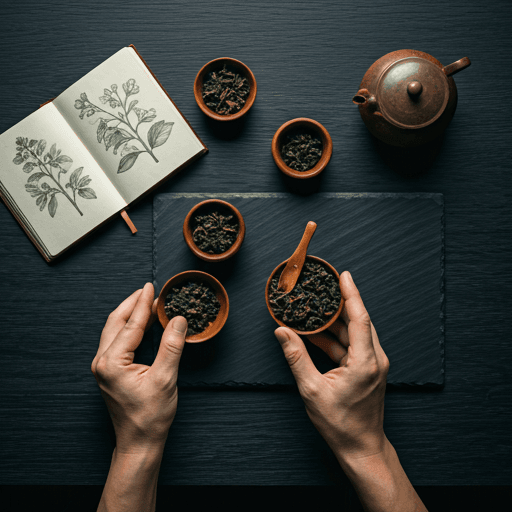
Hong Shui (red water) oolong is a traditional Taiwanese oolong style — not a single garden or cultivar — made with higher oxidation plus charcoal roasting to give a reddish-amber liquor and a deep caramel, honey, and roasted-nut character. It is the "old style" of Dong Ding country, close to how many Taiwanese oolongs were made before today's greener, high-mountain teas became fashionable.
What is Hong Shui (red water) oolong?
Hong Shui (紅水, literally "red water") is a way of making oolong rather than a place or a plant. Two processing choices define it: the leaves are oxidized further than a modern green oolong, and then they are given a long, slow roast — traditionally over charcoal. Together those two levers deepen the liquor from pale gold to a warm amber-red and shift the aroma from fresh florals toward caramel, honey, and toasted grain. The name simply describes the cup: pour it out and the "water" runs reddish.
Because Hong Shui (red water) oolong is a style, you will meet it under several labels — "red water oolong," "Hongshui," or sometimes just "traditional roasted Dong Ding." What holds them together is the recipe, not the mountain. To place it within the wider family, it helps to read a general primer on oolong tea first: oolong is the broad, partially oxidized category that sits between green and black tea, and Hong Shui lives toward the darker, more oxidized and roasted end of that spectrum.
Why is it called "red water"?
The reddish liquor comes from two sources working together. Higher oxidation browns the leaf's polyphenols before the tea is fixed, much as it does in black tea, deepening the infusion. The roast then layers on additional colour and toasty, sugary depth. Neither alone would produce the signature hue — a lightly oxidized leaf that is heavily roasted, or a heavily oxidized leaf left unroasted, reads differently. It is the pairing that yields the classic amber-red "red water."
Crucially, Hong Shui is not a black tea, even though its colour can hint that way. Oxidation is pushed higher than a green oolong but stopped well short of full — the leaf is still fixed (its enzymes deactivated) partway through, which is exactly what keeps it in the oolong family rather than tipping it into a fully oxidized black tea.
A processing style, not a place or a cultivar
This is the single most important thing to understand, and the point most often muddled online. Hong Shui does not name a village or a tea bush. You will find it made on several cultivars and in more than one township. What makes a tea "Hong Shui" is how the maker handles oxidation and roast.
Higher oxidation
Modern high-mountain oolongs are often only lightly oxidized — bright, green, and floral. Hong Shui pushes further. Few makers publish exact figures and sources vary, but the style is commonly described in the region of roughly 40–60% oxidation, with some heavier examples pushing further still. That is markedly more than a green high-mountain oolong yet still less extreme than the famously bug-bitten, heavily oxidized Oriental Beauty oolong, which sits at the very oxidized end of the oolong range. Hong Shui occupies the fuller, rounder middle-to-dark band.
Charcoal roasting
The second lever is roast, and traditionally that meant charcoal. A slow charcoal roast can run across several days, applied in stages at gradually managed temperatures, and the best examples are often re-roasted every year or two as they age — a practice that lets the raw smokiness settle and the sweetness come forward. Done well, the fire "refines" the leaf rather than scorching it, concentrating a burnt-sugar depth without preventing the leaf from opening in the pot. Charcoal work is skilled, slow, and increasingly rare; many modern roasts use electric ovens instead, which is easier but generally considered to give a flatter result than a patient charcoal cure.
Cultivars and terroir
Hong Shui is most classically made on Qing Xin (青心, "green heart") oolong, the benchmark cultivar of Dong Ding country. But because the character comes from processing, makers also produce it on Jin Xuan (TTES No. 12, the creamy cultivar behind many milk oolongs) and Cuiyu / Tsui Yu (TTES No. 13), among others. The historic heartland is small — traditionally the villages of Dong Ding, Yonglong, and Fenghuang in Lugu (Lu Gu) township, Nantou County, at a modest elevation of roughly 700–1,000 metres, well below today's high-mountain gardens — though the style now appears from other Taiwanese growing areas too. For the broader landscape of the island's teas, our overview of Taiwanese tea maps how region, cultivar, and processing intersect.
The Dong Ding connection and the "old style"
Hong Shui is bound up with the history of Dong Ding oolong. The Dong Ding lineage is traditionally traced to Qing Xin ("green heart") oolong plants said to have been carried from the Wuyi area of Fujian to Lugu in the mid-1800s, and by the time Dong Ding became one of Taiwan's most prestigious teas, premium lots were commonly processed in the Hong Shui manner — more oxidized and more roasted than today's green versions. Many drinkers therefore describe Hong Shui as the original Dong Ding style. In fact, the label "Hong Shui" is often said to have come into wide use in the early 1980s, as Dong Ding's fame spread and a term was needed for teas made in the same way but grown outside the three original villages.
Tastes then shifted. As cultivation pushed to ever higher elevations and competition judging rewarded bright, fragrant, lightly oxidized "green" oolongs, the older red-water, charcoal-roasted style fell out of fashion. In recent years it has enjoyed a revival: some makers have deliberately re-adopted the "Hong Shui" name to present the tea on its own terms, rather than have a heavily worked, darker oolong marked down against green-oolong competition standards. So the label carries a small manifesto — a nod to how tea was made in Lugu before lighter styles took over, a heritage that traces back through Dong Ding to the charcoal-roasting rock-tea tradition of Fujian's Wuyi mountains.
Flavour profile
Expect an amber-red cup that drinks warm and comforting. Typical notes include:
- Caramel and brown sugar / burnt sugar — the roast's signature.
- Malt and toasted grain, sometimes reading like freshly baked bread or biscuit.
- Honey and ripe fruit — dried plum, roasted apple, stone fruit; honey notes are especially pronounced in bug-bitten summer leaf.
- Roasted nuts and a gentle mineral or woody depth in the finish.
The body is fuller and rounder than a green oolong, with a smooth, sometimes almost cocoa-like broth and a long sweet aftertaste. A well-made, properly rested Hong Shui should not taste of raw smoke or char; if it does, it often needs more time in the tin for the roast to mellow.
Hong Shui vs. modern light oolong vs. Dong Ding
The clearest way to place Hong Shui is beside its neighbours. The comparison below is a general guide — real teas vary by maker.
| Style | Oxidation | Roast | Liquor | Character |
|---|---|---|---|---|
| Green high-mountain oolong (e.g. Alishan) | Light (~10–25%) | Little to none | Pale green-gold | Floral, fresh, buttery, high fragrance |
| Modern roasted Dong Ding | Light–medium | Light to medium | Gold to light amber | Floral base with toasty warmth |
| Hong Shui (red water) | Higher (~40–60%) | Medium to heavy, often charcoal | Amber-red | Caramel, honey, malt, roasted nuts; full and round |
| Oriental Beauty | Very high (~60–80%) | Usually unroasted | Reddish-amber | Honey, ripe fruit, muscat; from bug-bitten leaf |
Two useful takeaways: first, a light, floral high-mountain tea such as Alishan oolong sits at the opposite end of the oolong spectrum from Hong Shui, even when both are grown in Taiwan. Second, Hong Shui and Oriental Beauty can both look reddish in the cup, but they get there differently — Oriental Beauty relies on very high oxidation of leafhopper-bitten leaf and is typically not roasted, whereas Hong Shui reaches its colour through the combination of moderate-to-high oxidation and roast.
How to brew Hong Shui oolong
Roasted, rolled oolongs reward patience and reasonably hot water. Use good, fresh, off-the-boil water and give the tightly rolled pellets a moment to open. The parameters below are starting points; adjust to taste.
| Method | Leaf : water | Water temp | Approach |
|---|---|---|---|
| Gongfu (small pot/gaiwan) | ~5 g per 100 ml | 95–100°C | Quick rinse, then short steeps (~15–30 s), extending each round; expect 6–8+ infusions |
| Western (mug/teapot) | ~3 g per 250 ml | ~95°C | 2–4 minutes; re-steep 2–3 times, adding time |
Because the roast dominates early, the first proper infusion can taste toasty; the honeyed, fruity mid-notes often bloom from the second and third steeps onward. A porous clay pot can soften a young, firmer roast, while a neutral gaiwan lets you read the tea more clearly.
Storing and aging
One reason drinkers love this style is that it keeps. Well-roasted Hong Shui is traditionally aged, and quality lots may be re-roasted periodically over the years, gradually trading fire for a mellow, plummy depth. Store it airtight, away from light, heat, moisture, and strong odours.
Caffeine and wellness
As a true tea from Camellia sinensis, Hong Shui contains caffeine — generally a moderate amount typical of oolong, sitting below a strong black tea and above most green teas, though the exact level depends on leaf, dosing, and steeping. Neither high oxidation nor roasting removes caffeine, so it is not a low-caffeine choice. Like other teas, it also provides polyphenols and the amino acid L-theanine, which is associated with a calm-but-alert feeling many drinkers report. Any wellness effects are modest and general; tea is a pleasure first, not a treatment, and anyone limiting caffeine or managing a health condition should check with a qualified professional.
The bottom line
Hong Shui (red water) oolong is best understood as a recipe rather than a region: take a classic Taiwanese oolong leaf, oxidize it further than the modern green fashion, and finish it with a patient roast. The payoff is that reddish-amber cup full of caramel, honey, malt, and roasted-nut warmth — a living link to how Dong Ding country made tea before lighter styles took over, and a rewarding, age-worthy alternative for anyone who finds bright high-mountain oolongs too delicate.