
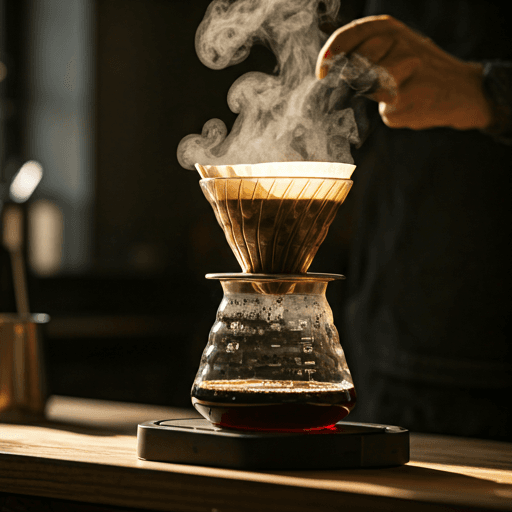
Yes, the island grows coffee. Guadeloupe coffee is real, it is arabica, and it is very small: a scatter of plots on Basse-Terre, the volcanic, rain-fed western wing of the island, farmed mostly by part-time growers alongside bananas, cacao and fruit trees, and sold under an inherited name usually written Bonifieur. Most of it never leaves the island.
What makes this origin interesting is not the size but the sequence. In most places where coffee collapsed, the crop and its reputation went down together and nothing was left to rebuild around. Guadeloupe lost the plantings but kept the name, and every attempt to revive the sector since has had to work backwards from that name to the farms, rather than forwards from farms to a market.
Where Guadeloupe coffee grows, and why only there
Guadeloupe is not one island but two, joined at a narrow channel and commonly described as a butterfly. The eastern wing, Grande-Terre, is a low plateau of reef limestone: flatter, drier, and not coffee country in any serious sense. The western wing, Basse-Terre, is its geological opposite, a young volcanic massif crowned by La Soufriere, wet on its flanks, steep almost everywhere, with deep soils weathered from volcanic rock.
So the growable ground here is not a region. It is a set of slopes. Sources place the surviving coffee overwhelmingly on the Cote-sous-le-Vent, the leeward coast on Basse-Terre's western side, with some attached to the coastal edge of the banana country wrapping the volcano's southern flank. Vieux-Habitants, on that coast, is the historic centre: the town has a coffee museum run alongside a working planter-roaster operation, and in the valley behind it sits Habitation La Griveliere, an old coffee estate listed as a historic monument, which grows coffee, cacao and vanilla again.
Two things follow. The elevations involved are low by the standards of the mountain origins arabica is usually associated with, and the plant compensates through everything else, in volcanic soils rich in humus, heavy rainfall, warm temperatures and dense shade; be careful assuming altitude explains this coffee, because here it does not. And the coffee sits inside a mixed, layered holding rather than a monoculture block, the arrangement Guadeloupe knows as a creole garden, shaded by fruit trees and grown in association with cacao, banana and root crops. That association is old and well attested on the island. It also keeps the plots small, irregular and awkward, which has consequences further down.
At a glance
| Question | What the record actually supports |
|---|---|
| Does Guadeloupe grow coffee? | Yes, genuinely, on a scale the world market never registers |
| Where | Basse-Terre only, and chiefly the Cote-sous-le-Vent |
| Where not | Grande-Terre, flat limestone, drier, unsuited to it |
| Species | Coffea arabica |
| Variety | Unsettled. Typica is the usual scholarly claim; growers name several different things. No study has established a single variety as the one entitled to the name |
| The name | Commonly written Bonifieur; Bonnifieur also appears. Not a registered designation |
| Local name for it | Ti cafe, small coffee, a small-bean arabica, as distinct from gwo cafe |
| Planting system | Mixed creole-garden agroforestry, coffee shaded and grown with cacao, banana and fruit |
| Processing | Washed: pulping, fermentation, washing, flotation, drying |
| Harvest | Selective hand-picking; terrain and mixed planting rule out machines |
| Where it goes | Mostly island roasters, residents and visitors. Accounts conflict on how much reaches Europe |
| Formal protection | None. An appellation route was studied and did not succeed |
| Documentation | Thin and repetitive; quoted output figures vary widely and are rarely traceable |
The name outlived the industry
Bonifieur comes from the French bonifier, to improve or make better. Past that point the sources diverge, and the divergence itself is informative.
The reading with the strongest documentary support is industrial. On the island, the building where coffee was pulped, fermented, washed and dried was a bonifierie, and island research states plainly that in the archives Guadeloupe's coffee was exported under the name cafe bonifieur because of the treatment it received in those buildings. The bonifierie is a real Guadeloupean building type, preserved at Vieux-Habitants and at La Griveliere, not a marketing invention.
The second reading is commercial, and it is the one most often repeated: that roasters elsewhere valued Guadeloupe's coffee as a blending component because a modest proportion of it lifted the whole blend, so the coffee became known as the improver. This usage also appears in the island's own agricultural literature, which asks outright which variety produced the coffee that improved other coffees. The readings are not mutually exclusive, but they aim the name at different things: one at a process performed at home, the other at a reputation earned abroad.
The spelling wanders as well: Bonifieur is the usual form, while Bonnifieur turns up on the island, including in the naming of outfits working with the crop. The scope is genuinely unsettled too. Some sources apply the word to any coffee grown in Guadeloupe, others restrict it to the leeward-coast slopes, and a few treat it as a variety, which it is not. It is a place-and-reputation name attached to arabica.
There is one boundary the name does seem to carry. Growers and older island accounts converge on bonifieur being the small-bean arabica known in creole as ti cafe, little coffee, and they exclude gwo cafe, big coffee, the liberica introduced to the island later, on the grounds that its aroma is too weak to deserve the name. Even in oral tradition, then, the word functioned as a standard that some coffee failed, which is exactly how a place-name behaves when it is doing real work.
Underneath all of this the documentation is thin. Much of what circulates in English traces back to a handful of secondary accounts, tourism copy and roaster product pages that repeat one another, including historical and present-day output figures, which differ substantially between sources and are rarely traceable to anything. No output figures appear here for that reason.
A revival built backwards from a name
A coffee origin normally develops in one direction. Someone plants; someone buys; quality gets defined by what buyers reward; and only then, sometimes after decades, does a name accumulate enough meaning to be worth defending. Reputation is the last thing to arrive.
Guadeloupe inherited the reputation first. By the time coffee had effectively dropped out of the island's agricultural accounts, the name was still in circulation and still carried an old claim to quality. That inverts the whole sequence. The question was never how to name a coffee the island had begun to grow, but what a name the island already held would now have to mean, and who was entitled to use it.
In practice that means locating surviving trees and old parcels on ground that had gone back to forest or bananas; deciding what standard the name implies and then doing the technical work to hit it consistently, which in a washed process means selective picking, controlled fermentation and above all drying; then finding growers willing to farm to that standard on plots that could more easily carry something else; and only at the end looking for buyers. That is appellation logic. A wine region protects a place-name by defining a boundary, a practice and a right to use the word, and growth is a secondary concern or an outright enemy.
The comparison is not decorative, because the appellation route was formally examined. An early-2000s study, carried out for the island's agricultural authorities as part of a coffee sector programme, set out to characterise Guadeloupe's coffee production systems and to delimit zones that could carry a controlled designation of origin. That attempt to relaunch the sector did not succeed, and the reasons recorded for its failure explain more about this origin than anything else in the record.
The first is that you cannot write a specification for something nobody has pinned down. The plantings are heterogeneous, several varieties are present, and the link between the coffee and a specific terroir has never been clearly established. Define a boundary and a practice on that basis and you are guessing. The second is structural: a controlled designation is a collective mark, usable only by members of a defined group, and collective organisation is precisely what this sector has found hardest. Island research describes growers with genuinely different objectives, some farming coffee out of habit and others with ambitions for the sector as a whole, which has made agreement on a shared standard difficult to reach.
The alternative that same research proposes is revealing. A certification mark, unlike a collective one, can be used by anyone who meets the criteria set by whoever owns the mark, and it sits alongside a producer's own label instead of replacing it. That shifts the question from who belongs to the group to who is willing to meet the standard, which is a far easier problem for small, independent growers who need not agree with each other in order to agree with a specification.
Until something like that exists, the name is unprotected, and the restriction of Bonifieur to Basse-Terre's coffee slopes is a convention sources state consistently rather than a boundary anyone can enforce. That is the hinge of the whole project, and it shows up as a contradiction in the record: island accounts describe a minute crop largely absorbed close to home, while the same literature describes the coffee being sold in Europe under the name and European trading houses sourcing it. An unregistered name is exactly the asset a revival built on a name cannot fully control.
The position also rules out the obvious alternative. Supplying the island's own coffee drinkers is not a realistic target, because Guadeloupe consumes far more coffee than it grows, by a wide margin; closing that gap would mean mass production, and mass production would forfeit the specialty quality the name depends on. So the sector aims at the top of the market instead, where a very small volume can matter. That carries its own well-known risks, which how scarcity works in rare coffee covers in detail, and a name with an old reputation, minute supply and no legal protection sits squarely in the middle of them.
How the coffee went away in the first place
Coffee arrived on Basse-Terre in the 1720s and the island became a coffee producer of real consequence through the eighteenth and nineteenth centuries, with plantings across the volcanic slopes and a shipping trade to match. Those estates were established under French colonial rule and worked by enslaved people.
The decline was not one event. Rising duties on the trade cut the exported volume sharply from its eighteenth-century peak. Hurricanes did the physical damage: Atlantic storms periodically flattened tree crops, and the hurricane of 1928 devastated the leeward coast's tree cultivation, coffee and cacao together. Coffee is a perennial that needs several years to come back into bearing, so it recovers from that kind of blow far more slowly than an annual crop, and after 1928 many growers moved the land to something that paid sooner.
Bananas then finished the job, in a quietly ironic way: they are commonly described as having entered the coffee plantations of southern Basse-Terre as a shade plant, and by the twentieth century banana export had become the island's agricultural engine, making the same slopes worth more under bananas than under coffee. Sugar held the flatter land. Coffee is reported to have dropped out of the island's export statistics altogether in 1967.
One popular claim deserves care. Accounts of the decline, including agricultural literature written on the island, list coffee leaf rust among its causes in the nineteenth or early twentieth century. The accepted record of that disease's spread does not support that timing: Hemileia vastatrix is not documented in the Americas until 1970, when it surfaced in Brazil, and reached Caribbean islands later still. Old Guadeloupean coffee certainly suffered pests and disease, and something was damaging it, but naming that specific pathogen in that period looks like an anachronism carried from one retelling into the next.
Two neighbours serve purely as contrast. Haiti shows what the collapse of a genuine giant looks like, a different order of magnitude entirely. Martinique is the sharper comparison: the island where the French Caribbean's founding coffee seedling landed, and where, unlike here, essentially nothing was rebuilt from it. Guadeloupe is the counter-example, the island where a revival actually took hold, however modest.
Who grows it now, and where the coffee goes
The growers are small and, in the main, part-timers: coffee is one element of a mixed holding rather than a specialised business, worked on small parcels of low productivity and organised through grower associations and cooperative-style structures rather than large estates. Island studies also note an ageing farming population, which matters for a crop that only rewards patience. A few visible operations anchor the sector, among them planter-roasters on the leeward coast, the restored estate at La Griveliere, and newer ventures working with researchers on quality. Published counts of holdings are best read as estimates.
Harvesting is the binding physical constraint. Coffee on steep, shaded, mixed plots has to be picked selectively by hand rather than stripped, and selective hand-picking covers what that work involves. The point specific to Guadeloupe is that this picking happens inside a French overseas department, under the same rules and cost structure as mainland France, while the coffee competes with origins built on nothing like the same arithmetic. That mismatch, more than any agronomic limit, is why a Guadeloupean slope stays small even when the coffee on it is good.
Where the crop goes is worth saying plainly: mostly not far. Island roasters take it, and it is drunk by residents and by visitors, sold through island retail and at the estate and museum sites that receive tourists. Some of it is described as reaching Europe under the name, and traders there as sourcing it, but the volumes involved are not documented in any way an outsider can check, and any claim of a substantial export programme should be treated as unverified.
What it tastes like, and what is not documented
There is no reliable public tasting record for this origin, no body of independent evaluations of the kind that exists for larger producers. What exists is a set of repeated descriptions: a clean, mild cup with restrained acidity, commonly reported notes of caramel, cocoa and gentle spice, sometimes a nutty character. Island sources also point to mixed-garden planting and to processing choices, fermentation and drying above all, as sources of variation, which is another way of saying the cup is not uniform.
Two cautions follow. First, the improver reputation describes a blending role, not a flavour: a coffee valued for lifting a blend is being praised for balance and body, not for a distinctive signature, and modern single-origin expectations do not follow from that history. Second, the botany is unsettled, and more so than most accounts admit. Typica is the usual claim for the first variety introduced, growers name a whole range of things on their own land, and the island's archives record arabica, moka and liberica among what was planted over the years. No study has established a variety exclusively entitled to the name, so no cup profile should be predicted from any claimed pedigree.
Could the scale ever change?
A little, plausibly. A lot, no, and probably not in the direction of volume at all.
The ceiling is physical before it is commercial. Basse-Terre's suitable ground is finite and already contested by bananas, forest protection and settlement, and Grande-Terre cannot substitute for it. Hurricane exposure is permanent, and falls hardest on exactly the kind of long-lived tree crop coffee is. Hand-harvest cannot be engineered away on this terrain. None of those constraints is going to loosen.
What can realistically improve is definition. The technical work with the most upside is post-harvest, and drying above all, because consistent drying is what turns good raw material into a coffee that performs reliably in front of a professional evaluation panel, the entrance requirement for the market this origin aims at. The institutional work with the most upside is the name: an agreed written specification, and a mark that anyone meeting it may use, would convert a convention into an asset. A revival that began from a name will be decided, in the end, by whether that name comes to mean something enforceable.
The bottom line
Guadeloupe coffee is a genuine micro-origin: arabica on the volcanic slopes of Basse-Terre, hand-picked in mixed creole gardens, mostly drunk where it grows. Its distinguishing feature is structural rather than sensory. Most collapsed origins have to build a reputation from nothing; this one inherited one and has been working backwards from it ever since. That is why the sector is tiny, deliberately upmarket, and far more concerned with who may use the word Bonifieur than with how much coffee the island could ship, and why the right posture is curiosity plus caution: the coffee is real, and much of what is written about it is not well sourced.