
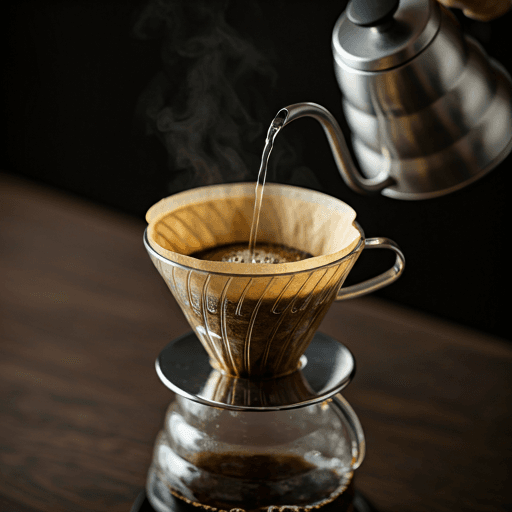
A good all-purpose french press coffee to water ratio is about 1:15 to 1:17 by weight — grams of coffee to grams (or millilitres) of water. Use roughly 1:15 for a stronger, fuller cup and 1:17 for a lighter one. A reliable starting point is about 30 g of coffee to 500 ml of water, which works out close to 1:16. Weigh it if you can; everything else is grind size, a four-minute steep, and a slow press.
The french press coffee to water ratio at a glance
A ratio is just shorthand for how much coffee you use per unit of water, written as 1:X by weight. A 1:16 ratio means one gram of coffee for every 16 grams of water, so 30 g of coffee needs about 480 ml of water. Because 1 ml of water weighs 1 gram, you can read the second number as either grams or millilitres, which is what makes the maths painless.
For the press, the sweet spot most brewers settle on sits between 1:15 and 1:17. Within that band, a lower number means more coffee and a bolder, heavier cup, while a higher number means less coffee and a cleaner, lighter one. If you only remember one figure, make it 1:16: about 60 g of coffee per litre, or 30 g per 500 ml. This is the same idea covered in our broader coffee brewing ratios guide, applied to immersion brewing.
French press ratio table
Use this french press coffee ratio grid as a starting point, then nudge it to taste. All figures are by weight, and coffee amounts are rounded to whole grams.
| Press / batch | Strength | Coffee (g) | Water (ml) | Ratio |
|---|---|---|---|---|
| 1 mug | Light | ~15 g | 250 ml | 1:17 |
| 1 mug | Balanced | ~16 g | 250 ml | 1:16 |
| 1 mug | Strong | ~17 g | 250 ml | 1:15 |
| Standard press | Light | ~29 g | 500 ml | 1:17 |
| Standard press | Balanced | ~31 g | 500 ml | 1:16 |
| Standard press | Strong | ~33 g | 500 ml | 1:15 |
| Large press | Balanced | ~62 g | 1 L | 1:16 |
| Large press | Strong | ~67 g | 1 L | 1:15 |
How to measure the ratio without a scale
A kitchen scale is the single best upgrade for consistent coffee, and it costs less than most brewers expect. We strongly recommend one, because scooped grounds vary with bean size, roast level, and how the spoon is packed. Even so, you can get close by volume: a rough guide is about 2 tablespoons of ground coffee per 180 to 240 ml (6 to 8 oz) cup of water. For a standard 500 ml press that is roughly 5 to 6 tablespoons. Treat volume scoops as a backup, not a precision tool; once you taste two cups side by side, the value of weighing becomes obvious.
Why the french press ratio matters
The ratio sets the strength of your cup, but it also drives extraction, which is how much flavour the water pulls from the grounds. Get it wrong in either direction and you taste it.
- Too little coffee (too high a ratio, like 1:20): the water over-extracts the small dose, and the cup turns thin, weak, and often sour or papery. Under-dosing is the most common reason a french press tastes watery.
- Too much coffee (too low a ratio, like 1:10): the cup is heavy and over-strong, and the metal filter passes more fines, so it can taste muddy and gritty as well as intense.
The 1:15 to 1:17 window keeps you in the balanced zone where the brew is full but clean. From there, you adjust by feel rather than by guesswork.
The rest of the method, briefly
The ratio only lands if the other variables are in place. Here is the short version; for the full walkthrough, see our french press guide.
- Grind coarse. Aim for a texture like coarse sea salt. A fine grind slips through the mesh, makes sludge, and over-extracts into bitterness. Grind matters so much that we gave it its own guide: the best grind for french press.
- Heat the water just off the boil. Around 93 to 96 C (200 to 205 F) is ideal. Water straight off a rolling boil can scorch the grounds, so let it rest about 30 seconds after boiling.
- Add water, start a timer, and steep four minutes. Pour to your measured weight, give it a gentle stir, and let it sit. At about one minute a crust of grounds forms on top; stir it to break it, then skim off the foam and floating grounds if you want a cleaner cup.
- Press slowly. At four minutes, lower the plunger with steady, gentle pressure. A slow press keeps fines out of the cup. If it fights back, your grind was too fine.
- Pour it all off straight away. Decant every drop into cups or a carafe immediately. Coffee left sitting on the grounds keeps extracting and turns bitter within minutes.
How to dial in your french press water to coffee ratio
Once your grind and timing are steady, the ratio is the dial you turn for strength. Change one thing at a time so you know what did what.
- Cup too weak or sour? Add coffee, moving from 1:17 toward 1:15. Thin, sour brews usually need more grounds, not a longer steep.
- Cup too strong or muddy? Use less coffee, moving from 1:15 toward 1:17, and check that your grind is coarse enough.
- Still flat? The beans may be the limit. Fresh, well-roasted coffee tastes fuller at any ratio; our pick of the best coffee for drip and french press is a good place to start.
Adjust in small steps, a gram or two per 250 ml at a time, and keep notes until your house cup is locked in.
The takeaway
Start at 1:16, about 30 g of coffee to 500 ml of water, and treat 1:15 to 1:17 as your working range for a stronger or lighter cup. Keep the grind coarse, the water just off the boil, the steep at four minutes, and the press slow, then pour off the grounds the moment you are done. Nail that coffee to water ratio french press routine once and you will rarely need to measure twice.