
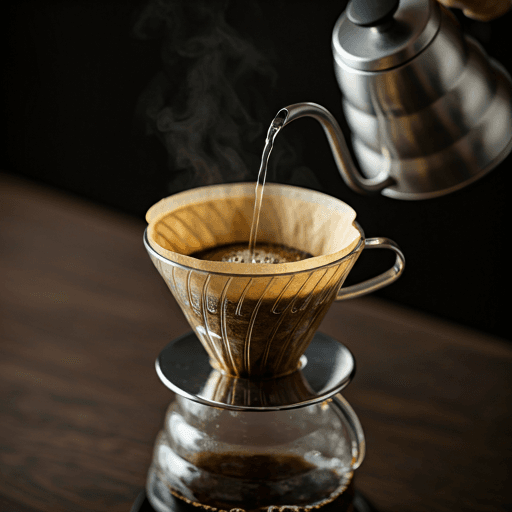
Filter coffee is any brewing method where hot water passes through a bed of ground coffee and a filter — paper, metal or cloth — so the brewed liquid drips clear of the grounds. That sets it apart from immersion brewing, where the coffee steeps in the water (a French press), and from pressure brewing, where a pump forces water through a tightly packed puck (espresso). In short, if gravity pulls water down through the grounds and a filter holds them back, you are drinking filter coffee.
The phrase is an umbrella. It covers automatic drip machines, manual pour-over devices like the V60 or Chemex, and — as a distinct regional sense — the South Indian metal-filter style known as "kaapi." This guide explains the filter coffee method, how the filter material shapes flavor, and a simple, repeatable way to brew a great cup at home.
What "filter coffee" actually means
At its core, the filter coffee method is about separation. Water meets the grounds, dissolves the flavor compounds you want, and then drains away through a barrier that keeps the spent coffee behind. Because the water is always moving downward and draining, this is a percolation style of brewing rather than a soak.
That single mechanical fact explains most of what makes filter coffee taste the way it does. The contact time is moderate, the extraction is even when you pour well, and the cup that lands in your mug is comparatively clean and clear. It is the most common way coffee is made at home around the world, whether from a countertop machine or a hand-poured cone.
Worth knowing: "filter coffee" carries two slightly different everyday meanings. Across most of the world it points to drip and pour-over. In South India it specifically means the strong decoction brewed in a small metal filter and cut with hot milk. Both are genuinely filter coffee — the water still drips through grounds and a filter — they just sit at different ends of the same family.
Filter coffee vs immersion and pressure brewing
The clearest way to place filter coffee is to line it up against the other two big brewing families. The difference is simply how the water and grounds meet.
| Brewing family | How it works | Examples | What you taste |
|---|---|---|---|
| Filter (percolation) | Water passes through grounds and a filter, then drains away | Drip machine, V60, Chemex, Kalita, South Indian filter | Clean, clear, often brighter and more tea-like |
| Immersion | Grounds steep fully in the water, then are separated | French press, cupping bowl, cold brew | Heavier body, more texture, rounder |
| Pressure | Pressurized water is forced through a compact puck | Espresso, moka pot (low pressure) | Concentrated, syrupy, intense |
None of these is "better." They are different tools. Filter coffee is prized for clarity and the way it lets you taste the character of a single origin. If you want a punchy shot you reach for espresso; if you want full-bodied richness you might steep a French press; for an honest, drinkable cup that highlights the bean, you filter it.
Paper, metal or cloth: how the filter changes your cup
The filter is not a neutral part. Its material decides how much oil and fine sediment reaches your mug, and that changes both flavor and mouthfeel more than most people expect.
| Filter type | What it lets through | Result in the cup | Trade-offs |
|---|---|---|---|
| Paper | Traps oils and most fine particles | Cleanest, brightest, lightest body; clarity of flavor | Single use; can add a faint papery note if not rinsed |
| Metal (mesh) | Lets oils and some fines pass | Fuller body, more texture, rounder mouthfeel | Sediment in the cup; reusable and waste-free |
| Cloth | Between paper and metal | Body of metal with much of the clarity of paper | Must be kept clean and damp; wears out over time |
If you love a crisp, tea-like cup that showcases floral or fruity notes, paper is your friend. If you want weight and a velvety feel and you do not mind a little sediment, a metal mesh delivers it. Cloth is the quiet middle path long used in places like the Vietnamese phin and the Japanese nel drip. There is no wrong answer — just match the filter to the cup you enjoy.
Drip filter coffee and pour-over: the everyday styles
Two formats account for most filter coffee made at home. They use the same principle and differ mainly in who controls the pour.
Automatic drip machines
A drip filter coffee maker heats the water and showers it over the grounds for you. It is the convenient, hands-off version: load the basket, press a button, walk away. The drink it produces is what most of the world simply calls "drip coffee," and the cup quality depends on even water distribution, a brew temperature in the right window (around 195–205F, or 90–96C), and a properly sized grind. For a closer look at the resulting drink see what is drip coffee, and for choosing the machine itself read our filter coffee machines guide, since "filter coffee machine" and "drip coffee maker" are two names for the same appliance.
Manual pour-over
Pour-over hands the controls to you. You pour hot water over the grounds in a cone — a Hario V60, a Chemex, a Kalita Wave — and your pour speed, height and pattern shape the extraction. It rewards attention and a steady kettle with a remarkably clean, articulate cup. If you want to learn the technique step by step, our guide on how to brew with a V60 walks through it. Pour-over and drip machines are close cousins; the machine just automates the pour.
South Indian filter coffee, or "kaapi"
South Indian filter coffee is the most distinctive branch of the family. Instead of a cone, it uses a small two-chamber stainless steel filter: ground coffee (often blended with chicory for body and a faint cocoa note) goes in the upper cup, a perforated press disc holds it down, and hot water is added on top. The brew percolates slowly into the lower chamber as a thick, intense decoction.
That decoction is not drunk straight. It is mixed with hot milk and sugar and traditionally poured back and forth between a tumbler and a wide-lipped bowl from a height, which cools it and builds a frothy top. The result is strong, milky and aromatic — a different drinking experience from a black pour-over, even though both are technically filter coffee. We cover the device, the decoction and the ritual in South Indian filter coffee, or kaapi.
How to make filter coffee at home
Here is a reliable method that works for a drip machine or a pour-over cone. Once you have it dialed in, you can nudge the numbers to taste.
- Weigh your coffee and water. Aim for a ratio of about 1:15 to 1:17 — that is roughly 60–67 grams of coffee per liter of water. A 1:15 ratio brews stronger; 1:17 brews milder. A kitchen scale beats a scoop every time.
- Grind medium. Filter coffee wants a grind around the texture of table salt or coarse sand. Too fine and it brews bitter and slow; too coarse and it runs through weak and sour. Grinding fresh, just before you brew, makes the biggest single difference.
- Heat fresh water. Use water just off the boil, about 195–205F (90–96C). If you brew lighter roasts, lean hotter; for dark roasts, lean a touch cooler.
- Rinse the filter (paper). Pour a little hot water through a paper filter first to wash out any papery taste and warm the vessel. Tip that rinse water away.
- Bloom the grounds. Wet all the grounds with about twice their weight in water and wait roughly 30–45 seconds. Fresh coffee will puff and bubble as trapped gas escapes; this even soak sets up a clean extraction.
- Pour evenly and steadily. Add the rest of the water in slow, even pours, keeping the grounds submerged but not flooded. On a machine, simply let it run.
- Let it draw down fully. A medium-batch brew typically finishes in around 3–4 minutes. Give the bed a gentle swirl, then serve. If it tastes weak or sour, grind finer; if it tastes harsh or bitter, grind coarser.
| If you want… | Adjust this |
|---|---|
| A stronger cup | Move toward 1:15, or grind slightly finer |
| A milder, lighter cup | Move toward 1:17, or grind slightly coarser |
| More body and oils | Switch from paper to a metal or cloth filter |
| A cleaner, brighter cup | Use paper and a slightly higher water temperature |
A quick word on gear
You do not need much. A burr grinder for an even, adjustable grind, a kettle (a gooseneck helps for pour-over control), a filter holder or drip machine, and a simple scale will get you most of the way. The grinder matters more than almost anything else, because uneven grounds extract unevenly no matter how careful your pour. From there, the variables are entirely yours: bean, roast, ratio, grind and filter material. Filter coffee is forgiving enough for a weekday autopilot brew and precise enough to chase the last 10 percent of flavor on a slow weekend.
If you are exploring the wider world of brewing, filter coffee is the best place to learn how grind, ratio and water temperature interact, because every change shows up plainly in the cup. Once those instincts click, immersion and espresso make far more sense too. Start with whichever style suits your kitchen — a hands-off drip maker or a hands-on pour-over cone — and let the cup in front of you guide your next small adjustment.