
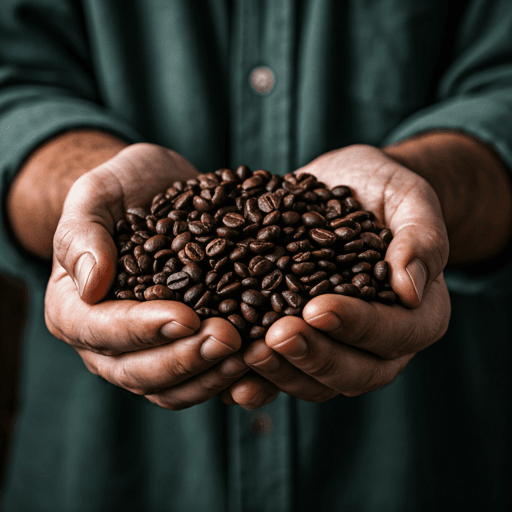
Fiji coffee exists, in quantities the world market never notices, and the interesting thing about it is not where it is planted but that much of it was never planted by anyone now living. Coffee arrived in the islands in the nineteenth century, failed to hold as a plantation crop, and then simply stayed — self-seeded, unmanaged, persisting in village gardens, along shaded river valleys and inside patches of highland forest. The contemporary sector is built substantially on going out and collecting cherry from those inherited trees rather than on establishing new ones.
That makes Fiji unusual. Most producing countries can be described through planting decisions: which variety went in, at what spacing, under what shade, in which year. Fijian coffee inverts the question. The standing crop came first and the industry came second, so the commercial problem has been organising collection and processing around trees whose age, spacing, shade and genetics nobody chose.
What Fiji coffee actually is
Fiji is a Melanesian archipelago in the South Pacific, and its two large islands — Viti Levu and Vanua Levu — carry mountainous, wet, volcanic interiors well inside the latitudes where coffee will grow. Coffee is reported growing across highland districts of both, with the interior and western uplands of Viti Levu appearing most often in accounts of the modern trade. Public reporting names several Coffea species as present in the islands, with arabica and liberica the two currently taken up commercially and robusta also mentioned — reported rather than formally documented, so treat the species picture as approximate. Liberica is a minor commercial species almost everywhere it turns up, and the background on why it behaves so differently from arabica sits in our guide to liberica coffee.
What Fiji coffee is not is a documented origin in the sense that Kenya or Guatemala is documented. There is no regularly published national production figure of the kind the major origins report, no established grading system, no widely circulated harvest calendar and no body of independent cupping results. Most of what is written in English about Fijian coffee traces back to a small number of accounts — a few trade-press features, some government and development-agency material, and marketing copy from the businesses involved. When those accounts agree, it is often because they share a source rather than because anything was independently verified. Anyone writing confidently about tonnages, planted area, tree ages or cup scores for this origin is extrapolating.
The ground that makes the crop possible
Fiji sits well within the tropics, which alone would suggest coffee should be straightforward. The complication is that much of the inhabited country is low-lying, and hot tropical coast is not arabica ground: the fruit ripens too fast to develop much. What gives Fiji a crop is relief. The larger islands have genuinely mountainous interiors with a pronounced wet windward side and a drier leeward side, and the highland belts inside them are cooler, cloudier and shadier than the coasts a short drive away. That is the narrow exception that makes coffee viable — not a general national condition, but specific upland ground reached by rough roads and, in the most remote collection areas, on horseback, well away from the coast most visitors ever see.
Those same highlands are why the trees survived without anyone tending them. Coffee is an understorey plant by ancestry, tolerant of shade and quite capable of persisting in forest margins and along watercourses where the canopy is broken. Accounts of the Fijian case describe plants blooming and fruiting in shaded river valleys and in jungle on community land, reached on foot. A coffee tree that is neither harvested nor cut simply fruits, drops cherry and seeds itself. Over enough decades, that is how an abandoned plantation crop becomes a population of feral coffee trees scattered through a landscape.
Feral, not wild: a distinction worth making
The trade language around this origin is "wild coffee" or wild harvested coffee, and that phrasing is imprecise in a way worth correcting.
These are not a wild Coffea species. Botanically wild coffee means a species growing in its native range — the genuinely wild populations of Ethiopia, South Sudan, Madagascar, West and Central Africa, many of them species no one has ever farmed. Fiji is nowhere near the native range of any Coffea species. Every coffee plant in the islands descends from material somebody carried there and planted deliberately. What has happened since is escape and naturalisation: cultivated plants that outlived their cultivation, reproduced on their own and spread modestly into surrounding vegetation.
The accurate word is feral, exactly as it is for a feral orchard or a feral cat. It matters for two reasons. First, it sets expectations about the plants themselves — these are ordinary cultivated coffee types gone unmanaged, not botanical novelties, and they carry whatever genetics arrived with the original introductions. Second, it prevents a claim that this coffee is a wild forest species being foraged. Forest, shade and environmental framing belong to a separate discussion, which our guide to sustainable coffee handles properly; the honest statement here is narrower and better — the trees were introduced, they escaped, and they are now being harvested.
Wild harvest as a business model
Now the substance. Treat gathering not as a curiosity but as a business model with a specific cost structure, and it becomes clear why it works in Fiji and why it also has a hard ceiling.
What the model removes
Establishing a coffee farm normally means committing land, sourcing seedlings, raising a nursery, clearing and planting, and then waiting several years before the first meaningful harvest — a wait covered in our guide to the coffee plant lifecycle. A gathering model deletes that entire front end. The trees are already there, already mature, already fruiting. Nobody clears land, nobody buys planting material, and nobody waits out an establishment period before the first cherry moves. Where highland households have land, labour and time but limited capital equipment, that is the reason the model exists at all.
It also changes who participates. A gathering economy has no barrier to entry beyond access to the trees and the willingness to walk to them. Accounts of the Fijian case commonly describe collection as village work fitted around subsistence gardening rather than replacing it, with women frequently described as doing much of the picking. That is a very different social shape from a plantation payroll or a titled smallholding.
What the model gives up
Everything a farmer normally controls, a gatherer does not.
- Variety. You harvest whatever was introduced and whatever crossed since. There is no cultivar selection, no replanting to a better type, no consistency of plant material across a collection area.
- Spacing and shade. Trees stand where seeds happened to fall — some in deep shade producing very little, some in gaps producing more, none arranged for access or efficiency.
- Pruning and tree age. Unpruned coffee grows tall, drops production into the upper canopy and cycles unevenly between heavy and light years. There is no stumping cycle and no renovation programme.
- Ripening. Scattered, unmanaged trees in mixed light do not ripen together. Collection is therefore piecemeal rather than organised into clean passes through a block — a contrast with the selective picking practice described in our guide to coffee harvesting and picking.
- Predictability. What comes out of any given area is a function of tree density, weather, and how far people are willing to walk. It cannot be forecast the way a planted block can.
The consequence for quality is direct and often missed. When the raw material arrives from many scattered trees of unknown type and uneven ripeness, almost all of the quality outcome is determined after collection — in sorting, in how fast cherry reaches processing, in drying discipline and in storage. A gathering business is therefore not a farming business at all. It is a collection-and-processing business, and its core skill is logistics rather than agronomy.
The ceiling
Here is the honest limit, and it is the point most coverage of this origin leaves out: a gathered crop cannot be scaled by deciding to scale it. The supply is a fixed inherited standing crop. You can harvest more of it by reaching further, organising collection better, working more districts and losing less cherry to spoilage — but those gains run out. Beyond that point the only way to grow is to start planting, at which stage the model has quietly converted back into ordinary farming, with all the establishment cost and waiting the gathering model was prized for avoiding. Recent activity in Fiji points exactly that way: alongside collection from existing trees, there is public discussion of nurseries, seedling distribution and new planted blocks. That is not a failure of the gathering model. It is what success forces.
At a glance
| Feature | What is reported for Fiji | How confident should you be? |
|---|---|---|
| Scale | Very small; no regularly published national production figure | High — the absence of data is itself well established |
| Where | Highland interiors of the larger islands, Viti Levu and Vanua Levu | High |
| Species | Arabica and liberica taken up commercially; further species reported present | Moderate — reported, not formally documented |
| Origin of the trees | Feral and village-grown descendants of nineteenth-century introductions | High for the mechanism, low for dates and plant types |
| Harvest method | Hand collection from scattered trees, often on community land | High — the most consistently reported feature |
| Share gathered versus farmed | Unknown; gathering is the distinctive part, not provably the whole | Low — treat any percentage as invented |
| Cup profile | Marketing descriptions exist; no independent body of results | Low — no reliable tasting record |
| Main risk | Tropical cyclones; thin infrastructure into the highlands | High |
| Main outlet | Domestic sale, hospitality and visitors; small specialty export | Moderate |
Why coffee never became a plantation crop here
The compact version: Fiji had better options. The colonial plantation economy moved from cotton to sugar in the later nineteenth century, and sugar — quick to establish, millable at scale, backed by capital and shipping — organised the country's agricultural export sector for a century. Accounts of the period note that coffee was considered and set aside, partly because it took years to come into bearing and partly because leaf disease made it unattractive next to cane. Later, tourism became a second great earner, absorbing coastal land, labour and investment attention. Coffee never lost a fight it seriously entered; it was simply never the crop worth committing to, and subsequent commercial plantings have been intermittent, with plantation production widely described as having effectively lapsed before the current interest emerged.
Cyclones and a standing crop you cannot replace quickly
Fiji lies in the South Pacific cyclone belt, with a distinct storm season across the southern-hemisphere summer months. Severe cyclones periodically cross the islands, and their agricultural effect is not subtle: defoliation, snapped branches, felled shade trees, landslips and washed-out access roads into exactly the highland districts where the coffee is.
For a gathering economy this risk has a specific edge. A planted farm that loses trees can replant on a known schedule with known material. A feral population has no replanting programme behind it, because nobody was managing it in the first place — recovery depends on whatever regenerates on its own. Add fragile highland roads and a storm can cut off collection areas for a season, making cyclone exposure a continuity risk for the collection network and not just a yield risk.
What the coffee is, and where it goes
This is the point at which accounts of small origins tend to overreach. There is no reliable, independent tasting record for Fijian coffee. Descriptions in circulation — clean, mild, soft acidity, chocolate and nut character — come overwhelmingly from the businesses selling it, and given uncontrolled variety, tree age and ripeness at collection, batch-to-batch variation should be expected to be wide. The right position is that Fiji coffee has no established, verifiable profile yet, and that anyone asserting one is describing a specific lot rather than an origin.
As for where it goes: much of it is consumed at home. A country with a large hospitality sector has a natural domestic outlet — cafés, hotels and visitors who will take a local bag away with them — and that market absorbs small, irregular volumes without needing export certification, container-scale consistency or an international grading standard. Small specialty export shipments are reported, and recent investment from outside the country is explicitly aimed at building an exportable specialty supply. But for now the sensible description of Pacific island coffee at this scale is that it mostly sells where it is grown, close to the people who gathered it.
Could the scale change?
Possibly, and there are real reasons to think the ceiling is being tested — outside investment in processing capacity, official interest in coffee as a diversification crop, training initiatives in highland communities, and a specialty market that rewards small distinctive origins. Fiji also has advantages most micro-origins lack: an established hospitality channel and existing shipping links.
The constraints are equally real. The relevant highland ground is community land worked by villages rather than consolidated farm blocks, which is a different starting point from assembling a plantation. Labour in the interior is limited and has alternatives. Cyclone risk recurs. And the moment expansion moves past the inherited trees, the economics stop being exceptional and become the ordinary economics of establishing a coffee farm in a remote, small-population country — a much harder proposition than gathering what is already standing. The likeliest outcome is not a Pacific origin at commodity scale but a slightly larger, better-organised version of what exists: a small specialty sector, partly gathered and partly planted, selling most of its output within sight of the trees.
The bottom line
Fiji coffee is worth understanding not for its volume, which is negligible, but for what it demonstrates. An origin can be built on a crop nobody currently living decided to plant. Feral coffee trees, left over from a plantation experiment that lost to sugar, became a real asset once someone organised collection and processing around them — no land clearing, no seedling cost, no establishment wait. That is a clever piece of agricultural economics, and also a model with a fixed roof over it, because inherited supply is finite by definition. Treat any specific number about this origin with suspicion, remember that "wild" here means escaped rather than native, and Fiji becomes one of the more instructive small origins in coffee.