
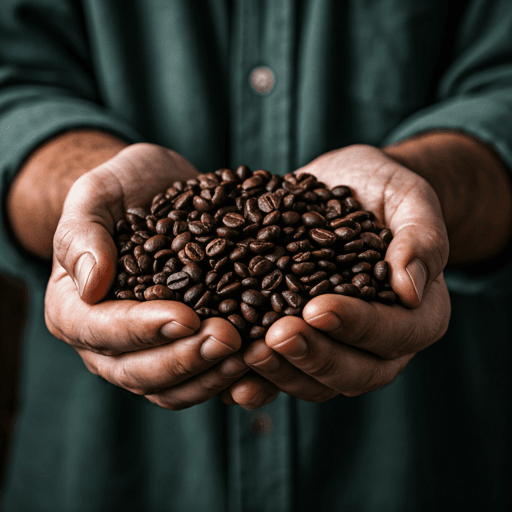
Fair trade coffee is coffee certified to standards designed to give the farmers who grow it a fairer, more stable deal. The headline promise is a guaranteed minimum price that acts as a safety net when the volatile global coffee market falls, plus an extra fair trade premium that farmer co-operatives invest in their communities. It is, at heart, about ethics and price rather than a promise about how the coffee tastes in the cup.
That distinction matters, because the term gets used loosely. Below is what fair trade coffee actually guarantees, how the main labels differ, why the system exists, and the honest debate about how well it works.
What is fair trade coffee?
Fair trade coffee is coffee grown and traded under a set of social, economic, and environmental standards verified by an independent certifier. To carry a Fairtrade certified mark, the coffee has to be traded on terms that include a price floor, a community premium, restrictions on the worst labor practices, environmental rules, and a requirement that smallholder farmers organize into democratic co-operatives. In other words, a Fairtrade label is a claim about how the coffee was bought and sold, not a tasting score.
The two best-known certifiers are Fairtrade International, whose round green-and-blue Fairtrade Mark appears on packs in much of the world, and Fair Trade USA, which resigned its membership in the international system at the end of 2011 and runs its own Fair Trade Certified seal. Their standards overlap heavily but are governed separately, and a key reason for the split was a disagreement over whether to certify larger plantations and unorganized producers, not just smallholder co-operatives.
Why fair trade coffee exists
Most of the world's coffee is grown by tens of millions of smallholder farmers, many working just a few acres. Yet the price they receive is largely set far away, on commodity exchanges, by the benchmark "C" price for Arabica and the London market for Robusta. That price swings wildly with weather, speculation, and global supply, and it can crash below what it actually costs a farmer to grow the crop.
When prices collapse, smallholders have little cushion. They may pull children from school, skip investment in their farms, or abandon coffee altogether. Fair trade was created to put a floor under that boom-and-bust cycle, so that growers are not left fully exposed to a market they cannot control. It is one answer to a structural problem: the people who do the hardest work in the supply chain often capture the least of its value. Smallholder origins such as Ethiopia, the birthplace of Arabica, are exactly the kind of farming communities the model is aimed at.
How Fairtrade works: the minimum price and the premium
Two mechanisms do most of the heavy lifting.
The Fairtrade Minimum Price
This is a floor. Buyers of Fairtrade coffee must pay at least the set minimum for a given type of bean. When the open market price climbs above that floor, farmers get the higher market price instead, so the minimum only "kicks in" during downturns. It functions as insurance against a collapse, not as a fixed payout. Washed Arabica carries a higher floor than Robusta, and natural-processed lots have their own levels.
The Fairtrade Premium
On top of the price, buyers pay an additional fair trade premium for every pound of certified coffee. Crucially, this money does not go straight into an individual farmer's pocket. It goes to the co-operative, and members decide democratically how to spend it, typically on shared projects like a school, a clinic, clean water, processing equipment, or training. There is usually an extra premium for coffee that is also certified organic. This community-investment fund is the part of the model supporters point to most proudly.
Together these make up the core promise of ethical coffee under the Fairtrade banner: a safety-net price plus a pooled fund for development, backed by audits of labor and environmental practices.
Fair trade labels and approaches compared
"Ethically sourced" coffee can carry several different seals, and they do not all mean the same thing. Here is how the main ones line up.
| Approach | What it guarantees | Minimum price? | Main focus |
|---|---|---|---|
| Fairtrade International / Fair Trade USA | Price floor, community premium, labor and environmental standards, co-op organization | Yes | Farmer income and social development |
| Rainforest Alliance (merged with UTZ in 2018) | Environmental protection, biodiversity, farm sustainability, some social criteria | No (buyer and seller negotiate; a separate sustainability differential and investment apply) | Sustainability and ecosystems |
| Direct Trade | Whatever the roaster and producer agree; often high prices, but uncertified and unstandardized | No set floor | Relationships, traceability, quality |
| Organic (e.g. USDA Organic, EU Organic) | No synthetic pesticides or fertilizers; certified growing and handling | No | Growing method, not farmer pay |
A few things to read from that table. Rainforest Alliance, which absorbed the UTZ program when the two merged in 2018, is more environmentally oriented and does not set a guaranteed minimum price, so growers remain more exposed to market swings, though the program includes its own sustainability investment and differential. Direct trade is not a certification at all; it describes a roaster buying straight from a producer, often paying well above commodity rates, but the integrity rests entirely on that relationship rather than an outside auditor. Organic certifies the farming method, not the deal the farmer got, which is why you often see coffee that is both organic and Fairtrade.
Does fair trade mean better-tasting coffee?
Not automatically. This is the most common misunderstanding. Fair trade certifies the economics and ethics of a purchase; it says nothing direct about flavor, roast, or grade. You can find ordinary supermarket-grade fair trade coffee beans and you can find exceptional ones. In practice there is meaningful overlap with quality, because many of the same co-operatives also pursue specialty and organic markets, and the premium can fund better processing and equipment. But the label itself is an ethics-and-price mark, not a cup score. If flavor is your priority, judge it the way you would any coffee, by origin, roast date, and how it tastes. For the quality side of the conversation, see our guide to what specialty coffee means.
The honest debate
Fair trade is widely supported but genuinely contested, and a good explainer should present both sides as views rather than settled fact.
Supporters argue it is one of the few systems that puts a hard floor under farmer income, channels real money into communities through the premium, and gives smallholders bargaining power by organizing them into co-operatives. For households at the mercy of the C price, a guaranteed minimum can be the difference between staying in coffee and walking away.
Critics raise several points. Certification and audit costs can be a burden for small co-operatives. Some studies question how much of the premium ultimately reaches individual farmers versus being absorbed by overhead. In years when the market price sits well above the floor, the minimum does little, and the premium becomes the main benefit. And many specialty roasters argue that a well-run direct trade relationship pays growers more per pound than certification does, with closer attention to quality, even though it lacks third-party verification. None of these criticisms means fair trade fails; they mean it is one tool among several, with real trade-offs.
How to spot it and weigh it up
When you are standing in front of a shelf or scrolling a roaster's site, here is a practical checklist.
- Look for the actual mark. The Fairtrade International Mark or the Fair Trade USA seal is your signal that the coffee is genuinely Fairtrade certified, not just labeled with vague "ethical" language.
- Read the other seals too. Rainforest Alliance, organic, and Bird Friendly each certify different things; more than one can appear on the same bag.
- Treat "direct trade" as a story, not a stamp. It can be excellent, but ask whether the roaster publishes origins, prices paid, or farm relationships to back it up.
- Separate ethics from flavor. Decide what you care about. Certification answers "was this a fairer deal?"; cup quality is a different question with its own clues, like roast date and origin transparency.
- Remember overlap is common. Plenty of coffee is fair trade and organic and single-origin, so you rarely have to choose just one value.
Where fair trade fits in the bigger picture
Fair trade coffee is best understood as one model for trying to make a notoriously unequal supply chain a little fairer, sitting alongside direct trade, sustainability certifications, and organic farming rather than replacing them. It does one job well, putting a floor under price and funding communities, and leaves other jobs, like guaranteeing the best possible cup, to other systems. Knowing what each label does lets you buy on purpose rather than on a buzzword.
To go deeper, read how a coffee roaster sources and transforms green beans, see how buying patterns differ across regions in our look at coffee culture around the world, and if you want sustainably sourced beans arriving regularly, our coffee subscription guide walks through what to look for.