
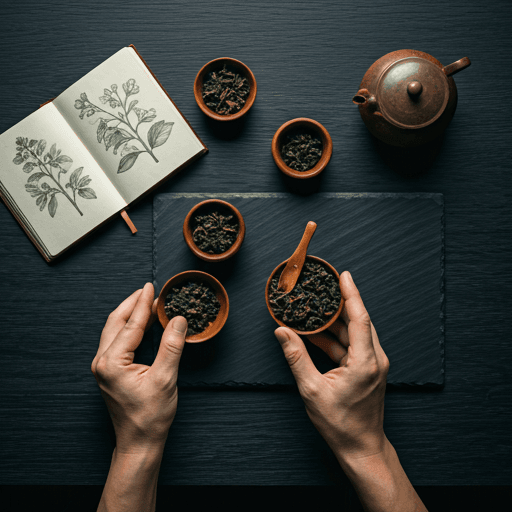
Duyun Maojian is a pan-fired green tea from the misty mountains around the city of Duyun, in the south of Guizhou Province in southwestern China, and it ranks among the country's most decorated leaves. Slender, tightly curved and cloaked in silvery-white down, it pours a clear yellow-green cup with a fresh, brisk, faintly floral-and-chestnut character. If you have seen it written as du yun mao jian, that is simply the same name spaced out from its Chinese pinyin (都匀毛尖), where maojian means “downy tip” — a nod to the fine white hairs that fur the youngest buds.
It is regularly counted among the lists of China's ten famous teas, and its traditional processing was recognised when Chinese tea-making techniques were inscribed on UNESCO's list of intangible cultural heritage in 2022. This guide walks through where Duyun Maojian grows, the terroir that shapes it, the much-repeated legend behind its name, how to tell it apart from the other famous “Maojian” (the one from Henan), what it tastes like, and how to brew it so those downy tips give their best.
What is Duyun Maojian?
Duyun Maojian is a hand-shaped, pan-fired green tea named for its home city, Duyun, in the south of Guizhou Province. The second word is the key to its identity: mao means “down” or “fine hair” and jian means “tip” or “point,” so the name literally advertises a downy-tipped leaf. It belongs to a small family of Chinese greens defined by that furry, bud-heavy pluck, and it is the most celebrated Guizhou green tea of the group — sometimes described as the best known of “the three Guizhou teas.”
As a Chinese famous tea, Duyun Maojian carries real historical weight. It was sent to the imperial court as a tribute tea under the Ming and Qing dynasties, and its reputation has only grown since. For a broader sense of where a leaf like this sits, our overview of the main types of tea explains how unoxidised greens differ from oolong, black and the rest.
Where Duyun Maojian grows: Guizhou's misty plateau
Guizhou is a high, folded plateau in southwestern China, and its combination of low latitude with high elevation gives tea gardens an unusual climate: mild, extremely humid, and wrapped in cloud and mist for much of the year. Around Duyun — the seat of the Qiannan prefecture in the south of the province — the bushes climb slopes that are frequently shrouded in fog, so the young shoots receive plenty of soft, diffuse light rather than harsh direct sun.
That diffuse light matters. Shade and mist slow the growth of the leaf and encourage it to hold on to amino acids such as theanine, which read on the palate as sweetness and savoury depth rather than coarse astringency. Cool nights, frequent rain, mineral-rich acidic soils and a long, gentle growing season round out a terroir that suits delicate, early-spring greens. It is the kind of high-mountain, cloud-and-mist setting that Chinese tea culture has long prized, and it is a big part of why a good Duyun Maojian tastes so fresh and rounded.
The legend behind the name Duyun Maojian
Before it was ever called Maojian, the tea was known locally as “fish hook tea” (yugou cha), because the finished leaves curl into slim, hooked commas that really do resemble tiny fish hooks. By tradition, the modern name dates to 1956, when growers are said to have sent a batch of their spring tea to Chairman Mao Zedong; the popular story holds that he replied with thanks and christened it “Duyun Maojian,” pairing the place-name with the downy-tip description. Historians treat the tale as charming but only loosely documented, so it is best repeated as legend rather than hard fact.
Older honours are attached to the tea too: it is frequently said to have taken a gold medal at the 1915 Panama–Pacific International Exposition, an accolade that local growers still cite with pride. Whatever the precise record, Duyun Maojian's standing as a Chinese famous tea has been centuries in the making, and it remains the pride of its home region.
Understanding a downy tip green tea: leaf, grade and style
Duyun Maojian is a textbook downy tip green tea. The prized pluck is fine and early — a bud with one just-opened leaf, gathered in spring while the shoots are still furred with silvery-white trichomes (the “down”). During processing the leaf is curled and twisted so that those white hairs stand out against the dark green, giving the dry tea its signature look: slim, tightly curved, uniform, and frosted with fine pekoe.
Like most Chinese greens it is pan-fired rather than steamed. Fresh leaves are first spread to lose surface moisture, then given a high-heat fixation (shaqing, or “kill-green”) that halts oxidation and locks in the fresh colour. The warm leaf is rolled and kneaded to bruise the cells and coax out flavour, hand-shaped into its hooked curl, and finished with a gentle, low-temperature roast that dries it down and builds a soft, toasty note. Tradition sums up a fine result with the phrase “three greens and three yellows,” pointing to the interplay of green and gold across the dry leaf, the liquor and the brewed-out leaf.
Grade tracks the pluck and the season. The finest tea comes from the first flush before the spring rains, is almost all fine buds, and shows the heaviest down; later pickings carry more open leaf, brew a touch stronger and cost less. You may also see the pinyin written apart as du yun mao jian on imported packaging — it is the same tea, just a different romanisation.
What Duyun Maojian tastes like
In the cup, Duyun Maojian is fresh and lively. The aroma lifts clean and high, with a delicate floral edge over a warm, toasty-chestnut base that comes from the pan-firing. The liquor is clear and bright — a pale yellow-green — and the flavour arrives brisk and vegetal, with a green-bean or fresh-grass snap, before mellowing into a smooth, sweet, lingering finish (a returning sweetness Chinese tasters call huigan). Well-made and well-brewed it is aromatic and rounded rather than sharp; water that is too hot is the main thing that turns it grassy or bitter.
Duyun Maojian at a glance
| Attribute | Duyun Maojian |
|---|---|
| Origin | Duyun, southern Guizhou Province, China |
| Type | Pan-fired (unoxidised) green tea |
| Leaf style | Slender, curved, tightly rolled, heavy silvery down |
| Liquor | Clear, bright pale yellow-green |
| Aroma | Fresh and high; floral over toasty chestnut |
| Taste | Brisk and vegetal, mellowing to a sweet finish |
| Pluck | Fine — bud and one young leaf; early spring prized |
| Caffeine | Moderate for green tea; varies with leaf, quantity and brewing |
| Brewing | About 75–80°C / 167–176°F water, short steeps |
How it compares with other famous green teas
The most important comparison is with its namesake. Xinyang Maojian shares the “downy tip” name and the slender, downy leaf style, but it comes from Xinyang in Henan Province, far to the northeast, and tends to taste cleaner and more brisk-vegetal. They are cousins in leaf shape, not the same tea — a common point of confusion, because “Maojian” describes a style of downy pluck that several regions produce.
Against Longjing (Dragon Well), the difference is obvious in the leaf: Longjing is pressed flat and smooth and leans nutty-savoury, whereas Duyun Maojian stays curled and downy with a lighter, more floral profile. It also sits close in spirit to Mengding Ganlu, another curly, downy, early-plucked mountain green — if you enjoy one, the other is a natural next pour.
| Tea | Origin | Leaf shape | Flavour lean |
|---|---|---|---|
| Duyun Maojian | Guizhou | Curled, hooked, downy | Floral, toasty-chestnut, sweet finish |
| Xinyang Maojian | Henan | Slender, straight-ish, downy | Clean, brisk, vegetal |
| Longjing | Zhejiang | Flat, pressed, smooth | Nutty, savoury, mellow |
| Mengding Ganlu | Sichuan | Curly, fine, downy | Soft, sweet, delicate |
How to brew Duyun Maojian
Downy green buds are delicate, so the golden rule is to keep the water below boiling. Let a fresh boil cool to roughly 75–80°C (167–176°F); anything hotter scorches the buds and pulls out bitterness. A tall glass or a gaiwan works beautifully, partly because you get to watch the frosted tips slowly sink and “dance” as they open.
- Leaf: about 2–3 g per 150–200 ml of water (a little less if you brew grandpa-style straight in a glass).
- Water: soft, filtered, and cooled to roughly 75–80°C / 167–176°F.
- First steep: 30–60 seconds, then taste; add short increments on later infusions.
- Infusions: good leaf gives three or more steeps, each pulling out a slightly different layer of the flavour.
- Storage: keep it cool, dark, airtight and away from odours, and drink young — fresh spring green tea is at its best within the year.
Like other unoxidised greens, Duyun Maojian is a natural source of caffeine and antioxidant polyphenols. Its caffeine content is moderate for a tea but not fixed — the exact level varies with the leaf, the quantity used and how you brew it — so treat any figure as a range rather than a hard number. Some of the widely discussed potential benefits of green tea may appeal to you, but responses vary from person to person; this is general information, not medical advice.
The bottom line
Duyun Maojian is Guizhou's flagship green tea and one of the most distinctive downy tip greens you can find — slim, curved, frosted with silvery hairs, and layered with floral, chestnut and sweet-finishing notes drawn from its cool, misty plateau. Remember that it shares only its style-name with Xinyang Maojian, keep your water off the boil, and you will have a bright, forgiving cup that shows exactly why this leaf has been treasured as a Chinese famous tea for so long.