
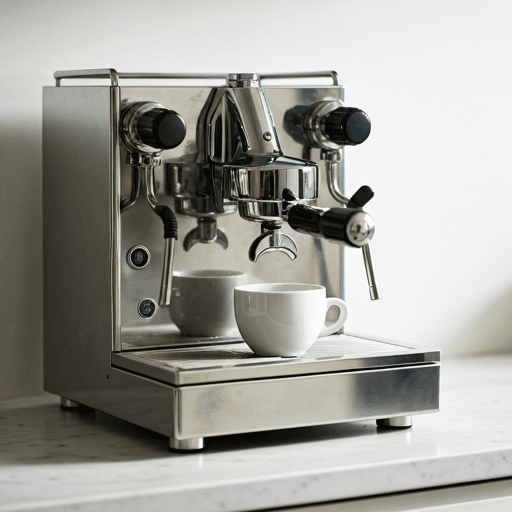
A De'Longhi coffee machine can mean one of several very different things: a slim manual espresso maker you steam milk on yourself, a one-touch bean-to-cup automatic that grinds and pours at the press of a button, or a pod machine that runs Nespresso or Dolce Gusto capsules. De'Longhi makes all of them. This guide maps the full range so you can see how the families fit together — and which kind suits the coffee you actually want to drink.
De'Longhi is an Italian appliance maker founded in 1902 and based in Treviso, in northern Italy. It started in heaters and air conditioning, entered the coffee category with a pump espresso machine in 1993, and launched its first super-automatic, the Magnifica, in 2003. Today its coffee portfolio spans manual portafilter machines, fully automatic bean-to-cup systems, and capsule machines built through long-running partnerships with Nespresso and Dolce Gusto. That breadth is exactly why the lineup confuses people — so let's break it into clear groups.
The four families of De'Longhi coffee machine
Almost every model fits into one of four categories. Pick the category first; the individual model names matter far less than the type of machine.
| Family | How it works | Effort from you | Best for |
|---|---|---|---|
| Manual pump espresso | You grind (or buy ground), dose, tamp, pull a shot, steam milk by hand | High — it's hands-on | People who want to learn espresso and control the result |
| Bean-to-cup automatic | Built-in grinder + brew unit; press a button for a drink | Low — mostly one-touch | Convenience with fresh-ground coffee, every day |
| Pod / capsule machine | Insert a sealed capsule, press a button | Very low — no mess | Speed, consistency, minimal cleanup |
| Drip / filter | Water drips through ground coffee into a carafe | Low | Brewing several cups of black coffee at once |
Manual pump espresso: Stilosa, Dedica and La Specialista
These are traditional portafilter machines. You attach a metal filter holder, tamp the grounds, and pull a shot under pressure. Milk drinks are made on a steam wand by hand. They reward technique and a decent grinder — pair one with a good burr grinder for the best results.
Stilosa — the entry point
The Stilosa is the simplest, most affordable manual machine in the range. It does the basics — espresso and a manual steam wand — with the least automation, which means it also asks the most of you. It's a low-commitment way to find out whether hands-on espresso is your thing.
Dedica — slim and popular
The De'Longhi Dedica is the brand's compact star: a manual pump machine only about 15 cm (roughly six inches) wide, designed for small kitchens. It uses a Thermoblock heating system that reaches brewing temperature quickly. The line has split into variants — the Dedica Style keeps an Adjustable Cappuccino System frother, while the Dedica Arte swaps in a slimmer "My Latte Art" steam wand for hand-textured milk, and the Dedica Maestro adds more advanced temperature control. If counter space is tight, the Dedica is the obvious starting point.
La Specialista — the prosumer step up
La Specialista machines are bigger and aimed at home baristas who want more control. Most include an integrated burr grinder, multiple brew-temperature settings, and pre-infusion. Within the line, the Arte is the most stripped-back and hands-on, the Prestigio sits in the middle, and the Maestro is the top tier with automatic milk frothing and the widest range of temperature settings. This is where De'Longhi blurs the line between "manual machine" and "automatic" — La Specialista gives you barista-style control without going fully one-touch. To see how these compare against a rival's hands-on lineup, the Breville espresso machines guide is a useful cross-brand reference.
Bean-to-cup automatics: Magnifica, Dinamica, Eletta and PrimaDonna
This is the heart of the modern range and the reason many people buy the brand. A bean-to-cup automatic has a built-in grinder and an internal brew unit, so it grinds fresh beans and pours a drink at the press of a button — espresso, lungo, and often cappuccino or latte with an automatic milk system. Cleanup is minimal because the brewing happens inside the machine.
| Range | Position | Typical highlights |
|---|---|---|
| Magnifica | Entry to mid | The classic, best-selling automatic; many sub-versions (S, Start, Evo, Plus) |
| Dinamica | Mid | More one-touch milk drinks; cold-brew on some models |
| Eletta | Upper-mid | Sleeker finish, touch screen, large recipe menu; Explore adds many programmed drinks |
| PrimaDonna | Top tier | Touchscreen, app control, electronically adjustable grinder, the most drink variety |
Magnifica — the one most people mean
The De'Longhi Magnifica is the brand's signature automatic and one of its longest-running names, first launched in 2003. It's the entry-to-mid bean-to-cup line, and it has the most sub-versions — Magnifica S, Start, Evo and Plus among them — which is exactly why shoppers find it confusing. Treat "Magnifica" as the affordable automatic family: fresh-ground espresso at a button press, with a manual or automatic frother depending on the version. If you want one-touch fresh coffee without learning to pull shots, the Magnifica is usually the starting recommendation.
Dinamica, Eletta and PrimaDonna — climbing the ladder
As you move up, you gain screens, presets, automatic milk frothing, app connectivity and cold-extraction features. The Dinamica adds more one-touch milk drinks. The Eletta brings a more refined design and a touch screen, with the Eletta Explore carrying a very large recipe list. The PrimaDonna sits at the top, with a touchscreen, app-controlled recipes, an electronically adjustable grinder you tune from the screen, and the widest drink menu. What you're really paying for as you climb is convenience and variety, not necessarily a "better" espresso — a well-dialed Magnifica makes very good coffee.
Pod machines: Nespresso by De'Longhi and Dolce Gusto
De'Longhi doesn't own Nespresso or Dolce Gusto — those are Nestlé capsule systems — but it has manufactured machines for both for years. A historic 2004 agreement with Nespresso led to De'Longhi-built capsule machines, including the milk-frothing Lattissima line. So when you see a Nespresso-branded machine with De'Longhi on the box, that's the partnership at work; De'Longhi is the appliance maker, Nestlé owns the capsule format.
Pod machines are the lowest-effort option: drop in a sealed capsule, press a button, get a consistent shot with almost no cleanup. The trade-off is ongoing capsule cost and less control over the coffee. If that suits you, read the Nespresso brand guide and the Dolce Gusto pod machine guide to compare the two capsule systems before choosing hardware.
Drip and filter machines
De'Longhi also makes conventional drip coffee makers, which brew a carafe of black coffee by dripping hot water through ground coffee. These are a different category from espresso entirely — they're about volume and ease rather than a concentrated shot. If brewing several mugs of black coffee at once is your goal, a drip maker is the simpler tool; see the broader drip coffee maker guide for how to choose one.
How to choose: match the machine to your habit
Start from how you actually drink coffee, not from the model name. The single most useful question is: do you want to make coffee, or just have it?
- You want to learn and tinker — manual pump (Dedica if space is tight, La Specialista if you want a grinder and more control).
- You want fresh-ground coffee with one button — bean-to-cup automatic (Magnifica to start; climb to Eletta or PrimaDonna for more drinks and screens).
- You want speed and no mess — pod machine (Nespresso or Dolce Gusto format).
- You brew big batches of black coffee — drip maker.
On cost, think in tiers rather than exact figures, which vary by country and retailer. Manual pump machines like the Stilosa and Dedica are the most affordable hardware; La Specialista sits higher; bean-to-cup automatics span entry (Magnifica) to premium (PrimaDonna); pod machines are cheap up front but carry ongoing capsule costs. A grinder is the other variable — manual espresso machines really want a good one, so factor that in.
Rule of thumb: the more the machine does for you, the more you pay for hardware and the less you control the cup. Manual machines flip that — cheaper to buy, more skill required.
Where De'Longhi fits against rivals
De'Longhi's strength is range: it's one of the few brands covering manual, automatic and pod under one name, which is why its bean-to-cup automatics are so widely recommended for everyday convenience. If you're specifically after a hands-on espresso machine with a grinder and a real steam wand, it's worth comparing against Breville (sold as Sage in some markets). For the espresso-only De'Longhi lineup in detail, the De'Longhi espresso machines guide compares the manual pump range against the automatics by skill and convenience.
The short version
Think in four buckets — manual pump (Stilosa, Dedica, La Specialista), bean-to-cup automatic (Magnifica, Dinamica, Eletta, PrimaDonna), pod (Nespresso and Dolce Gusto formats), and drip — and the De'Longhi catalogue stops feeling like an alphabet soup of model names. Decide whether you want to make coffee or just have it, pick the family, then choose a model within it. From there, keep exploring: read up on the espresso lineup or the pod systems before you commit, and you'll buy the machine that matches how you actually drink.