
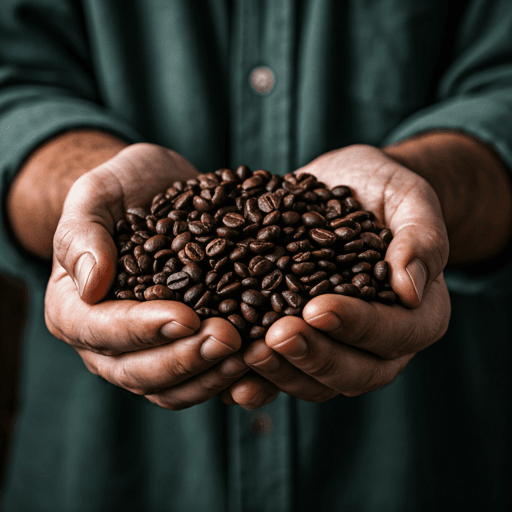
Decaf coffee is ordinary coffee that has had most of its caffeine removed from the green bean before roasting. It is not caffeine-free: a typical cup still carries a small amount, usually only a few milligrams. The flavor is real coffee flavor, and the way the caffeine is stripped out depends on which of four main methods the roaster used. This guide explains how decaffeination works, how much caffeine is actually left, how decaf tastes, and who tends to reach for it.
What decaf coffee actually is
Every coffee starts as a green, unroasted bean that naturally contains caffeine. Decaffeination happens at this green stage, before any roasting. The beans are processed to draw the caffeine out, then dried, shipped, roasted and ground like any other coffee. So decaf is not a different plant or a synthetic substitute. It is the same Arabica or Robusta bean with the stimulant largely taken away.
The key word is "largely." No commercial process removes every molecule of caffeine. Regulators set a floor for how much has to go. In the United States, the rule is that at least 97 percent of the caffeine must be removed for coffee to be sold as decaffeinated. The European Union sets even tighter residue limits on the bean. Either way, a trace always remains, which is why drinking decaf coffee is best described as low-caffeine rather than no-caffeine.
How decaf coffee is made: the four methods
All decaffeination relies on the same basic chemistry. Caffeine dissolves easily in water and in certain solvents. The processes differ in what does the dissolving and how the caffeine is then captured. Here are the four you will see named on bags and menus.
1. Swiss Water Process (water process)
The Swiss Water Process uses only water, temperature and time, with no added solvent. Green beans are soaked so that caffeine and flavor compounds dissolve out into the water. That water is then passed through activated carbon filters sized to trap caffeine molecules while letting the flavor compounds through. The result is a caffeine-free, flavor-rich liquid that is reused to soak fresh batches, so the new beans lose their caffeine but keep most of their flavor. It is a popular choice for roasters who want to label decaf as chemical-free, and it is a registered trademarked process.
2. CO2 (carbon dioxide) process
This method uses carbon dioxide held under high pressure until it behaves as a "supercritical" fluid, somewhere between a gas and a liquid. The CO2 is forced through moistened beans, where it selectively binds caffeine while largely leaving the oils and flavor compounds behind. The caffeine is then separated out and the CO2 is recycled. It is efficient, very selective, and tends to preserve flavor well, which is part of why it is common for large-volume commercial decaf.
3. Ethyl acetate ("sugarcane" / natural) process
Ethyl acetate is an ester that occurs naturally in fruit and can be derived from fermented sugarcane, which is why coffee made this way is often marketed as the "sugarcane process" or "natural decaf." The solvent is circulated through steamed beans to bond with and carry off the caffeine. Because ethyl acetate has a low boiling point, the beans are rinsed and steamed afterward so that no meaningful residue remains in the final product. It is widely used and is recognized as safe in food by major regulators.
4. Methylene chloride (direct solvent) process
This is the oldest solvent method and still in use. Methylene chloride is applied to draw out the caffeine, then the beans are thoroughly steamed and dried. The compound is volatile and largely evaporates during roasting and brewing. Regulators set strict residue limits — in the US the maximum allowed residue is ten parts per million, and the EU limit is lower still — and authorities consider those trace levels safe. It does, however, attract the most consumer concern of the four, because methylene chloride is flagged as a hazard in industrial settings, so some buyers deliberately avoid it. If a bag does not state its method, it may have used a solvent process; water-process and CO2 decafs almost always say so on the label.
Methods compared at a glance
| Method | What does the work | Solvent added? | Reputation |
|---|---|---|---|
| Swiss Water | Water plus carbon filters | No | Marketed as chemical-free; good flavor retention |
| CO2 / supercritical | Pressurized carbon dioxide | No (CO2 only) | Very selective; common in commercial decaf |
| Ethyl acetate (sugarcane) | Naturally derived ester | Yes (food-safe, rinsed out) | Often labeled "natural"; bright flavor |
| Methylene chloride | Chemical solvent | Yes (tightly regulated residue) | Oldest method; most consumer concern |
How much caffeine is actually left in decaf?
This is the question that matters most, and the honest answer is: a little, but not zero. Across typical reporting, an 8 oz (about 240 ml) cup of brewed decaf contains roughly 2 to 5 mg of caffeine, with some sources putting the broader range at around 3 to 15 mg depending on the bean, the method, the brew strength and the serving size.
For comparison, the same size cup of regular brewed coffee usually carries somewhere around 95 mg, and can run much higher for stronger brews. So a cup of decaf typically holds in the order of a tenth or less of the caffeine of regular coffee. Put bluntly, you would need to drink many cups of decaf to match the caffeine in a single regular cup.
| Drink (about 8 oz / 240 ml) | Rough caffeine |
|---|---|
| Regular brewed coffee | ~95 mg (often more) |
| Decaf brewed coffee | ~2 to 5 mg (up to ~15 mg) |
| A single shot of decaf espresso | typically a few mg |
Two practical caveats. First, espresso-based decaf drinks can carry more caffeine than a small drip cup simply because there may be more than one shot. Second, the trace is real, so anyone advised by a clinician to avoid caffeine entirely (for a medical reason, for example) should treat decaf as low-caffeine rather than caffeine-free. For the broader picture of how caffeine behaves in the body, see our guide to caffeine, explained.
Does decaf coffee taste different?
Decaf has long had a reputation for tasting flat or papery, and old, carelessly processed decaf earned it. Modern decaf is far better. The decaffeination step does change the bean slightly — it can soften acidity and mute some aromatic compounds — but a well-chosen water-process or CO2 decaf, freshly roasted and freshly ground, can be genuinely good.
A few things help. Buy decaf with a visible roast date and use it fresh, because decaffeinated beans can stale a touch faster. Grind just before brewing. And match the brew method to the bean as you would with any coffee — a clean pour-over or a French press both flatter decaf. If you grind your own, our guide to grinding coffee beans at home applies equally to decaf, and the choice of brewer in our coffee maker guide matters just as much.
Who drinks decaf, and why
Decaf is not only for people avoiding caffeine entirely. Common reasons people choose it include:
- Time of day. An evening cup without the sleep disruption of a full dose of caffeine.
- Sensitivity. People who feel jittery, anxious or shaky on regular coffee but still want the ritual and flavor.
- Quantity. Heavy coffee drinkers who want a fourth or fifth cup without piling on more stimulant.
- Medical guidance. Those advised to cut back on caffeine, while remembering decaf is low-caffeine, not caffeine-free.
- The taste of coffee itself. Plenty of people simply like the flavor and warmth of a cup, caffeine aside.
Decaf also pairs naturally with the wider world of low- and no-caffeine drinks. If you are cutting caffeine in the evening, caffeine-free herbal infusions are worth exploring alongside it — start with our guide to herbal teas and their types.
Decaf and your daily coffee habit
If you already drink and enjoy regular coffee, the simplest way to think about decaf is as a flavor-first version of the same drink, with the stimulant turned down. Many people keep a bag of each and switch by time of day. The brewing, the grinding, the milk, the cup — none of it changes. Only the caffeine does.
That said, decaf still earns its place on the strength of the bean and the roast, not the absence of caffeine. A stale, cheap decaf will taste like a stale, cheap regular coffee. A fresh single-origin water-process decaf can be a delight. The same buying instincts apply: freshness, a clear roast date, and a method you are comfortable with. If you want to compare against the full-caffeine reference point, see the benefits of black coffee for how the regular version stacks up.
The bottom line on decaf coffee
Decaf coffee is real coffee with at least 97 percent of its caffeine removed at the green-bean stage, using one of four methods: the chemical-free Swiss Water Process, the CO2 process, the naturally derived ethyl acetate "sugarcane" process, or the older methylene chloride solvent process. A cup still carries a small trace of caffeine — usually a few milligrams, far below regular coffee — so it is best thought of as low-caffeine rather than caffeine-free. Choose a fresh, clearly labeled bean, brew it like any good coffee, and decaf can taste every bit as satisfying. From here, dig into how the stimulant itself works in our caffeine guide, or keep exploring the wider coffee hub.