
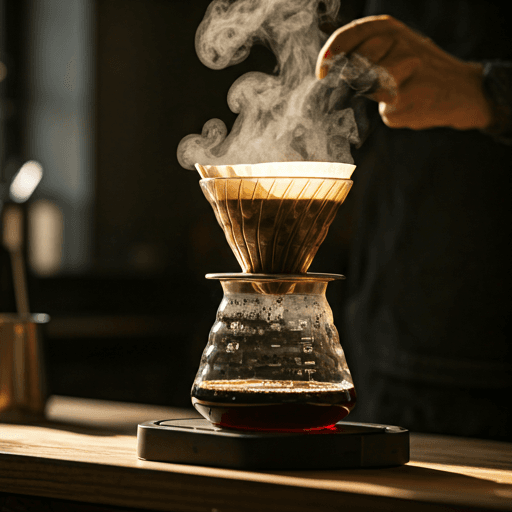
A cup of coffee is the everyday name for a single serving of brewed coffee, and a "cup of joe" is simply American slang for the very same thing. The twist is that nobody fully agrees on why coffee is called "joe," and a "cup" is not even a fixed amount. This guide untangles the phrase as plain language, the folklore behind the nickname, and what actually counts as a cup when you pour one.
The phrase "a cup of coffee" in everyday language
Before it was slang, "a cup of coffee" was just a description: hot water passed through ground coffee, served in something you can hold. Over time the phrase did far more work than that. It became shorthand for a small, friendly amount of time. "Let's grab a cup of coffee" rarely means the drink matters most; it means a short, low-pressure chat. A "two-cup problem" is one that needs a bit of sitting and thinking.
The phrase also measures effort and brevity. A musician who "couldn't carry a tune for a cup of coffee" is hopeless at it; an athlete who had "a cup of coffee in the big leagues" played there only briefly. None of these uses care about the actual beverage. They borrow the cup as a unit of something small, ordinary and human, which is exactly why the drink slipped so easily into so many idioms. If the social side of the ritual interests you, our guide to what a coffee break is and our tour of coffee culture around the world pick up that thread.
What is a cup of joe?
A cup of joe is American English slang for a cup of coffee, plain and simple. There is no special preparation, roast or size implied. So when someone asks "what is a cup of joe," the honest answer is that it is the same drink wearing a nickname, the way "java" or "a brew" do. The word "joe" almost always attaches to ordinary, everyday coffee, the diner-counter or office-pot kind, rather than a delicate single origin. That casual flavour is a clue to where the name may have come from.
The phrase is firmly North American and started turning up in print in the 1930s, with "joe" used for coffee in U.S. Navy circles a little earlier. It has stayed in steady, affectionate use ever since, which is part of why its true origin is so hard to pin down: by the time anyone wrote it down, the story behind it had already gone fuzzy.
Why is coffee called joe? The origin theories
Here is the short version: nobody knows for certain. The question "why is coffee called joe" has several competing answers, all repeated confidently and none actually proven. Etymologists do not agree, and the most popular story is also one of the shakiest. Treat the theories below as folklore worth knowing, not settled fact.
| Theory | The story | How solid is it? |
|---|---|---|
| Navy / Josephus Daniels | U.S. Secretary of the Navy Josephus "Joe" Daniels reportedly tightened alcohol rules on ships around 1914, supposedly leaving coffee as the strongest drink aboard, so sailors drank a "cup of joe." | The most repeated story, but historically shaky. There is roughly a 20-year gap before the phrase appears in print. |
| The average "Joe" | "Joe" is slang for an ordinary man, so a cup of joe is the common person's everyday drink. | Plausible and fits the casual tone, but unproven. |
| "Jamoke" (java plus mocha) | "Joe" is a contraction or corruption of jamoke, a 1930s nickname for coffee blending the words java and mocha. | Favoured by several linguists; still circumstantial. |
| Martinson's coffee | A New York roaster founded by Joe Martinson, whose coffee was locally called "Joe's." | A charming marketing story with little hard evidence. |
The Navy and Josephus Daniels
This is the version you will hear most. As Secretary of the Navy, Josephus "Joe" Daniels is often said to have banned alcohol from ships in 1914, after which coffee became the strongest drink available to a sailor. Hence, the story goes, a "cup of joe." It is a tidy tale, but historians push back on it. Wine and spirits were already scarce on most ships before Daniels, and, more tellingly, the phrase does not show up in writing until the 1930s, a long silence for a term supposedly born in 1914. Repeat it if you like, but flag it as legend.
The ordinary "Joe"
In American slang, "Joe" stands in for any regular guy, the average Joe, G.I. Joe, a good Joe. Coffee in the early twentieth century was the people's drink: cheap, everywhere, and democratic. By this reading, a cup of joe is simply the ordinary person's cup, named after the ordinary person. It cannot be proven, but it sits comfortably with how casually the word is used.
The "jamoke" contraction
Many language scholars lean toward the least dramatic explanation. "Jamoke" (sometimes "jamocha") was a real period nickname for coffee, stitched from java and mocha, two famous coffee-trading names. The idea is that "jamoke" got clipped in everyday speech down to "joe." The words java, jamoke and joe even appear together in a 1931 U.S. Navy manual, which strengthens the link without quite sealing it. It is unglamorous, which is often a good sign in etymology.
What actually counts as a "cup" of coffee?
Here is the part that surprises people: a "cup" is not one fixed size. The word means different things in your kitchen, on your coffee maker and in a brewing standard, which is why a "12-cup" pot never fills twelve mugs.
| "Cup" | Volume | Where you meet it |
|---|---|---|
| Kitchen / US customary cup | 8 fl oz (about 237 ml) | Recipes and measuring cups |
| Coffee-maker "cup" | about 5 to 6 fl oz (roughly 150 to 180 ml) | The rating on drip machines and carafes |
| Metric cup | 250 ml | Common in many countries |
| Typical mug | about 10 to 16 fl oz (300 to 475 ml) | Your everyday coffee at home or work |
| Espresso / demitasse | about 2 to 3 fl oz (single or double shot) | A short, concentrated serving |
The mismatch is real and worth remembering. A kitchen cup is 8 fluid ounces, but most drip machines quietly define their "cup" as only about 5 to 6 ounces, a holdover from older porcelain coffee cups. So a "10-cup" carafe holds roughly 50 to 60 ounces, not 80. A standard mug, meanwhile, usually holds one and a half to two of those small cups, which is why a single mug can quietly carry a fair amount of caffeine. If you want to dial in your own pour, our walkthrough on how to make coffee covers ratios and volumes in plain terms.
How much caffeine is in a cup?
Because the cup itself is fuzzy, so is the caffeine number. As a general guide, a standard 8 fl oz cup of brewed coffee tends to carry somewhere around 80 to 100 mg of caffeine, though the real figure swings with bean type, roast, grind and brew time. A large mug or a refilled diner cup can push well past that. A single espresso shot is concentrated but small, often landing in a similar ballpark per serving despite the tiny volume. For the full picture, see our explainer on how much caffeine is in a cup of coffee.
So, what should you call it?
All of it is correct. "A cup of coffee" is the plain description, "a cup of joe" is the friendly nickname, and "java" or "a brew" work too. The nickname carries a little history and a lot of warmth, even if the history itself is unsettled. That is rather fitting for a drink whose whole charm is being ordinary, shared and reliably good. Next time someone pours you one, you will know that the phrase is older and stranger than it looks, and that the size in the cup is anyone's guess until you measure it.