
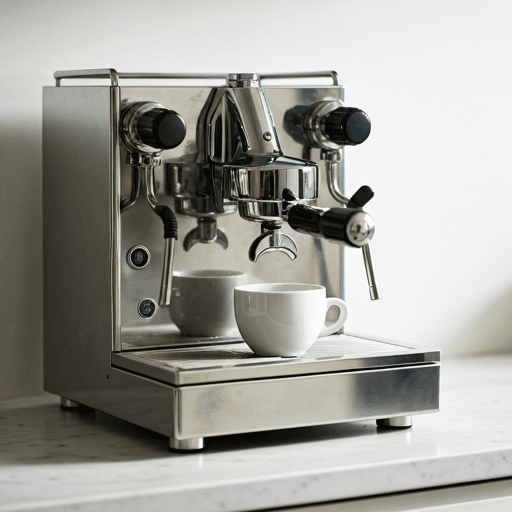
A commercial espresso machine is the engine room of a cafe, coffee bar or busy office: a plumbed, high-output, group-head machine built to pull shot after shot all day without losing temperature or steam pressure. Choosing one well comes down to a handful of decisions, not a brand badge. How many group heads do you need for your peak rush? What boiler design keeps your shots stable while you steam milk? And how will you treat your water? This guide walks through the types and the trade-offs so you can match a machine to your real throughput, your space and your team. We sell nothing here, so there are no prices and no ranked picks, just the criteria that actually matter.
What a commercial espresso machine actually is
A commercial espresso machine forces water heated to roughly 195-205F (90-96C) through a compacted puck of finely ground coffee at around 9 bar of pressure, producing a concentrated shot topped with crema. If you want the fundamentals of the drink itself, our explainer on espresso, the base of every coffee covers what is happening in the cup. The difference between a home unit and a true cafe espresso machine is duty cycle. Commercial machines are built to brew continuously for twelve hours or more, recover heat almost instantly between shots, and steam milk powerfully enough to keep a queue moving. They are usually plumbed directly to a water line, run on dedicated high-amp power, and use larger boilers, sturdier group heads and serviceable parts.
This guide is the espresso-specific deep dive. If you are weighing espresso against bean-to-cup machines and batch brewers for a wider menu, start with our broader overview of commercial coffee machines and come back here once you have decided espresso is your heart drink. For making shots in a domestic kitchen, see how to make espresso at home instead, since the priorities there are very different.
The three types of commercial espresso machine
Commercial espresso machines fall into three broad families, defined by how much the operator controls and how much the machine automates. Picking the right family is the single biggest decision, because it sets your staffing model, your training burden and your ceiling on quality.
Semi-automatic: the classic cafe workhorse
On a semi-automatic, a barista grinds, doses, tamps and locks in the portafilter, then starts and stops the shot by hand. The machine supplies pressure and temperature; the human supplies judgement. This is the traditional group-head setup behind most specialty bars, because it gives a skilled operator full control over every shot and the highest quality ceiling. It demands a trained barista and a separate grinder, but it is the format serious coffee is built on.
Automatic (volumetric): consistency at speed
An automatic, or volumetric, machine is mechanically similar to a semi-automatic but adds programmed shot volumes. The barista still preps the portafilter, but the machine measures the water and stops the shot itself once it has dispensed a set volume. That removes one variable during a rush and keeps shots consistent across a busy team and a long shift. Volumetric control is the quiet workhorse of high-volume cafes where speed and repeatability matter as much as craft.
Super-automatic and bean-to-cup: one-touch, no barista
A super-automatic, often called bean-to-cup, grinds, doses, tamps and brews at the press of a button, and frequently steams or texturises milk automatically too. There is no portafilter and no barista skill required, which makes this the natural fit for self-serve offices, hotels, convenience settings and locations that cannot staff a trained operator. The trade-off is a lower quality ceiling and more internal components to clean and service. For a full treatment of this category, see our bean-to-cup coffee machine guide.
| Type | Who controls the shot | Best for | Staffing |
|---|---|---|---|
| Semi-automatic | Barista times the shot by hand | Specialty cafes, quality-first bars | Trained barista required |
| Automatic (volumetric) | Machine measures a programmed volume | Busy cafes needing speed and consistency | Trained barista, faster across a team |
| Super-automatic / bean-to-cup | Machine does everything, one touch | Offices, hotels, self-serve, no barista | Minimal; restock and clean |
How many group heads do you need?
The group head is where hot water meets the coffee, and the number of group heads sets how many shots you can pull at once. This is your throughput dial, and you size it to your peak hour, not your daily average. A two-group machine that idles all morning can still buckle if it cannot keep up with the eight-thirty rush.
- One group: low volume. Small offices, kiosks, a tasting bar or a second backup station. Compact and lower-power, but a bottleneck the moment two orders land together.
- Two groups: the default for most cafes. Two baristas can work in parallel, one pulling shots while the other steams, which is where real service speed comes from.
- Three or more groups: high-traffic cafes, drive-through and venues with sustained queues. More groups mean more simultaneous shots, but also more space, more power and more water demand.
| Group heads | Rough drinks per day | Typical setting |
|---|---|---|
| 1 group | Up to ~150 | Small office, kiosk, low-volume bar |
| 2 groups | ~150-350 | Most cafes and coffee bars |
| 3+ groups | ~350-500+ | High-traffic cafes, drive-through, events |
Treat these bands as starting points. Drink mix matters too: a menu heavy on milk drinks leans harder on steam capacity than on group count, while a straight-espresso crowd stresses the groups.
Boiler design and temperature stability
Boiler architecture decides whether your machine can brew and steam at the same time without the temperature drifting, and it is where cost and capability separate most. There are three common designs.
Single boiler
One boiler heats water for both brewing and steaming, switching between the two. It is simple and inexpensive, but you cannot brew and steam simultaneously, which makes it impractical for genuine commercial service and better suited to very low volume.
Heat exchanger (HX)
A heat exchanger runs a single steam boiler with a small tube passing fresh, cooler water through it for each shot. That lets you brew and steam at once with fewer parts to fail, which is why HX machines are popular, reliable cafe workhorses. The catch is slightly less precise brew-temperature control, often managed with a brief "cooling flush" before the first shot.
Dual boiler
A dual-boiler machine has one boiler dedicated to brewing and a separate one for steam, each held at its own temperature. This gives the most stable, repeatable brew temperature while you steam at full power, which is why it is the choice for quality-focused, high-volume bars. Many also offer independent temperature per group. Expect a higher cost and more to maintain.
Layered on top of any of these, PID temperature control uses an electronic controller to hold the brew water within a degree or so of target, a meaningful upgrade for shot-to-shot consistency. On multi-group machines, look for whether each group can be set independently, which lets you dial different temperatures for different coffees.
Steam power for milk
In most cafes, milk drinks outnumber straight espresso, so steam capacity is as important as brewing. A larger steam boiler and well-designed wands let baristas texture silky microfoam fast and keep going through a rush without the steam fading. Check the number and reach of the steam wands, whether the machine offers cool-touch wands and, on some models, automatic or temperature-controlled steam that helps less experienced staff. If your menu is milk-forward, prioritise steam recovery just as highly as you prioritise group count.
Water, power and plumbing
A commercial espresso machine is a piece of infrastructure, not a countertop appliance, and the install requirements are easy to underestimate. Plan these before you buy.
- Plumbed water and drainage: nearly all commercial machines connect directly to a water line rather than a fill tank, and they need a drain for the drip tray. Confirm you have both a supply point and a drain where the machine will sit.
- Power: these machines draw far more than a wall socket. Smaller one and two-group units often run on a dedicated single-phase high-amp circuit, while larger multi-group machines may need three-phase power. Three-phase can heat bigger boilers faster and more efficiently, but it requires the right supply at the site. Have an electrician confirm voltage, phase and amperage before ordering.
- Space and ventilation: allow room for the machine, the grinder, a knock box and barista movement, plus airflow and bench strength for the weight.
Water treatment: the top reliability factor
If you remember one thing from this guide, make it this: water quality is the single biggest factor in how long a commercial espresso machine lasts. Scale, the mineral build-up from hard water, is the leading cause of commercial machine failure. It coats heating elements, narrows valves and pipes, and slowly chokes the machine. A dedicated water treatment system, typically softening and filtration matched to your local water, prevents that build-up and protects every internal part. It also improves the coffee, since water chemistry shapes extraction and flavour. Test your incoming water, fit the right filter or softener, and service it on schedule. It is the cheapest insurance you can buy for an expensive machine.
Workflow features worth knowing
Beyond the core hardware, a few features shape day-to-day service and the quality ceiling of a commercial espresso maker:
- Pre-infusion: a gentle low-pressure wetting of the puck before full pressure hits, which can reduce channelling and even out extraction for a sweeter shot.
- Flow and pressure profiling: higher-end machines let the operator shape pressure across the shot. It is a powerful tool for specialty work, but a refinement rather than a necessity for most bars.
- Volumetric programming and shot timers: on-screen shot timers and programmable doses help a team hold consistency through a rush.
- Display and diagnostics: clear readouts for temperature, cleaning prompts and fault codes make the machine easier to run and to service.
Serviceability and a trained operator
A commercial machine is a long-term relationship, so weigh how easy it is to keep running. Favour machines with strong local service support, accessible spare parts and a technician network you can actually reach. Daily cleaning, group backflushing, gasket changes and periodic descaling are routine, not optional, and a maintenance schedule keeps a machine reliable for years. Just as important is the human: a semi-automatic or volumetric machine is only as good as the barista running it, so budget for training. A super-automatic lowers that skill bar but still needs disciplined cleaning. Match the machine to the team you can realistically staff and support.
How to choose a commercial espresso machine: a checklist
Before you commit, run through these questions. They turn a confusing catalogue into a short list that fits your site.
- Peak throughput: how many drinks at your busiest hour? Size group heads to the rush, not the daily total.
- Type and staffing: can you staff a trained barista (semi-automatic or volumetric) or do you need one-touch self-serve (super-automatic)?
- Drink mix: milk-heavy menus need strong steam and dual-boiler or HX capability; espresso-heavy menus stress the groups.
- Boiler and temperature: single boiler only for very low volume; HX or dual boiler for real simultaneous brew-and-steam; PID for consistency.
- Utilities: confirmed plumbed water, drainage, and the right single-phase or three-phase power on site.
- Water treatment: a softening and filtration plan matched to your local water, in place from day one.
- Service and parts: reachable technicians, available spares and a maintenance schedule you will keep.
- Space: room for machine, grinder, knock box and barista flow.
Brands such as the traditional group-head makers and the established volumetric and super-automatic ranges all build to these principles; the right one is whichever fits your throughput, your team and your water, not whichever name is best known. Get those fundamentals right and almost any reputable cafe espresso machine will serve you well. When you are ready to compare espresso against the wider field of cafe equipment, our overview of commercial coffee machines is the natural next stop.