
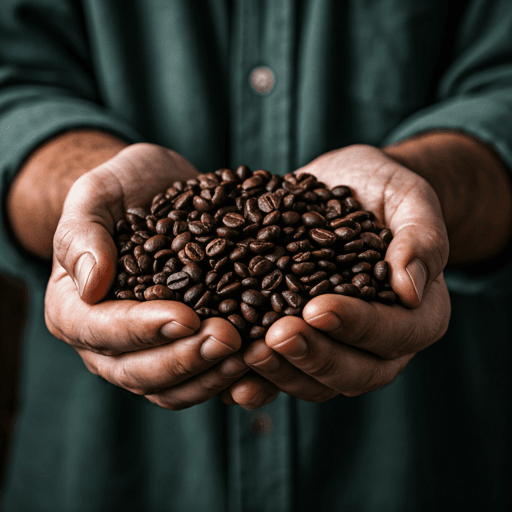
Charrieriana coffee is a wild Coffea species from the Bakossi forest region of southwestern Cameroon, and the one thing it is famous for is that its seeds are reported to be effectively caffeine-free. Not decaffeinated — caffeine-free from the outset. The plant appears never to make the compound in the first place, so there is nothing to strip out later. That distinction is the entire story, and it is the part most popular coverage of the plant gets wrong.
Two things need saying immediately, because almost every misunderstanding of this plant starts by skipping them. First, charrieriana is a species, not a variety. It is not a kind of arabica the way Bourbon or Typica are; it is its own branch of the genus, as separate from arabica as robusta is. Every expectation carried over from variety talk — pedigree, breeding programme, release year, cup score — has to be reset. Second, it is a wild forest plant known from a very small area. Nobody farms it. Nobody sells it. There is no bag of it to buy, and the honest distance between "a species that lacks caffeine" and "a cup in front of you" is the second half of this article.
What charrieriana coffee actually is
Coffea is a genus of well over a hundred species, only two of which the world drinks in any quantity — if that framing is new, our explainer on what the Coffea plant is covers the genus properly. Charrieriana sits far out in the long tail. It was described formally only in 2008, in a paper titled "A new caffeine-free coffee from Cameroon" in the Botanical Journal of the Linnean Society, and the botanical authority is given as Coffea charrieriana Stoff. & F.Anthony. The name honours André Charrier, a French geneticist long associated with work on coffee genetic resources, which is why the plant is also called Charrier coffee.
The material was not new when the paper was. Published accounts describe cuttings collected in the Bakossi forest in the mid-1980s, kept and grown on in research collections, and studied closely only more than a decade later, when it became clear that the plant did not match any described Coffea species. That gap — roughly two decades between a plant reaching a collection and the plant getting a name — tells you a good deal about how thin the record on wild African coffees still is.
What the description reports is a modest shrub rather than a tree: published accounts put it at roughly one to one and a half metres, with small elliptic leaves, white five-petalled flowers and red fleshy fruit, in the ordinary Coffea pattern. Treat those as reported observations from a small number of studied plants, not as an agronomic specification. Nobody has grown a field of this to see how it behaves at scale.
At a glance
| Attribute | What the record says |
|---|---|
| Scientific name | Coffea charrieriana Stoff. & F.Anthony |
| Also called | Charrier coffee |
| Status | A species in its own right — not a variety, not a cultivar, not a process |
| Formally described | 2008, in the Botanical Journal of the Linnean Society |
| Named for | André Charrier, French coffee geneticist |
| Native range | Bakossi forest area, southwestern Cameroon — endemic, known from a very restricted area |
| Habitat | Wet rainforest on rocky slopes; published accounts report low elevation, a few hundred metres at most, far below typical arabica country |
| Growth habit | Small shrub, reported at roughly 1 to 1.5 m, with small elliptic leaves |
| Caffeine in the seed | Reported to be effectively caffeine-free; the biosynthesis pathway appears not to complete |
| Alkaloid picture | Reported to accumulate theobromine, the precursor that caffeine is normally made from |
| Wider affinities | Reported as genetically distinct from other African coffees, with affinities noted toward Madagascan species |
| Conservation | Assessed as Critically Endangered; threats named as logging and oil palm clearance in lowland forest |
| Grown commercially | No — not anywhere, at any scale |
| Published cupping record | Essentially none; treat any detailed flavour claim with suspicion |
Naturally caffeine-free is not the same as decaf
This is the distinction the whole page turns on, and it is a difference of mechanism, not of degree.
Decaffeinated coffee starts life as ordinary caffeinated coffee. The seed grows, is harvested and is processed with its full alkaloid load intact, and the caffeine is then extracted from the green bean industrially before roasting. We are not going to re-teach those routes here — our guide to decaf coffee walks through how the methods differ and what each does to the cup. The point for our purposes is structural: decaf is a subtraction. Something that was present is taken away, the removal is never perfectly complete, and it is never entirely free of consequence for whatever else leaves the bean alongside the caffeine.
Charrieriana is the other case entirely. The reported absence has nothing to do with anything done to the seed after harvest. It is a property of the plant. Coffee plants normally build caffeine through a series of methylation steps, with theobromine as the last intermediate before caffeine itself, and charrieriana is reported to accumulate theobromine rather than converting it onward — the caffeine synthase step that would complete the pathway is described as deficient in this lineage. The same broad picture has been documented in another naturally caffeine-free wild coffee, Coffea humblotiana of the Comoros, where published work attributes the outcome to the caffeine synthase gene simply not being present.
So the two things end up in superficially similar places by opposite roads. Decaf is a bean that had caffeine and had it taken out. Charrieriana is a seed that was never going to have any. One is a processing step; the other is a genome.
It is worth being careful with the word "free" in both directions. Decaf is not zero-caffeine; residual trace amounts are normal and expected. And in charrieriana’s case the responsible phrasing, and the one the literature uses, is that the seed is reported to be caffeine-free or effectively so — a finding resting on a limited number of analyses of a small amount of material. We are not going to quote you a percentage, because any precise figure you see attached to this plant is worth checking hard before repeating.
Where it sits on the family tree
Charrieriana is not close kin to arabica. Arabica is an allotetraploid, a natural hybrid carrying two sets of parental genomes, while the great majority of the genus — charrieriana included — is diploid. That difference in genome structure is one of the reasons moving a trait from a wild diploid species into arabica is a slow, technical business rather than a simple pollination.
Genetically, the species is reported to be distinct from the other coffees of West and Central Africa, with some published work noting affinities toward the Madagascan species rather than its geographical neighbours. Its description was framed as a real addition to the known diversity of the region rather than a footnote, and the paper made the wider point explicitly: Cameroon is one of the main centres of diversity for the genus, holding a number of Coffea species comparable to Tanzania. Charrieriana is evidence for that, not an oddity in spite of it.
Two further wrinkles are worth knowing without over-reading them. The species has featured in discussions of the old boundary between Coffea and the group once split off as Psilanthus — a boundary since collapsed back into a single genus — with reports of chloroplast evidence pointing to an ancient hybridisation somewhere in its ancestry. And a caffeine-free African coffee was not without precedent: the 2008 description positions charrieriana as the first such species recorded for Central Africa and only the second reported for the continent, the earlier being C. pseudozanguebariae of East Africa. Caffeine-free and low-caffeine species are more common among the island coffees off Africa’s southeastern seaboard, which is a useful reminder that caffeine is a widespread feature of the genus rather than a defining one.
Cameroon, and why the location matters
The plant is endemic to a small part of southwestern Cameroon, in the Bakossi forest region: wet rainforest on steep, rocky ground at low elevation. That is not coffee-farm country in the usual sense. It is low, hot and wet, a long way from the highland conditions arabica is grown in. Cameroon does have a real and long-running coffee sector of its own, which is a separate subject and is covered in our guide to Cameroonian coffee. Charrieriana has nothing to do with that industry. It is a forest plant that happens to share a country with one.
The location matters for a harder reason too. A species known from essentially one place is a species with no margin. Published assessments class charrieriana as Critically Endangered, and the threats are named plainly: clearance of lowland forest for timber and for oil palm. A restricted-range plant in a forest under conversion pressure can be lost before anyone has finished describing what it does. That is not an abstraction here. The most interesting biochemical trait found in a wild coffee in decades sits inside a population that could be reduced faster than it can be studied.
What we honestly do not know
This is where most writing about the plant goes wrong, so let us be blunt about the gaps.
- How it tastes. There is no meaningful published cupping record. It has not been run through panels the way a commercial coffee is, because there has never been a commercially relevant quantity of it. Anyone describing its flavour profile in detail is describing something they have not tasted.
- How it performs as a crop. Yield, cherry behaviour, disease resistance, response to shade or pruning, how it handles a dry season — unknown at any agronomic scale. Plants have been raised in research collections for biochemical work, but a greenhouse shrub tells you very little about a hectare.
- What the rest of its seed chemistry would mean in a cup. Published analyses report other differences besides caffeine, including a lower chlorogenic acid picture and a different fatty-acid profile than other Coffea seeds. What any of that would do to a roasted, brewed beverage is simply not established.
- How stable the trait is. The caffeine-free finding rests on limited material. Whether it holds identically across every wild individual, and how it would express in a hybrid background, is a research question rather than a settled fact.
- How much of the wild population exists. The record is thin, and we are not going to invent a number.
Saying "this is not known" is not a failure of the article. It is the accurate description of a species that has been formally on the books for well under two decades and has never been an agricultural plant.
Why breeders find it interesting anyway
The appeal is obvious the moment you frame it as a breeding problem rather than a beverage. If a caffeine-free trait could be moved into a coffee that is already agriculturally viable, you would get a cup with no caffeine that never went through an extraction step at all, and therefore never lost whatever else the extraction takes with it. That idea circulates under the label Decaffito, and charrieriana is one of the plants most often cited as evidence that the concept is biologically real rather than wishful. Reports of breeding interest in it exist; none of them amounts to a coffee on a shelf.
The genetics look, in principle, tractable. Crossing work on the other African caffeine-free species, C. pseudozanguebariae, reported the absence of caffeine behaving largely as a recessive condition tied to a single major gene, against a background of smaller polygenic effects on overall alkaloid content. A trait that behaves simply is a trait a breeder can move. One smeared across dozens of loci is not. That is why the caffeine-free wild coffees are treated as a genetic resource rather than a curiosity.
Everything else about the project is hard. Crossing a wild diploid species into tetraploid arabica is technically demanding, and the wild parent brings its whole genome along — small seeds, forest growth habit, unknown cup, unknown disease response — all of which then has to be bred out again over generations while holding on to the one trait you wanted. That is a multi-decade programme and nobody should promise a finish date for it. The alternative route people discuss, disabling the caffeine synthase step directly in an existing commercial coffee, sidesteps the crossing problem but lands squarely in the regulatory and market questions that surround edited crops.
Charrieriana is not going to replace decaf. It is a proof of concept and a genetic resource, and those are genuinely valuable things to be.
The comparison worth making
Charrieriana is not the only wild coffee whose alkaloid profile makes people sit up: Coffea racemosa of southeastern Africa is the other name that keeps coming up, low in caffeine, much romanticised and commercially almost nowhere, and its story is told in our guide to racemosa coffee. The pattern behind both is the same. A wild species does something the two commercial coffees do not, the trait attracts attention, and then the ordinary constraints of a tree crop — small seed, modest yield, no supply chain, no established market — keep it in the research plot and the herbarium sheet.
The bottom line
Charrieriana coffee is a wild species from a small patch of Cameroonian forest whose seeds are reported to be effectively caffeine-free because the plant never completes the pathway that makes caffeine. That makes it categorically different from decaf, which removes a compound that was there all along. It also makes it, right now, a botanical fact rather than a drink: not cultivated, not traded, not cupped in any documented way, and assessed as Critically Endangered in the one place it is known to grow. The useful posture is curiosity with the claims kept honest — and, more urgently, an interest in whether the forest it lives in survives long enough for anyone to find out what it can do.