
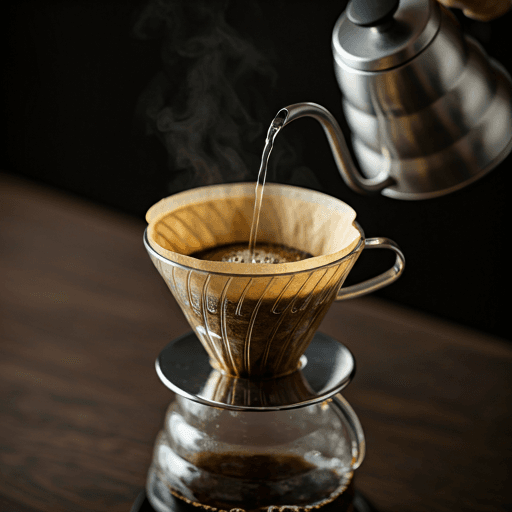
When you compare batch brew vs pour-over, you are really weighing two ways of making the same thing — filter coffee — with opposite priorities. Batch brew is what an automatic drip machine makes: it showers hot water over a large bed of grounds to fill a whole pot consistently and hands-free. Pour-over is brewed by hand, pouring hot water in stages through a cone one cup at a time for more clarity, brightness and control. Both are gravity-fed filter coffee; the real question is whether you want effortless volume or hands-on nuance.
Neither is universally "better." A good batch machine can rival hand brewing, and a rushed pour-over can taste flat. What follows breaks down the difference between batch brew and pour over so you can pick the one that fits your morning, not a leaderboard.
Batch brew vs pour-over at a glance
Here is the short version before we dig in. Skim the table, then read the sections that matter to you.
| Attribute | Batch brew | Pour-over |
|---|---|---|
| Method | Automatic drip machine; one shower head over a flat or cone filter | Hand-poured gravity drip through a paper cone (V60, Chemex, Kalita) |
| Effort | Hands-off — press a button and walk away | Hands-on — you stand at the kettle and pour |
| Volume | Several cups to a full pot at once | Usually one or two cups at a time |
| Speed | A full pot in minutes, no attention needed | A few minutes per brew, all of it active |
| Control | Mostly a fixed cycle; premium machines allow some tuning | Full control of pour, bloom, flow and timing |
| Taste (typical) | Clean, balanced, remarkably consistent | Brighter, more nuanced and articulate at its best |
| Consistency | Very repeatable batch to batch | Varies with your technique and focus |
| Best for | Crowds, offices, busy mornings, volume | Solo cups, tasting nuance, single-origin coffee |
What batch brew is
Batch brew is coffee from an automatic drip machine. You add grounds to a filter basket, pour water into a reservoir, and the machine heats the water and sprays it through a single shower head over the whole bed of grounds, dripping the finished coffee into a carafe below. It is the format most people mean by "drip coffee," and it is built for volume: many machines brew anywhere from a couple of cups to a full pot in one hands-off cycle.
The appeal is consistency and convenience. Because the machine runs the same water temperature, flow and timing every time, one pot tastes much like the next — which is exactly what you want when you are brewing for a crowd, an office or a groggy weekday morning. A well-built machine with an even shower head and a stable temperature can produce a genuinely excellent cup that rivals careful hand brewing. For how the brewer actually works and how to get the most from one, see our batch brew coffee explainer and the drip coffee maker guide.
What pour-over is
Pour-over is hand-brewed filter coffee. You place a paper filter in a cone — a Hario V60, a Chemex, a Kalita Wave — add grounds, and pour hot water over them yourself, in deliberate stages, letting gravity draw the water through into the cup below. You control the whole process: how you wet the grounds for the bloom, how fast and where you pour, and how long the whole brew takes.
That manual control is the point. A careful pour-over tends to taste bright, clean and articulate, teasing out the delicate flavors of a good single-origin coffee that a bulk brew can blur together. The trade-off is that it is one small brew at a time and it asks for your attention at the kettle. For technique — grind, ratio, pour pattern and timing — see the pour-over coffee guide.
Batch brew vs pour-over: the key difference
Strip away the gear and the difference between batch brew and pour over comes down to one axis: automated volume and repeatability versus manual control and clarity. Batch brew hands the recipe to a machine so you can make a lot of coffee with zero effort and near-identical results every time. Pour-over hands the recipe to you, trading effort and some run-to-run variation for the ability to shape the cup.
Everything else — taste, speed, consistency — flows from that trade-off. If you want the deeper contrast between manual pouring and immersion methods, our pour-over vs French press comparison covers a related fork in the road.
Taste
At their respective bests, the two lean different ways. A good pour-over is usually brighter and more nuanced — it separates and highlights individual notes, so a fruity or floral coffee reads as fruity or floral. A good batch brew is clean, balanced and remarkably consistent from pot to pot, which many people actually prefer for an everyday cup. Both results depend heavily on fresh beans, the right grind and a sensible ratio, so taste varies by coffee and by cook far more than by format alone.
Volume and speed
This is where batch brew wins outright. Load it, press start, and it fills a pot in minutes while you do something else — no standing, no pouring, no timing. Pour-over is the opposite: one or two cups at a time, with you at the kettle for every second of the brew. If you are serving several people or want coffee ready the moment you walk into the kitchen, batch brew is the practical choice. If you are making a single considered cup, the slower ritual of pour-over is part of the pleasure.
Control
Pour-over gives you the dials. You decide the bloom, the pour speed and pattern, the pauses, and the total brew time, and you can adjust any of them cup to cup. Most batch machines run a fixed cycle you cannot change, though premium models add adjustable temperature, bloom cycles or pulse pouring that narrow the gap. If you like tinkering to dial in a specific coffee, pour-over is more expressive; if you would rather never think about it, a fixed cycle is a feature, not a limitation.
Consistency
Batch brew is more repeatable by design — the machine removes your hands from the equation, so your Monday pot and your Friday pot taste the same. Pour-over consistency depends on you: your pour, your focus and your practice. Experienced hands can be very consistent, but there is more room for a cup to drift if you rush or get distracted. So the honest read on "batch brew or pour over" for reliability is that the machine holds the line for you, while the cone rewards a steady technique.
Is pour-over better than batch brew? Which to choose
There is no single winner, so frame it as pour over vs batch brew for your situation. Choose batch brew when you want effortless volume: multiple cups, a hands-off routine, an office or household to feed, and a clean, dependable result every time. Choose pour-over when you want hands-on clarity: a single thoughtful cup, the flexibility to tune the brew, and the brighter, more nuanced flavors that reward your attention.
Plenty of coffee drinkers keep both — a batch machine for weekday mornings and busy pots, a cone for a slow weekend cup or a special single-origin bag. Asking whether pour-over is better than batch brew is a bit like asking whether a bicycle is better than a car: it depends entirely on the trip. Match the method to the moment, use good fresh beans and a suitable grind for either one, and both will reward you.