
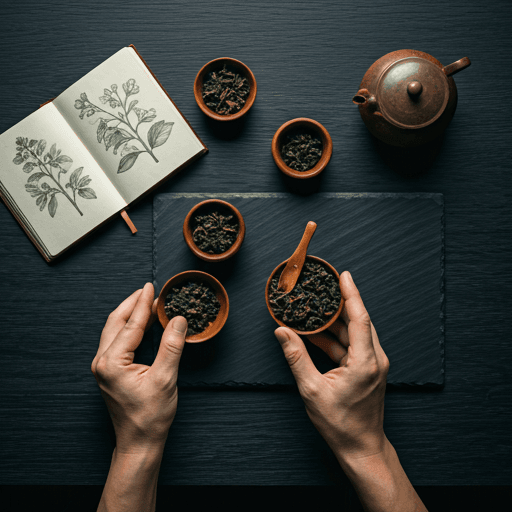
Roughly a third of the way across the Atlantic from Lisbon toward North America, a cluster of green, mist-wrapped hillsides does something almost no other place in Europe manages at commercial scale: it grows, harvests and processes its own leaf. This is the world of azores tea, a genuine single-origin curiosity produced on São Miguel, the largest island of Portugal's Azores archipelago.
Almost all of the tea people drink is grown in Asia and Africa, so a European origin that has stayed in continuous production for well over a century feels like a small triumph of climate and stubbornness. What follows is a tour of where azores tea comes from, why a volcanic mid-ocean island can grow it at all, the grades you are likely to meet, how it tastes, and how it sits alongside its rare neighbors.
What is Azores tea?
Azores tea is tea from the Camellia sinensis plant that is cultivated and manufactured on São Miguel in the Azores, an autonomous region of Portugal set far out in the North Atlantic. It is the only place in Europe that carries a crop from field to finished leaf at true commercial scale, which is why the islands are so often called Europe's last working tea gardens. Both black and green teas are made here from the same species, the evergreen shrub behind green, black, oolong and white teas everywhere. If you want a refresher on how one plant becomes so many different drinks, our guide to the types of tea explained lays out the framework, because everything grown on São Miguel fits inside it.
The plant and the place: terroir
The tea grown here is ordinary Camellia sinensis. By most accounts the island's stock traces back to seed and cuttings brought from China in the nineteenth century, of the small-leaf China-bush type (Camellia sinensis var. sinensis) that tolerates cool, damp conditions. Precise cultivar names are not well documented publicly, so it is fair to treat the plants as heritage China-bush lineage rather than named modern clones.
What makes the island viable is its terroir. São Miguel sits at roughly 37–38° North, a subtropical latitude, but its weather is governed by the ocean rather than the sun. The maritime climate is mild and remarkably even, with temperatures that commonly stay within a band of about 10–25°C across the year, frequent cloud and mist, and generous, well-distributed rainfall often cited around 1,500–2,000 mm annually. The soils are young, volcanic and basaltic: free-draining, mineral-rich and naturally acidic, which is close to what the tea plant prefers. Drinkers and visitors alike often describe a faint mineral, almost sea-salt edge to the cup, which they attribute to that oceanic, volcanic setting. That is sensory impression rather than laboratory fact, but the terroir story behind it is real enough.
One consequence of the island's isolation deserves emphasis. Far out in the Atlantic, with a cool, breezy microclimate on the tea-growing north coast, the plants face few of the pests and fungal pressures that plague tropical gardens. Growers there have long been able to work without pesticides, herbicides or fungicides, and the leaf is frequently described as organically grown as a result, a happy accident of geography rather than a marketing pose.
How Portuguese tea took root: a short history
The story of portuguese tea on São Miguel begins with a crisis in a different crop. For much of the nineteenth century the island's economy leaned heavily on oranges shipped to northern Europe. When disease devastated the orange groves in the 1860s, farmers went hunting for a replacement, and tea, already a booming global commodity, was an obvious candidate for the mild, wet climate.
Early experimental plantings in the 1860s were followed by a decisive step in the late 1870s, when a local agricultural society is widely reported to have brought two specialists from Macau, then a Portuguese territory, to teach the fundamentals of cultivation and manufacture. Their expertise helped turn a promising idea into a working industry. The plantation that became Gorreana is generally dated to the 1880s (the founding year is often given as 1883) and, by many accounts, took its familiar Gorreana identity as it modernized in the early twentieth century. At its peak the island supported many small tea operations; today only a couple remain, which is exactly why the Azores are described as Europe's last working tea gardens.
Gorreana tea and its surviving neighbor
Two factories carry the tradition on São Miguel's north coast. The better known is Gorreana tea, generally described as the oldest surviving tea plantation in Europe and notable for having stayed in continuous family operation since the 1880s. Its fields cover a few dozen hectares, and reported output sits in the range of tens of tons of finished tea per year, tiny by world standards but remarkable for the continent. Part of Gorreana's charm is that some of its machinery is well over a century old: Victorian-era rolling and drying equipment that still runs.
The second is the Porto Formoso factory, a short drive along the same coast. It had fallen quiet in the late twentieth century and was revived in the early 2000s, restoring a second thread of the island's tea heritage along with a small museum. Between them, these two operations account for essentially all commercially made sao miguel tea, and by extension nearly all tea genuinely grown and processed within Europe's borders.
How the leaf is made
Because the island manufactures its own crop, the same fields feed a full production line rather than shipping raw leaf elsewhere. The harvest window runs roughly from spring into autumn, with the youngest, tenderest flushes prized for the finer grades. For black tea the leaf is withered to shed moisture, rolled (often on those heritage machines) to bruise the cells and start oxidation, left to oxidize until it darkens, then dried and sorted by size. For green tea, oxidation is halted early with heat so the leaf keeps its fresher, greener character. The sorting stage is where the traditional grade names come from, separating whole leaf from the smaller broken particles.
Grades and styles of Azores tea
Because the island processes its own leaf, it makes a surprisingly full range from a single growing season. Both green and black teas are produced, and the naming leans on traditional leaf grades rather than flavor marketing. If the vocabulary of "pekoe" and "broken leaf" is unfamiliar, our primer on what black tea is explains how oxidation and leaf size drive those names.
- Black teas are typically sold under grade names such as Orange Pekoe (larger, wiry leaf), Pekoe, and Broken Leaf (smaller particles, darker and stronger in the cup), plus a few lesser-seen labels and, occasionally, a small run of oolong.
- Green teas appear under traditional names such as Hysson, a lively, slightly tangy green, and are generally gentle and grassy rather than intense.
As a rule of thumb, the larger-leaf blacks give a softer, more aromatic cup, while the broken grades brew darker and fuller and stand up better to milk. Green tea drinkers curious about the category more broadly can read our overview of green tea benefits, keeping in mind the caveats below on caffeine and wellness claims.
What Azores tea tastes like
The signature of azores tea is smoothness. The black teas are frequently described as mild, mellow and low in the harsh astringency you can find in some robust tropical blacks, with a gentle malty body and, in some batches, a whisper of smokiness. Tasters often reach for words like clean, round and softly mineral. The greens run fresh, vegetal and grassy, again on the delicate side rather than the brisk, high-toned intensity of some East Asian styles.
Two forces shape that profile. First, the cool maritime climate slows the plant's growth and tends to keep tannin levels moderate, which reads as softness in the cup. Second, that oft-mentioned volcanic-mineral, faintly saline quality gives the tea a sense of place that regular drinkers come to recognize. None of this makes it a powerhouse tea; its appeal is exactly the opposite, an easygoing, everyday cup with an unusual passport.
Azores tea at a glance
| Attribute | Detail |
|---|---|
| Origin | São Miguel island, Azores, Portugal (mid-North Atlantic) |
| Plant | Camellia sinensis, largely heritage China-bush (var. sinensis) stock |
| Latitude / setting | ~37–38° N; oceanic, volcanic, mild and misty |
| Climate | Even temperatures (commonly ~10–25°C); high, well-spread rainfall (often cited ~1,500–2,000 mm) |
| Soil | Young, free-draining, mineral-rich volcanic basalt; naturally acidic |
| Working gardens | Gorreana (continuous since the 1880s) and Porto Formoso (revived in the early 2000s) |
| Teas made | Black (Orange Pekoe, Pekoe, Broken Leaf and others) and green (such as Hysson); occasional oolong |
| Growing inputs | Widely reported as pesticide-, herbicide- and fungicide-free thanks to isolation and climate |
| Flavor signature | Smooth, mild, low-astringency; soft malt in blacks, grassy freshness in greens; faint mineral/saline edge |
Figures such as hectares and annual tonnage are drawn from commonly cited sources and should be read as approximate; small artisan operations rarely publish exact, audited numbers.
How it compares to its rare neighbors
Because commercial european grown tea is so scarce, azores tea has almost no direct rivals, which is precisely what makes comparison interesting. The most meaningful counterpart lies on the far side of the continent: the tea of the Republic of Georgia, in the Caucasus, which has a much larger historical footprint and its own distinctive character. If you want to see how a very different European-adjacent origin evolved, our guide to Georgian tea is a useful companion piece. Where Georgia built an industrial tea sector across the twentieth century, the Azores kept a boutique, almost museum-like continuity.
Closer to home there are experimental and small-batch gardens elsewhere in Europe, notably in Cornwall in the United Kingdom and scattered trial plots on the mainland, but these are generally young, tiny or intermittent compared with São Miguel's unbroken century-plus of production. Against the giants of Asia, azores tea is best understood not as a competitor on strength or complexity but as a genuine terroir curiosity: milder, softer and unmistakably oceanic. It rewards drinkers who value provenance and gentleness over sheer intensity.
Brewing notes
Azores blacks are forgiving. A common approach is near-boiling water and a steep of around three to five minutes, adjusting to taste; the larger-leaf grades take heat well and stay smooth, while broken grades brew faster and darker and can carry a splash of milk. The greens prefer cooler water, off the boil, roughly 75–85°C, and shorter steeps of two to three minutes to keep them sweet rather than bitter. Because these are loose-leaf teas, a little technique pays off; our walk-through on how to brew loose-leaf tea covers leaf-to-water ratios and steeping times you can adapt to any Azorean grade.
On caffeine: like all true tea, azores tea contains caffeine, but the exact amount in your cup varies with the leaf, how much you use, the water temperature and the steeping time, so treat any single number you see as a rough guide rather than a fixed fact. As for wellness, tea drinking may fit comfortably into a balanced routine, and green and black teas are widely studied for various plant compounds, but responses vary from person to person and this is general information, not medical advice; anyone with specific health concerns should speak to a qualified professional.
The bottom line
Azores tea is not the boldest or the most complex leaf you will ever drink, and it was never trying to be. Its value lies in what it represents: a living, working tea tradition on European soil, sustained on a volcanic island in the Atlantic for well over a century, largely without chemical inputs, and processed on machinery old enough to be a museum piece in its own right. Gorreana and Porto Formoso have kept alive something the rest of the continent lost: the full arc from field to finished leaf. For anyone who cares about where their tea actually grows, a smooth, softly mineral cup of sao miguel tea is one of the most distinctive origins you can put in a pot.