
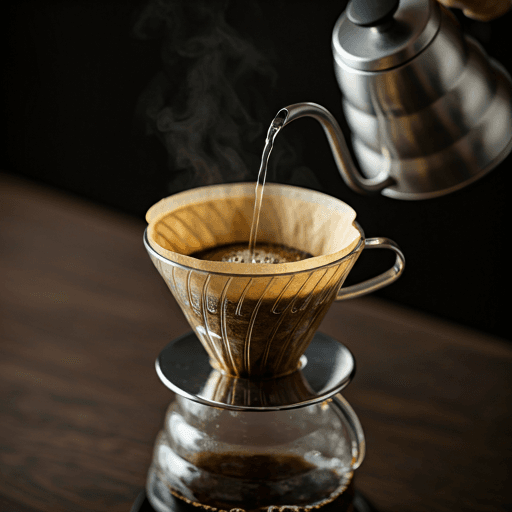
The short answer to aeropress vs pour over is that both brew a clean, single cup, but they get there by different mechanisms. An AeroPress combines a short immersion with gentle air pressure to push water through the grounds quickly, giving a smooth, rounded, low-acidity cup that is famously hard to mess up. Pour-over relies only on gravity as you hand-pour water through a cone, which tends to taste brighter, more delicate and more nuanced, but rewards a steadier pour and a little practice.
Neither method is objectively "correct." The better tool depends on whether you value forgiveness and speed or clarity and control. When people ask whether to pick aeropress or pour over, they are really asking which set of trade-offs they prefer. Below we break down how each brewer works, how the coffee tastes, and which one fits your routine.
What is an AeroPress?
An AeroPress is an immersion-plus-pressure brewer. You add ground coffee and hot water to a cylindrical chamber, stir and let it steep for a short time, then press a plunger down to force the brew through a paper (or metal) filter directly into your cup. That combination of steeping and gentle plunger pressure extracts flavor evenly and fast, and a typical brew takes only about one to two minutes from start to finish.
Because the immersion does most of the work, the AeroPress is remarkably forgiving. Grind size, water temperature and timing all have some wiggle room before the cup turns sour or bitter. It makes roughly a single serving, you can dilute a concentrated brew into a bigger mug, it rinses clean in seconds, and it packs down into a compact, near-indestructible unit that travels well. For a full step-by-step walkthrough of the method, see our AeroPress guide.
What is pour-over coffee?
Pour-over coffee is made by hand-pouring hot water over a bed of grounds sitting in a cone-shaped dripper lined with a paper filter, such as a Hario V60, a Kalita Wave or a Chemex. There is no full immersion and no added pressure: gravity alone pulls the water down through the grounds and into the vessel below, a process called percolation. You control the extraction entirely through how you pour.
That control is the whole appeal. A steady, even pour, usually from a gooseneck kettle, combined with the right grind and timing produces a bright, clean, tea-like cup that shows off the delicate, complex notes in a good single-origin coffee. The trade-off is that pour-over is more technique-sensitive. Rush the pour or grind unevenly and the cup can turn thin or astringent. Our pour-over coffee guide covers the technique in detail.
AeroPress vs pour over: the key difference
The core of the aeropress vs pour over question comes down to mechanism: pressure plus immersion versus gravity plus percolation. The AeroPress steeps the coffee and then uses air pressure from the plunger to drive the water through in one quick push. Pour-over never immerses the grounds fully. Water is always flowing through and draining away under gravity as you pour.
That single distinction is the real difference between AeroPress and pour over, and it cascades into almost everything else: how the coffee tastes, how forgiving the method is, how long it takes and how easy it is to clean up. Everything below follows from pressure-and-immersion on one side and gravity-and-percolation on the other.
Taste: smoother vs brighter
Broadly speaking, the AeroPress tends to produce a smoother, rounder cup with lower perceived acidity. The short steep and quick press mellow the sharper high notes, and the paper filter keeps things clean. Many people find it more approachable, especially if bright coffees taste too sour to them. Pour-over, by contrast, usually tastes brighter, more delicate and more layered, highlighting the floral, fruity and acidic notes that a fuller-bodied method can mask.
These are tendencies, not laws. You can brew a bright, punchy AeroPress with a finer grind and hotter water, or a softer, gentler pour-over with a coarser grind, so treat the taste descriptions as starting points and adjust to your beans. In the pour over vs aeropress matchup, most of the flavor gap you notice can be nudged in either direction once you start tinkering with grind, ratio and temperature.
Effort and forgiveness
If you are new to manual brewing, the AeroPress is close to beginner-proof. The immersion step buffers small mistakes, you do not need any special kettle, and it is genuinely hard to produce something undrinkable. Pour-over asks more of you: a gooseneck kettle for a controlled pour, attention to your pour rate and pattern, a consistent grind, and a sense of timing. The reward for that effort is a cleaner, more expressive cup, but the learning curve is real.
This is also where AeroPress-versus-French-press questions come up, since both are immersion-style and forgiving; if you are weighing those two, see AeroPress vs French press. And if your real alternative to pour-over is an automatic machine rather than a cone, our pour-over vs drip coffee comparison is the better read.
Speed, cleanup and travel
The AeroPress wins on convenience. Start to finish it brews in about one to two minutes, the plunger pushes the used grounds out as a tidy puck you can knock straight into the bin, and a quick rinse leaves it clean. Its compact, sturdy build makes it a favorite for travel, camping and the office. Pour-over is a little slower. A careful brew with a bloom and staged pours often runs three to four minutes, and cleanup means disposing of a soggy filter and rinsing the dripper and kettle. A glass Chemex or ceramic V60 is also more fragile and less packable than an AeroPress.
Volume: how much can each make?
Both methods are fundamentally single-cup brewers. A standard AeroPress makes roughly one mug per press; brew it strong and top it with hot water for a larger drink. You can brew back to back, but it is not built for a crowd. Pour-over scales a bit better at the top end: a single V60 is one cup, but a large Chemex can brew several cups at once if you have the patience for a longer, larger pour. If you routinely make coffee for four or more people, neither is as convenient as a dedicated batch brewer.
AeroPress vs pour over at a glance
| Attribute | AeroPress | Pour-over |
|---|---|---|
| Mechanism | Immersion + gentle air pressure | Gravity-fed percolation |
| Filter | Paper (or metal) | Paper |
| Typical taste | Smooth, rounded, lower perceived acidity | Bright, clean, delicate, complex |
| Body | Medium and rounded | Lighter, tea-like |
| Brew time | ~1-2 minutes | ~3-4 minutes |
| Forgiveness | Very forgiving, beginner-friendly | Technique-sensitive |
| Gear needed | AeroPress + any kettle | Cone + gooseneck kettle recommended |
| Volume | ~1 cup (concentrate can be diluted) | 1 cup (V60), several with a Chemex |
| Cleanup | Fast: eject the puck, rinse | Toss the filter, rinse the dripper |
| Portability | Excellent, packs down small | More fragile, less portable |
| Best for | Speed, travel, beginners, an easy cup | Ritual, clarity, showcasing single origins |
Which should you choose?
Choose an AeroPress if you want a fast, forgiving, low-cleanup brewer that makes a smooth, easygoing cup and travels anywhere. It is ideal for beginners, small kitchens and desks. Choose pour-over if you enjoy the ritual, want to taste every nuance in a special coffee, and do not mind adding a gooseneck kettle and dialing in your technique. Plenty of coffee lovers own both and switch based on mood, beans and how much time they have that morning.
There is no universal winner in the aeropress vs pour over debate, just the method that matches the cup you like and the effort you want to spend. The most reliable way to settle it is to brew each with the same beans and let your own palate decide. Responses to strength, body and acidity vary from person to person, so trust what you actually enjoy in the cup over any rule of thumb.