
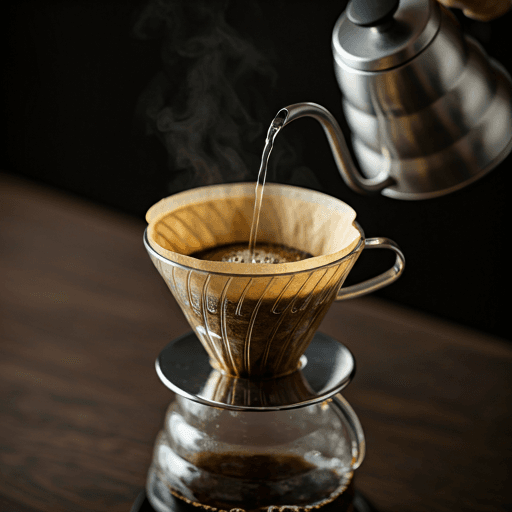
A lever espresso machine is a manual machine where you pull a lever — rather than let an electric pump do the work — to generate the pressure that forces hot water through a bed of finely ground coffee. That single mechanical choice puts the shot in your hands: you feel the resistance build, decide how hard and how long to push, and shape the extraction by touch. The result is a hands-on, deliberate way to make espresso that many enthusiasts prize for control, quiet operation and long-term durability.
What a lever espresso machine actually does
Every espresso needs pressure — roughly nine bars of it — to push hot water through the tightly packed grounds and pull a concentrated shot with crema. On a conventional machine, an electric pump supplies that pressure. On a lever espresso machine, a lever connected to a piston inside the group head does the same job. As the piston presses down on the water sitting above the coffee puck, it builds the force that drives extraction. There is no pump and no electronic pressure control — just a piston, a lever and either your arm or a spring behind it.
Because a person or a spring supplies the force, the pressure is not pinned to one fixed number for the whole shot. It rises, peaks and then tapers off — a curve baristas call a "pressure profile." On a lever machine that profile is a physical, felt thing rather than a menu setting, and that tangibility is a big part of why people fall for the format. If you want a refresher on what a finished shot should look and taste like, our explainer on what an espresso shot is covers the target.
The two types: spring-piston and direct lever
Nearly every lever machine falls into one of two families. They look similar — a tall group with a swinging arm — but they generate pressure in very different ways, and that difference shapes how the machine feels to use.
Spring-piston lever
On a spring lever espresso machine you cock the lever to compress a heavy internal spring, which loads the piston. When you release the lever, the spring drives the piston down and pushes water through the coffee on its own. The pressure starts high and declines as the spring relaxes — a naturally tapering curve that many drinkers associate with sweetness and balance. You do not hold the pressure yourself; the spring does, which makes shots more repeatable once the machine is dialled in. Olympia's Cremina SL, the Londinium range and the Bezzera Strega are well-known spring-lever designs, and the same principle scales up to large commercial groups such as the La Marzocco Leva.
Direct (manual) lever
A direct or manual lever espresso machine removes the spring entirely: the lever links straight to the piston, so the pressure is whatever your arm applies, moment to moment. That lets you raise and lower pressure mid-shot — a gentle pre-infusion, a firm peak, a soft finish — giving the most complete pressure profiling of any format. It also means every shot rides on your hand, so consistency takes practice. Classic examples include the La Pavoni Europiccola and Professional, while modern boilerless presses such as the Flair 58 (a single direct lever) and the Cafelat Robot (a twin-handled press) bring the same all-by-hand approach to a countertop or even a suitcase.
| Type | Where the pressure comes from | How it feels to use | Best for |
|---|---|---|---|
| Spring-piston lever | A compressed spring drives the piston after you cock the lever | Cock, release, wait; the machine holds a tapering curve for you | Repeatable shots with a classic declining profile and less arm fatigue |
| Direct (manual) lever | Your arm pushes the piston down directly — no spring | You feel and steer the pressure the whole way down | Hands-on profiling, experimentation and quiet, portable brewing |
How a lever machine differs from a pump machine
The headline difference is the missing motor. A pump machine converts electricity into a steady, high-pressure stream; a manual espresso machine converts your effort (or spring tension) into pressure instead. A few practical consequences follow from that:
- Pressure profiling by feel. Where a pump typically delivers one flat pressure, a lever gives you (or the spring gives you) a rising-then-falling curve. Shaping that curve is manual and intuitive rather than programmed.
- Fewer electronics. Many lever machines skip the PID controllers, pressure transducers and pre-infusion software found on modern pump machines. Temperature is often managed by the boiler and group mass and by your timing rather than by a chip.
- A quieter, simpler machine. No vibrating or rotary pump means a lever pulls a shot in near silence. Fewer moving electrical parts also means fewer things to fail.
- A different workflow. You are more involved at the moment of extraction — cocking a spring or leaning on a lever — instead of pressing a button and waiting.
None of this changes the fundamentals of the drink itself. The grind, the dose and the ratio all behave the same way; the lever simply changes how the pressure that pulls it all together is produced.
The pros and cons of a lever espresso machine
Lever espresso has a devoted following, but it asks something of the user in return. Here is the honest balance.
What people love
- Control. You (or a well-chosen spring) decide the pressure curve, opening up flavours a fixed pump pressure can flatten.
- That declining profile. The natural taper of a lever shot — high at the start, gentle at the end — is often described as sweeter and more forgiving on the finish.
- Quiet operation. No pump hum; just the soft sound of extraction.
- Durability and repairability. Simple mechanical parts, few electronics and a design ethos that favours gaskets and pistons you can rebuild mean many lever machines last for decades.
The trade-offs
- A learning curve. Grind, dose and timing all matter more when there is no software smoothing things over.
- Consistency takes practice. On a direct lever especially, two shots are only as alike as your two pulls; muscle memory takes time to build.
- No push-button ease. You are hands-on for every cup, which is the point for some people and a chore for others.
- Temperature discipline. Without a PID, holding a steady brew temperature can mean warming the group, timing your pour and keeping a rhythm.
Who a lever espresso machine suits
A lever rewards curiosity and patience more than convenience. It tends to suit the hobbyist who enjoys the ritual, the tinkerer who wants to profile pressure by hand, and anyone who values a quiet, long-lived, low-electronics machine over one-touch speed. Portable manual presses like the Flair and the Cafelat Robot also appeal to travellers and small-space brewers because they need no pump and, in some cases, no power at all — just hot water and good technique.
It is a less natural fit if you want a fast, repeatable shot with minimal involvement, or if a busy morning leaves no room for a hands-on routine. Choosing between a lever, a pump machine and everything in between comes down to temperament and workflow as much as budget or looks; our guide to how to choose an espresso machine walks through those trade-offs in detail. Whichever machine you land on, the craft of dosing, distributing, tamping and pulling the shot is broadly the same — you can see that routine step by step in how to make espresso at home.
The bottom line
A lever espresso machine trades automation for agency. By putting the pressure — and therefore the character of the shot — back in your hands or in a carefully tuned spring, it turns espresso from something you dispense into something you perform. That is not the right bargain for everyone, but for the growing number of people who want to feel their coffee being made rather than simply pressing a button, the lever remains one of the most rewarding, quietly durable ways to pull a shot.