
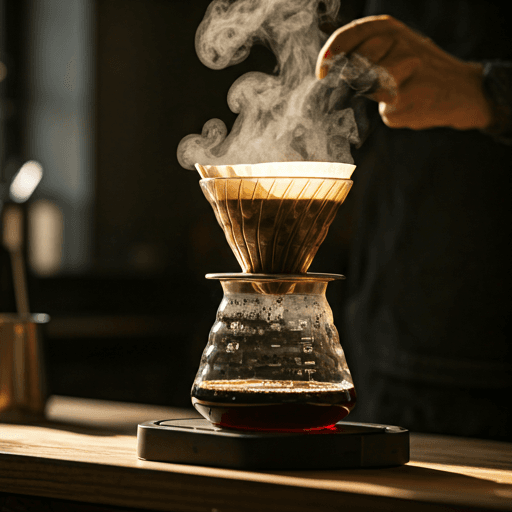
Wamena coffee is arabica grown around the town of Wamena in the Baliem valley, a broad inland highland valley on the western side of the island of New Guinea, in quantities so small that the world market never notices them. Two facts explain more about this coffee than any tasting note: it leaves the valley in an aircraft, because there is no dependable road from the valley to a port, and the households growing it fed themselves perfectly well before coffee arrived and would carry on if it vanished tomorrow.
Almost everything else follows from those two conditions: the quality ceiling, the volume floor, the unreliability that frustrates buyers, and the reason this origin can only ever be sold to people who want it specifically. They also explain the thin written record. A crop this small generates very little documentation and a great deal of promotional copy.
What Wamena coffee actually is
In plain terms: washed arabica from smallholder garden plots in and around a high valley, usually sold as a single origin under a name pairing Wamena or the Baliem valley with Papua, and usually reaching the market through a growers' cooperative or a small number of specialty buyers who have worked in the valley for years. It is a real crop with real growers and real geography, not a marketing invention. It is also nothing like a major origin in structure. There is no published variety roster, no grading system of its own, no dependable harvest calendar and no independent tasting record for this valley, and where any of those four turn up in confident detail, they are being supplied by the seller rather than by evidence.
Take the introduction story. Published accounts do not agree and cannot be reconciled. One strand credits a colonial-era agricultural service with bringing improved arabica seed into these highlands around the middle of the twentieth century, and a related account credits church missions. A widely repeated version dates the start of cultivation in the valley to 1960 and says the typica seed came over from the other side of the island. A further strand, attributed to a farmer-group leader in the valley, describes a government seed distribution to families in the early 1980s. Meaningful harvests are usually placed in the mid-1990s and the first sales abroad later still. These versions circulate mainly by being copied from one listing to the next, and no publicly available source settles them. The disagreement is the most reliable thing anyone can currently say about the timeline.
Variety claims are shakier still. Sellers name typica and S-line selections, and several listings market the coffee outright as a Jamaica Blue Mountain selection. That last claim recurs constantly and rests on no verifiable documentation. Typica is at least plausible for a highland arabica planted from mid-century seed; treat the Blue Mountain pedigree as trade lore unless somebody produces a record.
A narrow geographic exception
The Baliem valley is not a typical tropical coffee landscape. It is a long, wide, flat-floored basin with a river running through it, enclosed by high mountains, sitting far enough above sea level that nights are genuinely cool and days feel temperate rather than hot. Equatorial daylength plus cool nights means slow, extended ripening, which is exactly the condition growers chase deliberately elsewhere and which exists here as an accident of topography.
The elevation figures attached to this origin should be read loosely. Listings quote bands that disagree with one another, and they conflate the valley floor with the garden land on the slopes above it, which is not at the same height. What holds up is qualitative, and more useful anyway: this is high ground, in the tropics, with a cool diurnal swing, deep worked soils on the floor and steeper garden plots above. On paper the site reads close to ideal, and that is genuinely part of the story. It is simply not the whole of it.
That combination is a narrow exception rather than a general Indonesian condition. Most of the country's arabica grows on the flanks of volcanoes: Flores coffee comes off volcanic highlands in the Lesser Sundas, and Bali coffee off that island's upland slopes. This is an inland mountain basin, reached from above rather than approached from a coast, and that difference drives everything downstream.
A farming system that does not need a market
This is the fact that explains all the others, and it has nothing to do with coffee.
Almost every coffee region in the world can be read through one question: the household needs money, so what is the best way to get it, coffee or maize or cattle or leaving to work? The Baliem valley's farming tradition does not start from that premise. It is one of the world's classic intensive subsistence horticultural systems, built around sweet potato and pigs, and it is genuinely capable of feeding a dense population from its own gardens without any market at all.
The technique is sophisticated and long established. On the valley floor, gardens are laid out as raised beds separated by a network of ditches that drain the ground when there is too much water and hold it when there is too little; weeds, silt and topsoil collect in those ditches and are lifted back onto the beds as compost. Ash goes back into the soil. Plots move through fallow on a long rotation, with a substantial share of the ground resting at any time. Sweet potato dominates the diet, alongside taro, greens and other garden crops, with pigs at the centre of exchange and standing. The system has been described in detail in the anthropological literature on the valley, and those descriptions still map recognisably onto accounts of how the gardens are worked today.
Read that as an economic fact rather than a cultural curiosity. This is not subsistence in the sense of scraping by. It is a food system that has already solved food, without needing anybody to buy anything. Coffee arrived into it as an addition, an extra thing growing in and around gardens that already worked, and decades after the first seed it still sits alongside the food system rather than inside it.
What happens when a cash crop meets a household that does not need cash
The consequences are specific, and they explain the supply behaviour that confuses buyers.
Inputs drop out of the equation. Nothing in the system calls for purchased fertiliser or sprays, because the gardens are already fed by ditch compost and ash and because no yield target exists to chase. Sellers and regional coverage agree on the outcome: the trees are commonly unsprayed and unfertilised. That is a real agronomic fact with real consequences in the cup, and it is not the product of a programme.
Support is thin, and where it goes is revealing. The extension effort that does exist in the valley concentrates on two things: getting seedlings to growers, and accompanying them from cultivation through post-harvest handling in order to protect the quality of what leaves. A local foundation working with valley growers does exactly that. Note what is not on the list. Nobody is working on soil or climate, because neither is the problem.
Timing answers to the household, not to the order book. Picking only ripe cherry means walking the same trees again and again over weeks; selective harvest picking covers how that discipline works and why it is the most consequential labour decision on a farm. A household whose year is already organised around garden cycles and pig obligations has no structural reason to rebuild that year around a cherry window. Some seasons the work happens beautifully. Some seasons it happens late, or partially, or not at all.
Put those together and you get an origin with a high ceiling and an uneven floor. When cherry is picked well and dried properly, the coffee can be genuinely excellent. Volume, timing and consistency, meanwhile, answer to priorities that have nothing to do with a contract. Regional coverage of the sector names the same short list of limits every time: grower succession, transport access and a shortage of processing facilities. Not one of those is a soil or climate problem, and not one of them is solved by planting more trees.
None of that is neglect. It is what optional looks like. The instructive contrast sits on the other side of the same island and the same mountain chain, where Papua New Guinea coffee grew into the cash economy for village households right across the highlands. There, coffee became the money. Here, it never had to.
Why "organic" here describes a circumstance
Nearly every listing calls this coffee organic, and in the ordinary sense of the word the description is accurate: no synthetic fertiliser, no pesticide, trees mixed into shaded garden systems. Some sellers are careful enough to say plainly that this reflects long-standing practice rather than a certificate. That distinction matters, because the inputs are absent because nothing requires them, not because a standard is being met.
Certification is a different animal. It requires an audit trail, documented internal controls across a whole group of growers, traceability from tree to bag, and recurring third-party inspection. That is administrative machinery, and it sits awkwardly on a supply chain where the volume is tiny, the processing infrastructure is limited and the record-keeping culture is oral. So when you read "organic" on a bag of this coffee, read it as "grown without purchased inputs", which is worth knowing and is probably true, and be sceptical of any claim of certified status that does not name the certificate and the body that issued it.
At a glance
| Question | What the record supports | How firm |
|---|---|---|
| Species and type | Arabica, mostly fully washed, grown in smallholder garden plots | Well attested |
| Where exactly | The Baliem valley and the highland slopes around it, near the town of Wamena, in the eastern Indonesian highlands | Well attested |
| Elevation | High tropical ground with cool nights; published bands disagree and mix valley floor with slope gardens | Directionally clear, figures unreliable |
| Variety | Typica and S-line selections named by sellers; a Jamaica Blue Mountain lineage is widely marketed and undocumented | Trade claim only |
| When coffee arrived | Mid-twentieth-century agricultural services or missions, a start date of 1960 with seed from across the island, and a government distribution to families in the early 1980s are all in circulation | Sources conflict irreconcilably |
| Scale | Very small, sold in small lots rather than in containers | Directionally clear, figures unreliable |
| Route to market | Collected and processed locally, then out of the valley as air cargo | Well attested in outline |
| Inputs | Commonly unsprayed and unfertilised, as a matter of circumstance | Consistently reported |
| Post-harvest weak point | Drying on tarpaulins laid on the ground; high moisture and missing sorting are reported | Reported in regional coverage |
| Cup character | Chocolate, caramel, spice and floral aroma recur; acidity low to medium, body medium to syrupy | Seller descriptors, not an independent record |
| Certification | No certified-organic status verifiable from public sources | Unverified |
The ride out, and why it forces the coffee upmarket
The valley has no dependable road route to a port. Road building into these highlands has gone forward in stages over many years, and the practical supply line into and out of the valley is still aviation. Wamena's airport functions as an air bridge for a whole highland region: food, fuel, building materials, medicine, passengers. A dedicated cargo terminal now handles freight moving into the town, and goods arriving by air are routed through it. The airport carries far more cargo than a town of its size otherwise would, precisely because there is no alternative.
Coffee joins that queue in the other direction. Cherry is pulped and washed near where it grows or at a collection point, then dried, hulled, sorted and flown out to be finished and roasted elsewhere. Drying is where the quality is won or lost, and regional coverage is blunt about it: green bean from the valley has commonly been dried on tarpaulins spread on the ground, where animals can walk across the beans and contaminate them, and lots have reached buyers with moisture still high and no sorting step performed at all. One buyer quoted in that coverage described losing a serious fraction of a delivered lot to problems created after harvest. Indonesia's national green-bean standard sorts coffee by counting defects rather than by tasting it, which means a valley with close to ideal growing conditions can still ship a poorly graded coffee. The difference is not the terroir. It is the tarpaulin.
There is a second consequence, and it is the commercial one. Because the only reliable way out is by air, alongside everything else the valley needs, this coffee has to be wanted specifically. A sack that is interchangeable with any other sack of washed arabica has no reason to occupy space in a hold; a sack a particular roaster asked for by name does. That is not positioning invented by marketers, it is the physical logic of the place. It means the origin can only ever be small, can only ever be sold near the top of the market, and would quietly stop existing as a traded coffee if it ever became ordinary.
What it reportedly tastes like, carefully
The published descriptors are remarkably consistent, which is less reassuring than it sounds, because most of them come from people selling the coffee and quoting each other. What recurs across listings: chocolate and caramel, a spiced quality, a floral aroma, acidity described as low to medium, a body running from medium to syrupy and thick. Some listings add herbal, earthy and nutty notes; others claim red fruit or citrus instead. No independent published cupping record of any scale exists for this origin, and no verifiable competition result or score belongs to it.
The post-harvest picture is the right frame for all of that. When drying and sorting are the difference between a clean lot and a contaminated one, much of what gets called the character of this coffee is decided after picking rather than at the tree. Read any flavour claim as a statement about one lot, handled a particular way, in a particular year, rather than as a fixed profile you can expect from the name on the bag. The one descriptor worth trusting more than the rest is the structural one: a washed highland arabica from long, cool ripening tends to arrive sweet and low in acid rather than bright and sharp, and that much is consistent with both the geography and the processing.
Could the scale ever change?
Three things would have to move together. Post-harvest handling would need to become routine rather than occasional, which is the most tractable of the three and the one that local effort has already targeted. The ride out would need to become shorter and more predictable, which depends on infrastructure nobody in the valley controls. And households would need a reason to organise part of their year around a harvest window.
That third one is the binding constraint, and it is not an agronomic problem at all. Grower succession pushes in the same direction: it appears on every short list of the sector's limits, and a crop that is optional for a household is also optional for the next generation of that household. No amount of agronomy answers that.
Even if all three shifted, the honest ceiling is still a small origin: a highland arabica from an inland Indonesian basin, sold in small lots, valued for being itself. That is not a disappointing outcome. Small origins handled well repay attention far better than large origins handled badly, and this one has the geography to be very good whenever the human links in the chain hold.
The bottom line
Wamena coffee is a genuine, tiny, high-altitude coffee whose defining features are structural rather than sensory. The valley's farming system already meets its own needs, so coffee is an addition rather than a livelihood, and supply behaves accordingly: capable of being excellent, incapable of being dependable. The only reliable way out is by air, so the coffee has to be worth asking for by name. Look for a specific lot, from a specific year, with a named handler behind it. Enjoy what is genuinely distinctive about a coffee grown this high in the eastern Indonesian highlands, and treat the confident numbers and pedigrees in the marketing copy with the scepticism a thin record deserves.