
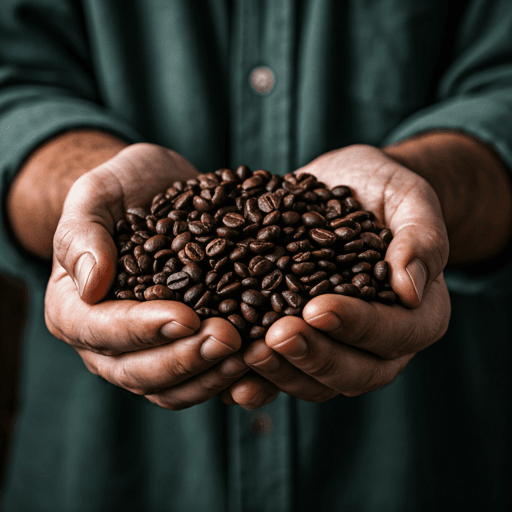
Stinker beans are individual coffee seeds that over-fermented somewhere between the tree and the drying bed, went sour and putrid inside, and then traveled onward hidden in an otherwise sound lot. The taint is enormously stronger than the coffee around it, so a few stinker beans can dominate a cup that is, by weight, almost entirely clean. That potency is what makes them a preoccupation in quality rooms rather than a footnote in a defect list.
That single mismatch — how little of the bad thing is present against how much of the cup it takes over — explains nearly everything else about how the trade handles this fault: why sampling behaves strangely, why the answer is machines rather than tolerances, and why an uncommon defect takes up so much of the vocabulary.
What a stinker actually is, and why the words are loose
Physically, a stinker is a seed in which microbial activity ran too long, too warm or in too dirty a setting, producing acids and volatile compounds that soak into the bean and stay there. Roasting does not burn them off. Grinding makes the smell louder, and hot water louder still.
The frustrating part is that a stinker frequently looks ordinary. Some over-fermented beans discolor — yellowish, brownish, sometimes a reddish cast — and those are what green graders call sour beans. Others give nothing away to the eye at all. The reliable field check is not visual: graders crush or cut suspect beans and smell them, because the defect announces itself as an odor long before it does as a color.
The naming is not standardized, and the boundaries between the terms are genuinely fuzzy rather than forming a clean hierarchy. Stinker, sour, full sour, fermented and over fermented coffee all circulate, they overlap, and people draw the lines in different places — partly because some of those words belong to visual green grading and others to the cupping table, describing one event from two vantage points. In common usage a stinker coffee bean sits at the extreme end, a point source of rotten smell rather than a mild vinegary note, but the word is also used loosely for the whole family. For the formal categories and how graders count physical defects, see our guide to green coffee defects.
Why stinker beans break the usual arithmetic of a bad ingredient
In most food, a bad ingredient degrades a batch roughly in proportion to how much of it there is. One bruised apple in a crate of forty is about one-fortieth of a problem. Coffee has plenty of defects that behave this way: broken beans, chips, a stray husk, a few shells. At low frequency they are noise, and their effect scales gently with their number.
Fermentation taint does not behave that way. The volatile products of runaway microbial activity — acetic acid at the mild end, propionic and butyric acids further along, plus assorted esters and sulfur-bearing volatiles — are compounds the human nose registers at very low concentrations. Published figures for exactly how low vary by compound, by method and by what else is in the cup, so any single tidy number claims more than is actually known. The direction, though, is not in dispute: these are potent smells, and they belong to the sour, rancid and putrid family that people pick out readily even when something else dominates by volume.
So the relationship between how many bad beans are present and how bad the cup is runs steeply. It climbs from undetectable to unmistakable across a very small range, then flattens out — once the taint is there, adding more does not make it dramatically worse, because it has already taken the cup. A handful of stinkers in a sack is a genuine problem. The same handful of broken beans is nothing.
Almost everything awkward about this defect follows from the shape of that curve, and the consequences are worth taking one at a time.
It changes what a sample can tell you
Sampling assumes the property being measured is spread evenly through the lot, so a scoop can stand in for the whole. Stinkers violate that assumption twice over. They are rare, so a small sample may not contain one at all. And they arrive in clumps rather than sprinkled evenly through — a cherry lodged in a pulper and then dislodged, one under-agitated corner of a tank, one patio section caught by a shower — so a scoop cannot be relied on to represent them even when it does catch some.
Two conclusions follow, and both cut against instinct. A clean cup from a small sample proves the sample was clean; it does not prove the lot is. And one foul cup among four good ones is not an outlier to be discarded. The reflex is to blame a dirty cup or a grinder holding old coffee, and occasionally that is right. More often the odd cup is the lot telling the truth, and the four clean ones got lucky.
That is the reasoning behind brewing several cups from a single sample rather than one — five is the long-standing convention on a specialty cupping table — and behind judging those cups individually rather than as one blended impression. Older score sheets awarded uniformity and clean-cup points cup by cup; newer assessment frameworks ask the taster to flag individual cups as non-uniform or defective. Either way, the protocol is built around the possibility that the fault sits in one cup and not the others, and quietly averaging a rogue cup away defeats the purpose of setting out five.
The same logic applies further along. A pre-shipment sample and an arrival sample are two scoops from the same uneven distribution, which is why the two can disagree without either party having done anything wrong, and why a disagreement of that kind is better read as evidence about the lot than as evidence about the other side's palate.
It explains why the answer is sorting, not tolerances
A tolerance limit is a sensible instrument when harm is proportional. A rule for broken beans works: a lot slightly over the limit is slightly worse than one slightly under, and because the beans are evenly mixed, a sample genuinely predicts the sack. That logic collapses for a fault whose per-unit impact is enormous and whose distribution is lumpy. A rule permitting a few per unit weight does nothing for the drinker whose cup happened to receive them all.
So the response is structural rather than statistical. Rather than sampling a lot and accepting it against a threshold, mills push the entire volume past sorting equipment, sometimes repeatedly, on the reasoning that every pass removes some proportion of whatever is there. That is a different philosophy from inspect-and-accept, and it exists because inspect-and-accept cannot work when a tiny fraction of the mass carries the cup.
It also explains an asymmetry that puzzles people new to the trade. A mill will run coffee through a sorter again over a fault that a defect count would barely register, while shrugging at a far larger number of broken beans. That is not inconsistency. It is a correct reading of two very different curves.
It explains the outsized share of attention
Measured by frequency, this is not the biggest problem in coffee. Measured by conversation it looms enormous: more nicknames than most defects, more anxiety in quality rooms, real influence over how buyers design cupping schedules and how contracts describe rejection. That is a rational response to variance rather than superstition. Mild, common faults can be managed by averages, because the average is close to what any given drinker actually experiences. Rare, severe ones have to be managed by vigilance, because the average is nothing like what the unlucky drinker experiences. A lot can be excellent on average and still deliver a cup somebody pours away.
How a bean becomes a stinker
There is no single origin story, but there is a common thread: microbial activity that ran longer, warmer or dirtier than intended, affecting one bean or a small pocket rather than the whole batch. The usual routes:
- Cherry held too long before pulping. Picked fruit is sugar-rich and already alive with microbes. Piled deep and left in warmth, the heap keeps fermenting inside intact skins, and the beans at the center go furthest.
- Fruit that fermented on the tree or on the ground. Overripe cherry left past its window, raisined fruit that split, and cherries that dropped onto wet ground all begin fermenting before anyone touches them.
- Damaged fruit that admitted microbes early. Insect entry holes, split skins, cracks from rough handling: any breach lets microorganisms reach the sugars ahead of schedule, and that head start is part of what separates a mildly fermented bean from a putrid one.
- An over-run or unevenly mixed tank. Whole-batch over-fermentation is obvious and usually caught. The insidious version is localized: an under-agitated mass with pockets behaving differently from the bulk, or a single cherry wedged in equipment, fermenting quietly out of sight before rejoining a later and otherwise sound batch as a concentrated point source.
- A stalled or re-wetted drying stage. A bean that has not finished drying is still a habitat. Rain on a patio, beds piled too deep, humid nights, moisture migrating back out of the parchment — any of these can restart microbial activity in coffee that looked finished.
Every route on that list is fermentation going wrong. Fermentation run deliberately and managed as a processing step, including the extended and anaerobic approaches now common in specialty, is a separate subject and is covered in our guide to coffee fermentation.
What it smells and tastes like
Whole and green, often nothing at all. Crushed or cut, a sharp sour-rotten smell that people reach for physical words to describe: vinegar, brine, pickle liquor, drain, silage, rotting fruit, and onion or garlic at the severe end.
In the cup, the fault presents as a sourness that does not read as fruit acidity. Good acidity is bright, structured and arrives with sweetness. Fermented taint coffee reads as sharp without being lively, and it strips sweetness out rather than sitting alongside it. The mid-range descriptors are vinegar, brine and overripe-going-rotten fruit, sometimes with an alcoholic or solvent edge. At the severe end it turns savory and putrid — that onion, garlic, sulfurous, fermented-vegetable register — and it lingers in a harsh, acrid finish rather than resolving.
Two behaviors are worth knowing. The fault usually becomes more obvious as the cup cools, so a sample that seemed acceptable hot can turn as it drops through room temperature. And espresso concentrates it, which is why a lot that cups as merely questionable can be unusable as a shot.
One category note: this is a flavor fault rather than a food-safety question.
Telling genuine taint from intentional fermentation character
This is a real and current source of confusion at the cupping table. Modern processing deliberately pushes coffee toward fruity, boozy, fermented character, and the descriptors used for a well-executed extended fermentation — winey, tropical, funky, lactic — overlap substantially with the language used for the sour beans coffee defect. Tasters genuinely disagree about individual coffees, and some of that disagreement is preference rather than skill. The reasoning they apply runs roughly in this order of weight:
- Uniformity across the set. The most useful discriminator by far. A deliberate process acts on the entire lot, so every cup shows the character. A stinker is a point source, so it shows up in one cup, or even in one sip, while its neighbors are clean. Difference between cups points to a defect; consistency points to a choice.
- Whether it resolves. Intentional fermentation character, when it works, integrates: it arrives, sits with sweetness and body, and finishes. Taint does not integrate. It stays sharp and acrid, and the finish gets worse rather than better.
- Register. Deliberate character tends to live in fruit, wine, spirit and cocoa territory; taint tends toward vinegar, brine, drain and rotting vegetable. That is a tendency rather than a rule — the aggressive end of intentional processing reaches into exactly that territory, which is why the call cannot be made on descriptors alone.
- Sweetness. Fermented character that works usually arrives with sweetness underneath it holding it together. Taint hollows sweetness out.
- Temperature. Evaluate hot and cool. Faults that hide in a hot cup often surface as it drops.
Published sensory work drawing a firm line between the two is thin, and most of what circulates is accumulated practitioner judgment rather than settled science. Where a given lot sits on that spectrum is often a matter for argument between buyer and producer rather than a fact to be looked up. That is one more reason uniformity carries so much weight in the argument: it is the criterion both sides can check the same way, on the same table, without agreeing about taste at all.
Where in the chain they are caught, and where they slip through
Every separation step in coffee works on a physical property: buoyancy, mass, color, size. A stinker's defining property is smell, and none of the machines smell. That mismatch is why they survive.
Water separation and flotation remove cherry and parchment lighter than they should be, catching much of the overripe, dried and insect-damaged fruit most likely to produce this fault; that separation is covered in our guide to flotation sorting. What it misses is the bean that over-fermented while staying intact and normally dense — it sinks with everything else. Gravity tables at the dry mill share the blind spot for the same reason.
Optical sorting is the workhorse, rejecting the discolored fraction at high throughput; the technology is covered in our guide to color sorting. Its limit is exact: it can only reject what differs visibly. A bean damaged internally under a normal-looking surface goes through. Hand sorting has the same blind spot, more slowly.
That leaves roasting and the cupping table. A badly fermented bean sometimes roasts differently from its neighbors, and the smell can become unmissable at the grinder — but by then it is already in the roast, which is detection rather than prevention. The last real defense is a person with a spoon, cupping a lot repeatedly rather than once.
At a glance
| Stage | Property it sorts on | What it catches | What it misses |
|---|---|---|---|
| Selective picking, prompt delivery | Ripeness and elapsed time | Overripe and dropped fruit; the delay that starts the problem | Damage already inside ripe-looking cherry |
| Flotation, water channels | Buoyancy | Light, dried, hollow and damaged fruit | Over-fermented beans of normal density |
| Gravity table | Mass and aerodynamics | Light and malformed beans | A dense stinker sorts as sound |
| Optical and color sorting | Reflected color | Visibly discolored sour beans, at high throughput | Internal damage under a normal surface |
| Hand sorting | Human vision | Obvious discoloration, foreign matter | The same invisible fraction, more slowly |
| Crush-and-smell checks | Odor | The fault directly, on the beans actually checked | Everything not checked |
| Cupping | Odor and taste in solution | The taint itself, including a single rogue cup | Only what is brewed |
The honest limits
No sorting line is perfect, and nobody in the chain claims otherwise. Each pass is a probability rather than a guarantee, and extra passes slow throughput, so the number of passes a lot receives is a judgment call rather than a standard. Any figure attached to a sorter's accuracy for this particular fault deserves skepticism, because the thing being counted — invisible internal damage — is hard to count independently in the first place.
Buyers and roasters compensate behaviorally rather than technically: cupping the same lot more than once, cupping across its storage life rather than only on arrival, taking a single bad cup seriously instead of rebrewing until it goes away, and treating a mismatch between how a lot looks and how it tastes as a reason to look harder. Producers compensate upstream, where the leverage is greatest — picking ripe, moving cherry promptly, keeping equipment clean so nothing lodges and ferments unseen, drying evenly and without interruption. All of that works better than removing the problem afterwards, because prevention acts on the cause while sorting only acts on the evidence.
Bottom line
Stinker beans are a small-numbers problem with large-numbers consequences. They are rare, frequently invisible, and immune to the sorting logic that handles most physical defects, because they are defined by a smell rather than by an appearance. Understand the disproportion and the rest follows: trust a clean sample less than you would like to, trust an odd cup more than you would like to, and remember that the last thing standing between an over-fermented bean and a drinker is somebody willing to taste five cups and believe the worst one.