
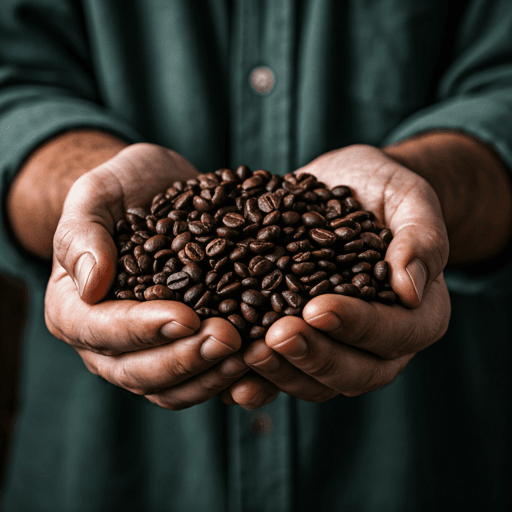
Coffee does grow in the Solomon Islands. Solomon Islands coffee comes from small plantings in the mountainous interior of Guadalcanal and from scattered household holdings elsewhere, and a little of it has been pulped, dried, roasted and even shipped out of the country. What it has never done is assemble into an industry. There is no national harvest calendar, no grading system the trade recognises, and no volume large enough to register in the export tables the coffee business actually reads.
The interesting part is why, and the answer is not climate. Parts of the interior are cooler, wetter and steeper than the coast, which is roughly the description of good coffee land everywhere. The obstacle is timing. The land use coffee competes with pays a household within the same season; a coffee tree pays nothing at all until somewhere around its fourth year. Where that is the choice, the tree loses, on ground perfectly capable of growing it.
The geography: a narrow band of usable ground
The Solomon Islands is a scattered archipelago of many islands, only a handful of them large. Guadalcanal is the biggest, and it is built the way most of the larger islands are: a rugged central spine rising to Mount Popomanaseu, the highest point in the country, dropping steeply to a rim of coastal lowland. Almost everything that makes trade possible sits on that rim, including the wharves, the roads, Honiara, and the plantation-scale agriculture that did take hold here, coconut along the coasts and oil palm on the northern plains.
The rim is also hot. Coastal Guadalcanal is warm and humid in every month with very little seasonal swing, and that is warmer than arabica wants: arabica does its best work where nights are cool enough to slow ripening down, and on a tropical coast at sea level it grows fast and cups flat. The temperature only comes down as you climb, which makes arabica here an interior crop by necessity, away from the road, away from the wharf, and across much of the interior away from any vehicle track at all. The island's southern flank, the wettest and most exposed side, is the extreme case: real growing country by climate, and among the hardest ground in the country to move a crop off.
Rain falls in every month almost everywhere, which feeds the trees and makes both disease pressure and drying harder than in origins with a dry season timed to the harvest. Robusta handles lowland heat and constant wet far better than arabica does, which is why the species reported varies from place to place rather than following one national pattern. Like most Pacific island coffee, this is a crop that lives on local exceptions rather than on a general condition.
Customary land, and why the unit stays a household
Land here is overwhelmingly held by kin groups under customary arrangements rather than as individually titled blocks, and the practical consequence for coffee is narrow but decisive. A planting is established by the household that will tend it, on ground its own group holds, at whatever size that household can weed and pick. Gathering many such plantings into a single estate with one manager, one pulper and one drying yard is not how ground is put to work here. So the sector that exists is an aggregate of small plots, and every problem downstream, including collecting ripe cherry within hours, drying it under cover, and assembling a lot large enough to interest a buyer, has to be solved across many separate plots rather than inside one boundary.
Why Solomon Islands coffee never became an industry
Rural income here has long rested on selling what already stands. Unprocessed round logs cut from customary land are the classic case, and trade summaries have for years described logs as the country's largest export. What matters for coffee is not whether that is the best use of a forest but the shape of the transaction, because the shape is what coffee has to compete against.
A standing tree requires no establishment. Nothing has to be planted, weeded, pruned, shaded or nursed through a first dry spell; the trees were there before anyone alive was. A landholding group agrees, access happens, harvesting happens, and payment follows inside the same agricultural year. No new skill is required, no equipment has to be carried up a hill, and no buyer has to be found, because the buyer is the party that came asking.
Now put a coffee planting next to that. The household gives up ground that was growing food, or would have been. It clears and plants, then tends the planting through several years in which nothing comes back: weeding in a climate where everything grows, gap-filling, formation pruning, and managing the trees overhead, because coffee here sits among other trees rather than in open blocks, and getting that right is a discipline in itself (see shade management). Somewhere around the fourth year the first real cherry arrives, which is when the difficult part starts rather than when it ends.
Ripe cherry has to be picked selectively and processed within hours, not days. Pulping, fermenting and washing are learned skills with a narrow tolerance for error, and they need water, a pulper and somewhere to put the waste. The parchment then has to dry in a place where rain arrives in every month, which means a covered drying structure or a spoiled lot. Then the coffee has to reach a buyer, across water, on a schedule nobody in the village controls.
That last step turns a slow investment into an uncertain one. The buyer, the collection point and the shipping date are the least reliable links in the chain, and a coffee planting is not a bet on today's buyer. It is a bet that a buyer, a collection point and a boat will all still exist in year four. The older development literature on the country's tree crops keeps returning to the same two obstacles for coffee specifically: constant rain, which attacks drying, and difficulty getting a crop to market, which attacks the sale. Neither of those is about whether the tree grows.
None of this is a comment on anyone's judgment. A household that takes the payment arriving this season over one that might arrive in four years is responding accurately to the information it has. When the near option is certain and the far one depends on a chain that has repeatedly failed to hold, waiting is not patience but exposure.
Why cocoa and coconut managed it and coffee did not
The obvious objection is that cocoa and coconut are also tree crops with an establishment period, and both took hold here on a scale coffee never approached. Cocoa reaches far more households than coffee ever has, and it is picked the way a savings account is drawn down, when income is needed for a school term or a family obligation. So the constraint is not simply the wait.
It is the wait combined with two other things. The first is ground: cocoa and coconut grow in the lowland belt where villages, roads and wharves already are, while arabica wants the ground behind them. The second is forgiveness. Cocoa is fermented in a heap or a box and dried over several days, and a lot handled imperfectly is still saleable; coffee cherry left overnight is not. Copra tolerates smoke-drying in a wet climate, and coffee parchment tolerates very little. Buying networks for cocoa and copra have also existed for generations, so the year-four question is already answered before a household plants anything. Coffee is the tree crop here that pairs the longest run of unpaid work with the least forgiving processing and the least certain buyer, and that combination explains the scale of this origin.
Solomon Islands coffee at a glance
| Question | What the record supports |
|---|---|
| Does it grow coffee? | Yes, genuinely, in small plantings, but not as a national industry |
| Where | Guadalcanal's hill country, the one location every account agrees on; others add further large islands, disagreeing with each other |
| Species reported | Both arabica and robusta, varying by place; arabica is the one tied to the cooler interior |
| Typical unit | Family-held plots inside a growers' association, not estates |
| Time to first crop | Around four years, against a land use that pays inside a season |
| Processing | Wet processing, for the best-documented Guadalcanal group; drying is the weak link |
| Where it goes | Mostly local roasting and drinking, with occasional small lots leaving |
| Binding constraint | The timing and certainty of payment, not climate or soil |
| Tasting record | None independently published; circulating descriptions are seller copy |
| Documentation | Thin, dated and internally inconsistent |
What has actually been tried
The record reads as a sequence of attempts rather than a trajectory, and most of what circulates about this origin was written in order to sell something. The best-documented grouping is a coffee farmers' association in the hills of central Guadalcanal, whose farms are family-held and whose coffee is described as wet processed. Descriptions put out by roasters abroad date the association to the late 1970s and the plantings to the 1980s, but those dates are repeated between sellers rather than independently confirmed, and are better treated as reported than as established. The same sources supply the only grower and village counts anywhere in circulation, which is a reason to read them as marketing rather than as measurement.
What stands on firmer ground is that the crop is still being extended. The agriculture ministry has run hands-on field training with growers from that association at Lumakanji in Guadalcanal, funded through the Solomon Islands Agriculture Rural Transformation project, and the subjects covered are exactly the ones the mechanism above predicts would bind: nursery management and seedling raising, moving seedlings into the field, and pruning. Training of that kind is an admission that the constraint is not interest. Households were asking; the skills and the planting material had to be brought to them. Raising those seedlings needs a nursery somebody maintains through a year in which it returns nothing, and in a crop that already takes about four years to pay, a wait for planting material adds time before year one even begins.
There was also a stretch around the turn of the 2000s when rural buying and inter-island transport were widely interrupted. For a tree crop, an interruption of that length is not a pause: plantings that go years without pruning, without a buyer and without processing practice do not resume where they stopped.
Small quantities have left the country, and reported growth from one year to the next has occasionally been steep, which sounds impressive until you notice the base: the whole reported harvest of a good recent year would be an unremarkable order for one mid-sized roastery. That is not a criticism of anyone. It is the size of the thing.
What the coffee is, and where it goes
Most of what is grown does not leave. It is bought locally, roasted locally and poured in Honiara, where cafes are commonly described as working with a mix of home-grown and imported beans. The emergence of that local cafe trade is, quietly, the most reliable buyer this origin has ever had, because it is the only one that does not depend on a boat. Coffee still appears on official lists of commodities the country exports, which is true in the narrow sense and misleading in the practical one: the sector-level trade picture is dominated by logs, fish and vegetable oils, and coffee does not register in it.
On flavour, the honest answer is that there is no reliable tasting record for this origin. No independently published cupping series exists, no results from a recognised competition circulate, and the adjectives that do circulate, among them smooth, balanced, chocolate and tropical fruit, are seller copy that appears almost word for word on pages about half a dozen unrelated origins. What can be said is structural: highland Melanesian coffee can be excellent, and the limiting factor for cup quality here is far more likely to be drying and handling than the fruit on the tree. That is a statement about potential, and it should not be dressed up as a profile.
How thin the record is shows up in a way anyone can check. At least one seller's description places these farms at an altitude higher than the highest point in the entire country. Be careful, then, with any confident number attached to this origin, altitude and grower numbers and volume alike. The dependable facts here are qualitative ones.
How it sits among its Melanesian neighbours
The obvious comparison is Papua New Guinea, the Melanesian origin that did scale: a smallholder sector large enough to be a fixture in the world market, built on a highland plateau with an internal road system and generations of buying infrastructure behind it. The difference is not the plant.
Closer in size is Vanuatu, but the binding problem there starts later. Vanuatu grows the coffee and then struggles to move a small volume out through a thin shipping network; in the Solomons the difficulty starts earlier, at whether the tree gets planted at all. Fiji is a different answer again, treating the harvest of what is already growing as a business model in its own right rather than as a stage on the way to plantations.
Could the scale change?
It could, but not through the levers usually proposed. A good score, a story about an untouched island origin, or an enthusiastic buyer in a distant city changes nothing on its own, because none of them touches the year-four problem. What would touch it is unglamorous: planting material available in the season households ask for it, a collection point close enough to walk parchment to, drying capacity that survives a wet month, a pulper within carrying distance, and a buyer whose presence in four years is credible rather than hoped for. All of that is standing infrastructure rather than enthusiasm, and standing infrastructure is what this chain has never had for long enough at one time.
There is one structural reason the arithmetic could shift on its own. Assessments have for decades described the country's timber harvest as running ahead of what the forests replace, and a transaction that depends on standing stock is not permanent by definition. If the option that pays this season becomes less available, the calculation that has always defeated coffee weakens without anyone intervening. That is a plausible direction rather than a forecast for any particular decade.
The likelier near-term outcome is the one already visible: coffee grown, processed and drunk close to home, with occasional small lots leaving the country, lots that matter enormously to the households involved and not at all to the world market. That is a real origin. It is simply a small one, for reasons that have very little to do with the coffee.
The bottom line
Solomon Islands coffee exists, grows on capable ground, and stays small because of an economic clock rather than a climatic ceiling. The land that suits arabica sits inland and uphill, behind the roads and the wharves, on plots sized to the households that hold them. The competing land use pays inside a season, with no establishment period and no skills to learn. Coffee asks for years of unpaid work, an unforgiving same-day processing step, drying in a climate that rains every month, and confidence that a buyer will be there at the end of it. With a record this thin, the thing worth taking away is the mechanism rather than a profile. The limiting factor here is time, and time is harder to fix than flavour.