
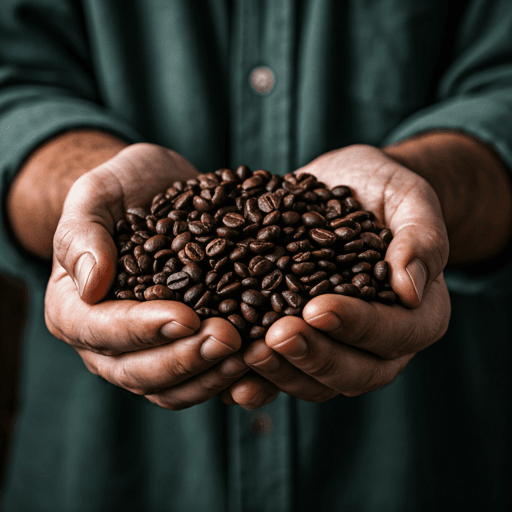
The SL-14 coffee variety is the quiet third member of the Scott Agricultural Laboratories selections made in Kenya in the 1930s — a tall, drought-tolerant tree retained for how it survived, not for how it cupped. Where SL28 and SL34 became famous specialty names, SL 14 was kept for agronomic resilience, and it is still widely planted today.
That is the whole story in one sentence, and it is worth sitting with, because it contradicts the way most people read a variety name. The same breeding program, the same laboratory, the same decade and the same country produced both a celebrated cup and a workhorse. One of them ended up on bags in specialty cafés. The other quietly became one of the arabica varieties that ordinary East African production actually rests on, without ever becoming a talking point.
What the SL-14 coffee variety actually is
SL-14 — also written SL14 or SL 14 — is a single-tree selection made at the Scott Agricultural Laboratories near Nairobi, the colonial-era research station whose initials give the SL prefix its name. Individual trees selected there in the 1930s were catalogued with that prefix, which is why a whole family of Scott Labs selections now shares it: SL28, SL34, SL14 and a longer list of numbered selections that never left the trial plots.
SL-14 is reported to have been chosen in 1936 from a single tree carrying the label Drought Resistant II (often written D.R. II). Seedlings connected with that material are described as having been established at Kabete, near Nairobi, around 1933, and then distributed into growing areas east of the Rift Valley.
Two things follow. First, the trait the selectors cared about is written into the name of the parent material itself — this was retained as a drought-tolerant tree, not as a flavor project. Second, the record is genuinely thin. Public sources on SL-14 are short, repetitive and largely derived from the same few variety-catalog entries, and the origin of the D.R. II material itself is not clearly documented. Treat any confident, detailed origin story for this variety with suspicion, including the ones that sound authoritative.
Lineage: what is documented, and what is only claimed
The honest position is that SL-14's precise parentage is not documented. No public source points to a verified mother population, a cross, or a named ancestral cultivar behind the D.R. II tree, and the sensible thing to do is say so rather than fill the gap.
What genetic work has established is broader and less satisfying: SL-14 is placed in the Bourbon–Typica group and described as Typica-related. That puts it in the same enormous family as most of the arabica planted outside Ethiopia — a family whose other branch produced Bourbon and its many descendants — but a group assignment is not a pedigree. "SL-14 is Typica-related" is reasonable shorthand. "SL-14 comes from X crossed with Y" is an invention.
One useful footnote: field labels from the 1930s recorded what a station knew or guessed at the time, and later genetic testing has not always agreed with them. They are good history and unreliable genetics, which is exactly why the D.R. II label tells you what SL-14 was selected for and nothing reliable about where it came from.
The counterweight to SL28: same program, opposite outcome
Here is the detail that makes SL-14 genuinely interesting rather than merely obscure. SL28 was itself selected out of drought-resistant material, so both selections started from the same kind of question: which trees keep going through a dry year?
The two answers diverged completely. SL28 turned out to combine that toughness with an exceptional cup at altitude, and it became the backbone of a specialty reputation. SL-14 kept the toughness, is additionally described as cold tolerant and low in nutrition requirement, and is rated as having good — not exceptional — quality potential at high altitude. So it was retained and distributed as a production variety, while SL28 and SL34 got the write-ups.
The SL28 and SL34 story, and how those two came to define what people expect from Kenyan coffee, belongs on that page. The point for SL-14 is structural: a breeding program produces workhorses as well as stars, and the workhorses often outlast the stars in planted area. When people discuss Kenyan coffee varieties, they are almost always discussing the handful of selections that made the cup famous, not the ones that made the harvest reliable.
How SL-14 behaves in the field
SL-14 is a tall, open-growing tree with light bronze leaf tips and beans described as average in size, though some Ugandan material has described it as producing large beans under good conditions. It is generally described as medium-yielding, coming into production in its third year, and is typically managed with single-stem pruning at the wide densities used for tall varieties rather than the tight spacing suited to compact ones.
Three field traits are consistently reported across the available sources:
- Drought tolerance. This is the trait it was selected for and the one thing every source agrees on. It is described as holding up through dry spells better than the quality-selected SL siblings.
- Cold tolerance. Frequently mentioned alongside drought tolerance, and in practice it widens the range of sites where the variety can be planted — including cooler, higher, more exposed slopes.
- Low nutrition requirement. A quietly important trait for smallholders. A tree that still performs on modest inputs is a different proposition from one that only rewards intensive feeding.
It is recommended for medium-to-high-altitude sites rather than exclusively high ones — a practical difference from SL28 and SL34, which want elevation to express themselves. The altitude guidance follows the standard latitude-adjusted pattern: above roughly 1,200 m within about five degrees of the equator, and progressively lower as you move away from it. In practice that means SL-14 can be planted on sites where the marquee selections would struggle, which is most of the reason it spread.
SL-14 is not disease resistant — say it plainly
This needs stating without hedging, because "resilient" gets misread as "resistant". SL-14 has low resistance to coffee leaf rust, and is susceptible to coffee berry disease and to nematodes. Some Ugandan sources go further and describe it as very highly susceptible to leaf rust. It is vulnerable to essentially all the major diseases of arabica.
Drought tolerance and disease resistance are separate axes, selected for by different means. SL-14 was chosen decades before rust resistance became a central breeding objective in East Africa, and nothing in its makeup addresses that problem. Growing it means committing to a spray and management program, or accepting losses in bad years.
The varieties bred to answer that problem came much later and from a different institution. Ruiru 11 is the compact, disease-resistant hybrid released in Kenya in 1985, and Batian is the taller, earlier-bearing disease-resistant release that followed in 2010. Those pages cover the two stories properly.
SL-14 at a glance
| Attribute | SL-14 |
|---|---|
| Also written | SL14, SL 14 |
| Selected | Reported as 1936, Scott Agricultural Laboratories, Kenya |
| Selected from | A single tree labeled Drought Resistant II (D.R. II); the origin of that material is not documented |
| Genetic group | Bourbon–Typica group, Typica-related; precise parentage not documented |
| Stature | Tall |
| Leaf tip color | Light bronze |
| Bean size | Average (described as large in some Ugandan sources) |
| Yield potential | Medium; first production around year three |
| Nutrition requirement | Low |
| Optimal altitude | Medium to high; latitude-adjusted, above roughly 1,200 m near the equator |
| Quality potential at high altitude | Good — not rated exceptional |
| Coffee leaf rust | Low resistance / susceptible |
| Coffee berry disease | Susceptible |
| Nematodes | Susceptible |
| Distinctive traits | Drought tolerance, cold tolerance, low input requirement |
| Where grown | Kenya and Uganda |
| Quality of public record | Thin and repetitive; hedge any specific claim |
How SL14 compares to its siblings and successors
| Variety | Origin | Kept or bred for | Stature | Disease | Cup reputation |
|---|---|---|---|---|---|
| SL-14 | Scott Labs, reported 1936 | Drought and cold tolerance, low inputs | Tall | Susceptible to rust, CBD, nematodes | Good, rarely singled out |
| SL28 | Scott Labs, 1930s | Selected from drought-resistant material; kept for cup | Tall | Susceptible to rust, CBD, nematodes | Exceptional at altitude |
| SL34 | Scott Labs, 1930s | Kept for cup and adaptability | Tall | Susceptible to rust, CBD, nematodes | Exceptional at altitude |
| Ruiru 11 | Coffee Research Station, Kenya, 1985 | Disease resistance in a compact tree | Compact | Resistant to rust and CBD | Debated; reported to have improved |
| Batian | Coffee Research Foundation, Kenya, 2010 | Disease resistance without sacrificing cup | Tall | Resistant to rust and CBD | Positively regarded |
Read that table across rather than down and the shape of a century of East African breeding becomes visible: three susceptible tall selections retained in the 1930s for different reasons, then two deliberately bred answers to the disease problem those selections could not solve. Nothing in the later work made SL-14 obsolete on the drought axis; it simply made its disease profile look worse by comparison.
What SL14 coffee is said to taste like
Cautiously: usually good, occasionally very good, rarely distinctive on its own terms. Variety catalogs rate its quality potential at high altitude as good rather than exceptional, and roaster descriptions of lots containing SL14 commonly mention a clean, sweet, moderately bright cup — citrus acidity, sometimes chocolate or soft stone-fruit sweetness — without the concentrated blackcurrant intensity that made SL28 a reference point. Those are descriptions of specific lots, not a fixed varietal signature, and should be read that way.
Two caveats matter more than any tasting note. The first is that SL-14 is very often not tasted alone. In Uganda especially it is picked, delivered and milled alongside SL28, Nyasaland and local selections, and sold as a regional lot rather than a single-variety one. A bag marked "SL14/SL28" is usually describing a mixed population standing in the field, not a blend decided at a roastery.
The second is that processing, altitude, picking discipline and mill work move the cup further than this particular variety choice does. A carefully picked, well-fermented SL-14 from a high site will beat a carelessly handled SL28 every time. That is less a defense of SL-14 than a description of how much of a cup is decided after the cherry leaves the tree.
Where SL-14 is actually planted
In Kenya, SL-14 was distributed east of the Rift Valley and remains present, but it is largely absent from the modern conversation. Kenyan variety discussion revolves around SL28, SL34, Ruiru 11, Batian and K7; SL-14 rarely appears in those lists at all, which is the clearest available evidence of its status there.
In Uganda the picture is different and more important. SL-14 is named among the arabica varieties planted in the country for many decades, particularly on the slopes of Mount Elgon in the Bugisu and Sebei areas, in Sironko, and westward in the Rwenzori region. It appears in extension and trade descriptions as a variety suited to medium-to-high-altitude sites, valued for yield and bean size while its rust susceptibility is flagged. Lots described as "SL14, SL28 and Nyasaland" are a standard way of characterizing washed Mount Elgon coffee.
So "forgotten" is accurate about the specialty conversation and wrong about the ground. SL-14 is under-discussed, not uncommon — and any figure you see for exactly how much of it is planted should be checked, because the reliable public sources do not give one.
A worked example: reading a Ugandan lot label
Suppose a washed lot is offered as "Mount Elgon, 1,800 m, SL14 / SL28 / Nyasaland, fully washed, raised beds". Here is what each part is and is not telling you.
The variety string is a description of the population growing on those farms, not a recipe — nobody separated the three at the picking table. The altitude is doing more predictive work than the variety string is, because at that elevation the slow cherry maturation is the main driver of density and acidity. "Fully washed" and "raised beds" tell you about process control, which on a mixed-variety lot is where most of the achievable difference sits. And the presence of SL28 in the string does not make the lot an SL28 coffee, any more than the presence of SL-14 dooms it.
The useful question about such a lot is never "which variety?" but "who picked it, how ripe, and what happened in the next thirty-six hours?"
A variety name on a bag is not a quality grade
SL-14 is the cleanest available proof of a point worth internalizing. It came out of the most celebrated selection program in East African coffee history, it shares its prefix with two varieties treated as shorthand for excellence, and it is nonetheless a solid production tree rather than a distinguished cup.
Variety influences the ceiling of a coffee. It does not set the floor, and it certainly does not certify anything. A variety name tells you about genetic potential and field behavior; on its own it says nothing about the altitude, the picking, the fermentation, the drying or the age of the roast. When "SL" appears on a label, the useful questions are still which SL, grown where, at what elevation, and processed how.
Bottom line
SL-14 is the Scott Labs selection that was kept for surviving rather than for shining. It is tall, medium-yielding, tolerant of drought and cold, undemanding about nutrition, thoroughly susceptible to rust and coffee berry disease, and capable of a good rather than remarkable cup. Its parentage is undocumented and the public record behind it is thin enough that hedged language is the only accurate language. It is also, in Uganda, a genuinely significant variety — which is precisely why it is such a good corrective to the idea that a breeding program's famous names are the whole story.