
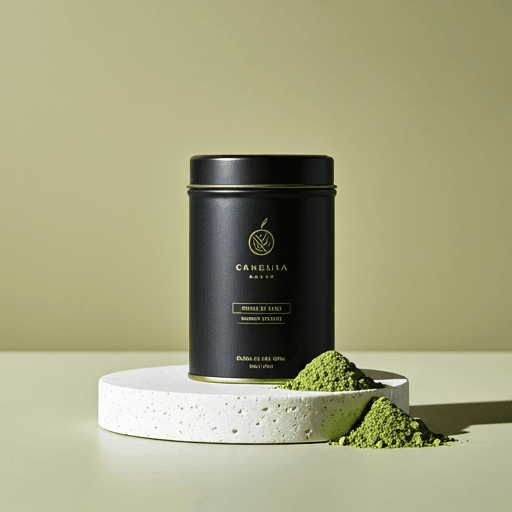
If you have ever stood in front of two tins of bright green Japanese tea and hesitated, sencha vs matcha is the clearest comparison to start with. Both come from the same plant, Camellia sinensis, and both are green teas, but one is a whole leaf you steep in water and strain away, while the other is a fine powder you whisk into water and drink leaf and all. That single difference cascades into everything else: color, body, taste, caffeine and how much effort each takes.
Put simply, matcha is thicker, more intense and higher in caffeine because you swallow the entire ground leaf, while sencha is lighter, grassier and quicker to make. Neither is "better." They are two answers to the same question of how to enjoy the green tea leaf, and they sit at opposite ends of the wider family of Japanese tea types.
Sencha vs matcha at a glance
Before the detail, here is the side-by-side view. Treat the caffeine numbers as rough guides rather than promises, because they shift with the cultivar, the grade, how much leaf or powder you use and how hot you brew.
| Attribute | Sencha | Matcha |
|---|---|---|
| Form | Whole loose leaves you steep and strain out | Stone-ground powder you whisk and drink whole |
| Growing | Mostly full sun | Shade-grown for roughly three to four weeks |
| Processing | Steamed, rolled into needles, dried | Steamed, dried flat as tencha, then stone-ground |
| Preparation | Steep around 70–80°C, then strain | Sift, then whisk into water and drink leaf and all |
| In the cup | Clear, golden-green, light-bodied liquor | Thick, opaque, frothy and vivid green |
| Taste | Bright, grassy, gently sweet, mild astringency | Rich, creamy, deep umami, more intense |
| Caffeine | Moderate (often cited near 30–50 mg a cup) | Higher (often cited near 60–70 mg a serving) |
| Re-steeping | Yes, several infusions from one measure | No, each bowl is whisked fresh |
| Effort | Quick and forgiving | More ritual: sifting and whisking |
What each one actually is
The difference between sencha and matcha starts long before the cup. It is really a difference of format: leaves versus powder, an infusion versus a suspension.
Sencha: loose leaves you steep
Sencha is the everyday green tea of Japan, the cup most households reach for. After picking, the leaves are quickly steamed to lock in their green color, then rolled into slender needle-like shapes and dried. To drink it, you steep those whole leaves in hot water for a short time and then pour the liquid off, leaving the spent leaves behind. What you taste is an infusion: the water has pulled flavor and caffeine out of the leaf, but the leaf itself stays in the pot. For a deeper look at grades, harvests and steeping windows, see the full guide to what sencha green tea is.
Matcha: stone-ground powder you drink
Matcha takes a different road. The best leaves are shaded before harvest, steamed, dried flat without rolling, and de-stemmed and de-veined to make a leaf called tencha. That tencha is then milled slowly between granite stones into a talc-fine powder. When you make matcha, nothing gets strained away. You sift the powder, whisk it into hot water until it froths, and drink the whole suspended leaf. Because you consume the leaf rather than an extract, matcha delivers more of everything the leaf contains in one bowl. The dedicated guide to what matcha is covers grades and grinding in more depth.
The growing difference: shade vs full sun
Here is the origin of most of the contrast. Sencha bushes generally grow in full sunlight right up to harvest. The leaves photosynthesize freely, which builds up the catechins that give green tea its brisk, slightly astringent edge and its grassy brightness.
Matcha's leaves are covered instead. For roughly the last three to four weeks before picking, the plants are shaded with cloth or reed screens that cut out most of the light. Starved of sun, the plant responds by producing more chlorophyll, which turns the leaves a deep jade, and by holding on to more of the amino acid L-theanine, which reads on the palate as sweetness and savory umami. Shading also tempers the catechins that cause bitterness. That is why matcha tastes rounder and more brothy while sencha tastes fresher and greener, and it is the same shading step that nudges matcha's caffeine upward. This shade-growing is the dividing line between sencha and the tencha destined to become matcha.
Preparation: steep and strain vs sift and whisk
The two teas ask for completely different tools and gestures, and this is often the deciding factor for people choosing between them day to day.
Brewing sencha
Sencha is quick. Warm your teapot, add the leaves, and pour water that has cooled to roughly 70 to 80°C over them; cooler water coaxes out sweetness and umami, while hotter water pulls more astringency. Steep for around a minute, then pour every drop off the leaves so they do not stew. The same leaves usually give two or three more infusions, each a little different from the last. All you need is a pot with a strainer or a simple infuser.
Whisking matcha
Matcha is more of a small ritual. Sift a scoop of powder into a bowl to break up clumps, add a little hot but not boiling water, and whisk briskly in a zig-zag or "W" motion until a fine froth forms on top. Traditionally this is done with a bamboo whisk called a chasen, though a small electric frother or a lidded jar also works. There is nothing to strain and nothing to re-steep: you whisk each bowl fresh and drink it right away before the powder settles.
Taste and caffeine: is matcha stronger than sencha?
On flavor, the two lean in clearly different directions. Sencha is bright and vegetal, with a grassy, sometimes marine freshness, a gentle natural sweetness and a clean, mildly astringent finish. Matcha is bolder and creamier, dominated by that shade-grown umami, with a fuller body and a lingering sweetness that comes from the L-theanine. Poured out, sencha is a translucent golden-green; whisked up, matcha is opaque and almost velvety.
So is matcha stronger than sencha? In most senses, yes. Because you drink the entire ground leaf rather than a strained infusion, a bowl of matcha is more concentrated in flavor, in that deep green intensity and in caffeine. Figures vary widely, but a typical bowl of matcha is often cited around 60 to 70 mg of caffeine, while a cup of sencha tends to land nearer 30 to 50 mg, depending on how much leaf you use and how you brew. Both are gentler and slower to hit than a shot of coffee, thanks partly to the calming L-theanine that rides alongside the caffeine in green tea. Responses to caffeine vary from person to person, so treat these as general figures rather than exact doses. If you want to see how powder stacks up against loose leaf more broadly, the comparison of matcha vs green tea widens the lens beyond sencha alone.
Which should you choose?
Choose sencha when you want an easy, refreshing, repeatable cup: something you can top up through a morning, brew in a minute, and re-steep without ceremony. Its lighter body makes it a natural all-day tea, and the low barrier to entry, just a pot and some hot water, is hard to beat.
Reach for matcha when you want intensity and a little theatre: a thick, vivid, umami-rich bowl, or a base for a latte or an iced drink. It asks for a few more minutes, a sifter and a whisk, and a little practice to get a smooth froth, but it rewards that effort with a depth sencha cannot match. Many tea drinkers simply keep both: sencha for the ordinary cups that fill a day, matcha for when they want to slow down and make something.
Ultimately, matcha vs sencha is less a contest than a choice of format. They begin as the same leaf and diverge at the field, one left in the sun to be rolled and steeped, the other shaded, ground and whisked. Understanding that fork is all you need to pick the right one for the moment, and to appreciate why two teas from a single plant can taste so different in the cup.