
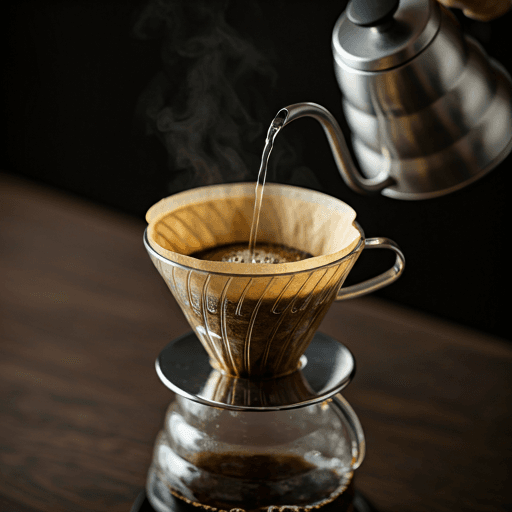
Samoa grows coffee. Not much of it, and not in quantities the world market registers, but Samoan coffee is a real crop on real farms - planted on the volcanic ground of Upolu and Savai'i, tended alongside taro and cocoa and coconut, and picked by hand for a few weeks a year. What holds it small is not the thing you would guess. The soil is good, the rain is dependable, and trees grow readily. The constraint is who is at home and available to pick when the cherry ripens.
That sounds like a small point. It is the whole story of this origin, and it separates Samoa from every other Pacific coffee country. Samoan households are unusually well connected, economically, to relatives living overseas, and money sent home is a normal, expected part of how a household operates rather than a windfall. The consequence for a coffee tree is direct: the harvest is not what keeps the household fed, and a harvest that is not essential has to compete for attention with everything else happening in the same few weeks.
What Samoan coffee actually is
The documented record thins out quickly here, so it is worth separating what is firmly attested from what is repeated.
Coffee is present in Samoa at all because of the plantation economy of the German administration before the First World War and the New Zealand administration that followed it, an estate system that relied on labour brought from outside the islands. Those estates are long gone as an industry, and what exists today is not a continuation of them so much as a series of later restarts.
The best-documented grower now sits in the interior uplands behind Apia, on Upolu, at Aleisa. That farm was started in 1994 by a couple who had returned to Samoa after years in New Zealand, and it is run today by their daughter: a family operation that grows, processes and roasts its own coffee, sells ground coffee into Apia supermarkets and cafes, and has spoken publicly about adding arabica to what it already has in the ground. The established plantation coffee there is generally described as robusta, with arabica as the ambition rather than the base - which fits the plain botany of the two species, since robusta tolerates warm, low ground while arabica wants the cooler air that comes with height.
Arabica has been planted in Samoa, though, on a different model. From around 2009 a Samoan women's village-business organisation worked with cafe owners on organic arabica grown by smallholder families, with a larger planting push reported in the early 2010s. Those beans were graded and marketed under a Samoan-grown label, and supplied by direct arrangement to specialty roasting in New Zealand rather than through any commodity channel. That is the characteristic shape of Samoan coffee's outside trade: direct, personal and small.
What Samoan coffee tastes like is genuinely unresolved, and no one has established it. There is no published cupping record for the origin, no repeated tasting assessment and no grading convention of its own. The flavour language in circulation comes from tourism and retail copy rather than from anyone scoring the coffee against a standard. Until lots are picked consistently enough to be assessed the same way twice, there is no stable profile to report - and the reason they are not is the subject of this page.
The geography: generous ground, modest heights, cyclone exposure
Samoa's two main islands are volcanic, and the shorthand "fertile volcanic soil" is true in a general way and misleading in a specific one. Upolu is the older and more weathered island, with a forested central ridge and a settled coastal fringe; the coffee sits inland and upslope, in country genuinely cooler than the shoreline. Savai'i is younger and larger, and parts of it are very young indeed - the lava fields around Saleaula, laid down by eruptions early in the twentieth century, are bare rock where soil has barely begun to form. Volcanic does not automatically mean deep, and it certainly does not mean evenly distributed.
Rainfall is not the problem. Samoa has a reliable wet season and heavy annual rain, comfortably more than a coffee tree requires. If anything the risk runs the other way, because a wet picking window makes drying slower and spoilage more likely, and a smallholder without covered drying space feels that immediately.
Heat and height are the more interesting questions. The islands sit close to the equator and are, for the most part, low. Samoa has real uplands, but modest ones by origin standards, with no equivalent of the highland plateau that made coffee obvious elsewhere in the Pacific. The growing belt is a narrow band of interior country rather than a general condition of the islands, which is exactly why arabica interest keeps pointing at the higher interior slopes while the coffee actually established sits lower down.
Then there is wind. Samoa lies in a cyclone track, and the recent record is unambiguous: Ofa in 1990, Val in 1991 and Evan in 2012 all struck the islands and left crops down. This is where a tree crop is punished differently from a root crop. Taro flattened by a storm can be replanted and harvested within a season. A coffee tree stripped or snapped represents years already spent, and years more before it bears again. Every cyclone therefore resets the argument for planting coffee rather than something that recovers faster - and taro, bananas and breadfruit all recover faster. A household that has been through two storms is running a different calculation from one that has been through none.
At a glance
| Question | What the record supports |
|---|---|
| Does Samoa grow coffee? | Yes - small plantations and village plantings on Upolu and Savai'i |
| Main growing area | Interior uplands of Upolu, notably Aleisa behind Apia; scattered plantings on Savai'i |
| Species reported | Robusta as the established plantation coffee; organic arabica in later smallholder plantings |
| Terrain | Fertile volcanic ground with dependable rain; uplands real but modest |
| Chief physical hazard | Tropical cyclones - a tree crop loses years, not a season |
| Binding constraint | Who is available to pick selectively during the ripening window |
| Where the coffee goes | Mostly drunk in Samoa; a thin, direct flow to New Zealand |
| Reliable tasting record | None published - circulating flavour language is promotional |
| Standing in world production | Negligible; Samoa does not register in world coffee production reporting |
| Nearest instructive comparison | Papua New Guinea - same ocean, highland ground, and a harvest the household year is built around |
The real constraint: a harvest that competes for a household's hours
Coffee is the most labour-intensive moment in tree agriculture, and nearly all of that labour lands in one short window. Ripe cherry has to be taken by hand, selectively, from trees that ripen unevenly, which means going over the same tree more than once across a few weeks. This page does not re-teach that mechanic - see selective picking and the coffee harvest for how it works and what happens to a lot when it is skipped.
What matters here is the condition sitting underneath it. Selective picking only happens when picking is the best use of a household's hours in exactly those weeks. In most producing countries that condition is met almost automatically, because the harvest is the household's income. In Samoa it frequently is not met, and the reason has nothing to do with willingness.
Start with what the household's position rests on. Being economically connected to relatives abroad is normal in Samoa rather than exceptional, and money sent home is a standing feature of the domestic economy rather than an emergency measure. Layered on that is the food plantation: taro, breadfruit, bananas, coconut, often cocoa. That plantation feeds people directly, and it forgives inattention for a week or two in a way a coffee harvest does not. Between the two, the household's position does not turn on whether the coffee got picked properly this year.
Now look at what the harvest is competing against in those same weeks. Village and church obligations arrive on their own schedule and are not optional. The food plantation has its own demands, and they do not pause. Paid work in and around Apia draws people out of the village. And seasonal work abroad has become a real claim on exactly the age group that does farm labour - the Aleisa grower has said as much publicly, describing workers taken on who then leave after a short time because they have applied for seasonal placements overseas. That is the most concrete evidence in the record of how this constraint operates: not an absence of hands, but hands with a better-defined alternative in the same months.
None of this says anyone is unwilling to work. It is arithmetic about which hours are worth committing, and every farming household everywhere runs the same calculation. What is distinctive about Samoa is the answer the calculation returns, and why it returns it: the household's position is set partly outside the country. The labour supply for a Samoan coffee harvest is, in effect, determined somewhere else, and no amount of agronomy inside the farm gate reaches it.
Why uneven picking locks the scale in place
The consequence is not simply that less coffee gets picked. It is worse than that, because it feeds itself.
When picking cannot be done selectively - one pass instead of several, or late, or by whoever happens to be available rather than repeatedly by the same hands - the lot arrives mixed, and nothing done afterwards separates it again. A mixed lot cannot be presented as anything better than ordinary. It goes into a blend, or the local market, or instant.
Which lowers the reward for careful picking. If a meticulously picked lot and a roughly picked one end up in the same place, the extra passes through the trees have bought nothing. So next season the harvest ranks lower still among the claims on a household's hours, the picking is rougher again, and the coffee has even less chance of being treated as distinctive. The loop tightens each time round, and it tightens without anyone making a bad decision.
This also explains why the obvious intervention keeps underperforming. Trees are the easy half of a revival: simple to distribute, quick to plant, and they show visible progress within a year. The hard half is the two or three weeks per season when someone has to walk the rows repeatedly, plus somewhere for the cherry to go on the day it comes off the tree. Planting material without picking arrangements and processing capacity behind it produces trees, not coffee.
How Samoa compares with its Pacific neighbours
Pacific island coffee divides on one question - is there highland ground or not - and Samoa is the clearest case of a country on the wrong side of that line growing coffee anyway.
Papua New Guinea is the direct comparison and the instructive one, because it is the Pacific origin where coffee did scale, becoming a normal part of village smallholder life at volumes the world buys, on highland ground Samoa does not have. See Papua New Guinea coffee for how that scale was reached; the difference is not only altitude but the fact that there, the picking season is what the household year is organised around.
Fiji makes a different contrast in a single line: its coffee story turns on harvesting feral, long-abandoned trees as a deliberate business model - see Fiji coffee. Samoa's trees are planted and tended, and its gap opens at the picking step rather than the planting one.
Worth noting, too, that coffee is not the drink carrying cultural weight here. That role belongs to kava, the Pacific's own prepared drink, which sits in an entirely different part of Samoan life - see kava, explained. Coffee in Samoa is an introduced crop and an urban cafe habit, and the two barely touch.
Most coffee in Samoa is imported; most Samoan coffee is drunk in Samoa
Both halves are true at once, and together they describe the market precisely.
Samoa's cafes, hotels, shops and kitchens run largely on imported coffee, roasted and instant alike. Imported supply is consistent, gradeable and available all year in the volumes a business needs, and locally grown coffee cannot yet offer any of those three things reliably. A cafe that runs out of local beans mid-year still has to serve coffee tomorrow, which is a more decisive argument than any quality comparison.
Meanwhile the coffee Samoa does grow goes mainly to Samoans and to visitors: roasted and ground on the islands, sold into supermarkets and cafes in Apia and at markets and events, bought in packets to carry home. What leaves the country does so thinly and by direct arrangement rather than through a commodity chain. That is a perfectly legitimate structure for an origin this size. It is simply not an export industry, and no auction or grading system sits behind it.
Could the scale change?
Possibly, but only if two problems are solved together, and most attempts have addressed one at a time.
The cyclone problem is agronomic and partly tractable with known methods: windbreak and shade planting, siting on sheltered aspects, planting material chosen for resilience rather than nostalgia, and a replanting discipline that assumes storms instead of hoping against them. None of that is exotic. It does require someone to hold the plan across more years than a single project cycle, because a coffee tree takes longer to come good than most funding windows run.
The labour problem is structural and harder, because it cannot be solved inside the farm gate. The plausible directions all move where the effort sits rather than asking households to value the harvest more than they do. Centralised processing lets a grower deliver cherry and stop short of also becoming a processor. Treating picking as a distinct, arranged, scheduled task with someone accountable for it, rather than one more household chore competing with obligations, changes the calculation directly. And deliberately small specialty volumes, where an entire crop can be handled carefully in one coordinated push, fit the labour reality far better than a volume strategy does.
What the record does not yet show is any of this producing a step change. Successive efforts since the 1990s have produced real coffee, real farms and real local demand, and no shift in scale. Anyone forecasting one should say which of the two constraints they intend to break first, because breaking either on its own leaves the other exactly where it was.
The bottom line
Samoan coffee is a genuine origin at a genuinely tiny scale: volcanic ground on Upolu and Savai'i, robusta established and arabica aspired to, mostly drunk at home, with no reliable tasting record and no presence in world production figures. The interesting thing about it is not the coffee, it is the mechanism. Samoa shows something that stays hidden in origins where picking labour is abundant: coffee quality is built almost entirely in one short, repetitive, hand-done window, and a country can have good ground, ample rain and capable farmers and still not produce fine coffee if the household arithmetic makes those particular weeks the wrong place to spend them. Land and climate set an origin's ceiling. Who is available to pick sets the floor, and in Samoa the floor is what binds.